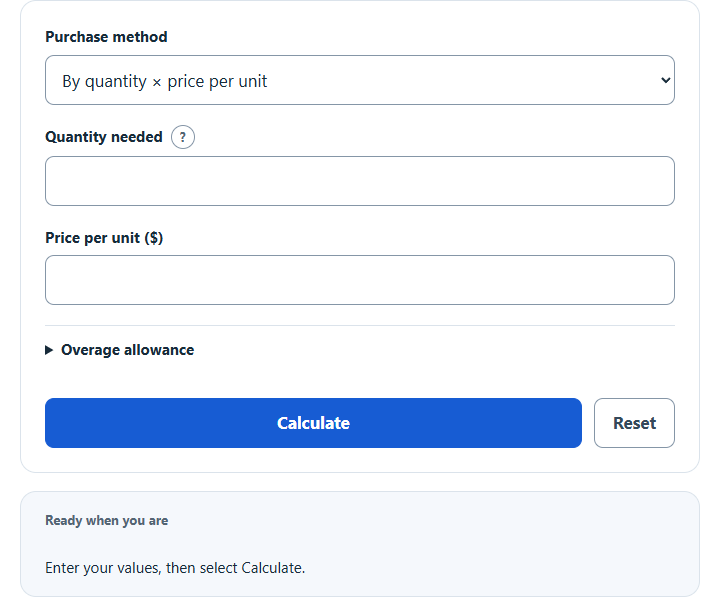
Calculate total material cost by multiplying the quantity needed by the price per unit, or by weight or bag, with an optional waste allowance.
- All Construction Calculators
- All Cost Calculators
- Cost Per Board Foot Calculator
- Landed Cost Calculator
Calculator Functions
| Function | What it does | What it requires |
|---|---|---|
| By quantity × price per unit | Finds the cost of a quantity bought at a price per unit | Requires the quantity needed and the price per unit, in the same unit |
| By weight | Finds the cost of material priced by weight | Requires the weight in kg, lb, g or metric tons and the price per kg, lb, g or metric ton |
| By bag or package | Finds how many whole bags or packages to buy and what they cost | Requires the weight needed, the weight of one bag and the price per bag |
The first two functions can add an overage allowance of 5%, 10%, 15% or 20% for waste and offcuts. The bag function has preset sizes of 25 kg, 40 kg, 50 lb, 80 lb and 1 metric ton. All results cover material only, without delivery or tax.
Material Cost Formulas
| MC | Total material cost ($) |
| Q | Quantity of material needed |
| w | Overage allowance (%), 0 when none is chosen |
| P | Price per unit of material ($) |
By quantity × price per unit
The quantity can be in any unit, such as pieces, feet, square meters, cubic yards or sheets, as long as the price is for that same unit. For 150 units at $3 each the cost is 150 × 3 = $450.00, and a 10% overage raises the order to 165 units and the cost to $495.00. A length of 15.5 ft at $2.80 per ft costs $43.40.
By weight
W is the required weight and Pw is the price per unit of weight. The two can be in different units, because both are converted to kilograms first, using 1 lb = 0.45359237 kg and 1 metric ton = 1,000 kg [1]. For 500 kg at $2 per kg the cost is $1,000.00. For 500 lb priced at $2 per kg with a 5% overage, the order is 525 lb, or 238.136 kg, and the cost is $476.27.
By bag or package
MC = Bags × price per bag
B is the weight of one bag, and ceiling means rounding up to the next whole number, because part of a bag cannot be bought. A job needing 1,000 kg in 40 kg bags at $8 takes exactly 25 bags, for $200.00. At 1,010 kg it takes 26 bags, for $208.00, with 30 kg left over. No overage allowance is added here, since the rounding already leaves extra.
Limits of This Estimate
- The total is the cost of the material alone. Delivery, sales tax, labor and equipment are extra.
- One price is applied to the whole quantity. Volume discounts, price breaks and minimum order charges are not modeled.
- The overage allowance is a chosen percentage, not a measured waste rate. The right figure depends on the material and how it is cut or placed.
Sources
- NIST Special Publication 811, Appendix B.8: pound to kilogram and metric ton to kilogram conversion factors