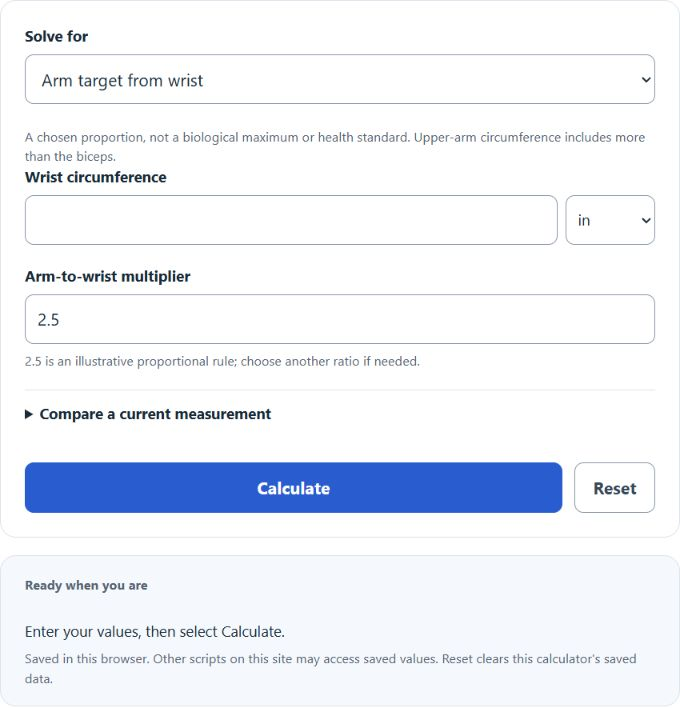
Calculate maximum bicep size from wrist size and arm-to-wrist multiplier, or solve for wrist size or R in inches or cm with step-by-step unit conversion.

Maximum Bicep Size Calculator

Enter any 2 values (leave the one you want to calculate blank)


Related Calculators

Maximum Bicep Size Formula

The maximum bicep size calculator estimates a potential upper-arm circumference from two simple inputs: wrist size and body fat percentage. It is most useful as a goal-setting benchmark for lifters, bodybuilders, and fitness enthusiasts who want a frame-based estimate rather than a guess.

LF = \frac{100 - BF}{100}
MBS = WS \cdot 2.5 \cdot LF
MBS = WS \cdot 2.5 \cdot \frac{100 - BF}{100}
Variable Meaning What it represents
MBS Maximum Bicep Size Estimated upper-arm circumference based on the model
WS Wrist Size A proxy for skeletal frame size
BF Body Fat Percentage The percentage of your body weight that is fat mass
LF Lean Factor An adjustment that scales the estimate based on body-fat level

How the Formula Works

This model assumes that larger wrist size generally corresponds to a larger natural frame, which may support more overall muscular size. It then adjusts that frame-based estimate using body fat percentage. As body fat decreases, the lean factor increases, and the estimated maximum bicep size rises. As body fat increases, the estimate decreases.

  • Bigger wrist size → larger frame estimate
  • Lower body fat percentage → higher lean factor
  • Higher body fat percentage → lower lean factor

How to Use the Calculator

  1. Measure your wrist circumference at the narrowest point.
  2. Enter your body fat percentage.
  3. Calculate your estimated maximum bicep size.
  4. Use the result as a planning target, not a strict genetic ceiling.

If the calculator allows you to solve for any missing field, you can also use it in reverse:

  • Estimate the bicep size implied by your frame and leanness
  • See what body fat level would correspond to a given estimate
  • Back-calculate the wrist size input needed to match a target output in the model

Measurement Tips

Good inputs produce better estimates. Use a flexible tape measure and keep your method consistent from one check-in to the next.

  • Wrist size: measure around the smallest part of the wrist, usually just below the hand.
  • Bicep size comparison: if you compare your actual arm measurement to the estimate, measure the arm the same way every time.
  • Body fat percentage: use a realistic estimate. Even a small change in body-fat input can shift the result.
  • Units: keep measurements consistent. If you switch between inches and centimeters, use the calculator’s unit options rather than mixing units manually.

Example Calculations

Example 1: wrist size of 6.5 and body fat of 15%.

LF = \frac{100 - 15}{100} = 0.85
MBS = 6.5 \cdot 2.5 \cdot 0.85 = 13.8125

The estimated maximum bicep size is approximately 13.81.

Example 2: wrist size of 7.0 and body fat of 10%.

LF = \frac{100 - 10}{100} = 0.90
MBS = 7.0 \cdot 2.5 \cdot 0.90 = 15.75

The estimated maximum bicep size is 15.75.

Body Fat Percentage and Lean Factor Reference

Body Fat % Lean Factor Effect on Estimate
8% 0.92 Higher estimate due to greater leanness
10% 0.90 Still strongly favorable for a larger estimate
15% 0.85 Moderate reduction from the frame-based value
20% 0.80 Noticeably lower estimate
25% 0.75 Further reduction in the modeled maximum

How to Interpret Your Result

Your result is best viewed as a theoretical benchmark. It does not account for training age, exercise selection, nutrition quality, recovery, limb proportions, muscle insertions, hormones, or genetics. Two people with the same wrist size and body fat can still have very different arm development potential.

  • Use the estimate to set realistic milestones.
  • Compare progress over time with consistent measuring technique.
  • Treat the value as a planning tool, not a guarantee.

When This Calculator Is Most Helpful

  • Setting a reasonable arm-size goal before starting a bulk or cut
  • Comparing how changes in body fat affect the estimate
  • Using wrist size as a simple frame-size input when more advanced measurements are unavailable
  • Tracking expectations alongside training progress

Common Questions

Is this my exact natural limit?
No. It is an estimate based on a simplified model. Real-world outcomes depend heavily on genetics, training quality, nutrition, and long-term consistency.

Does lower body fat always mean bigger actual arms?
Not necessarily. The formula increases the estimate as body fat drops, but your tape-measured arm size can fluctuate with glycogen, hydration, body composition changes, and whether the arm is measured flexed or relaxed.

Why use wrist size?
Wrist circumference is often used as a quick proxy for frame size. It is not a perfect predictor, but it gives the formula a simple structural input.

Should I measure my biceps flexed or relaxed?
Either can work, but be consistent. If you are comparing your real arm measurement against the estimate over time, use the same position, same tape placement, and similar conditions each time.