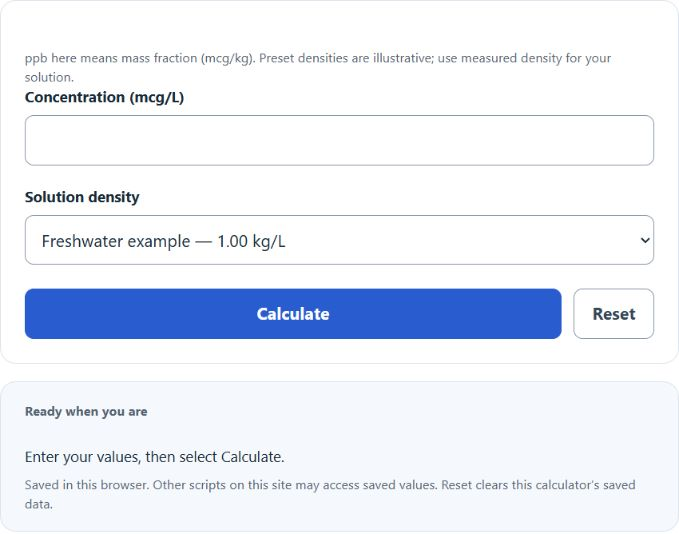
Convert mcg/L to ppb for freshwater, tap water, seawater, or wastewater by entering a concentration and selecting the medium density.
Quick Overview: mcg/L to ppb
mcg/L is a mass-per-volume unit, while ppb is a mass-per-mass ratio. For dilute water-like solutions with density close to 1 kg/L, you can usually treat 1 mcg/L ≈ 1 ppb.
The general relationship is:
ppb = (mcg/L) ÷ density (kg/L)
- Freshwater, ρ ≈ 1.00 kg/L: 10 mcg/L = 10.00 ppb
- Tap water, ρ ≈ 0.998 kg/L: 10 mcg/L ≈ 10.02 ppb
- Seawater, ρ ≈ 1.025 kg/L: 10 mcg/L ≈ 9.76 ppb
- Treated wastewater, ρ ≈ 0.995 kg/L: 10 mcg/L ≈ 10.05 ppb
These densities are illustrative examples, not fixed properties of all samples. The calculator also accepts measured density; ppb here means mass fraction, not gas volume fraction.
- All Unit Converters
- PPB to mg/l Calculator
- ug/ml to ppb Converter
- ug/ml to mg/dl Converter
- dew point to ppm Converter
- g/mol To ppm Calculator
mcg/L to ppb Formula
The following formula is used to convert micrograms per liter into parts per billion when the density of the liquid is known.
Variables:
- ppb here is a mass fraction: micrograms of solute per kilogram of solution
- mcg/L is the concentration in micrograms per liter
- ρ is the density of the solution in kilograms per liter (kg/L)
To convert mcg/L to ppb, divide the concentration in micrograms per liter by the density of the liquid in kg/L. If the density is exactly 1 kg/L, then the numerical value in mcg/L is equal to the numerical value in ppb.
What is mcg/L to ppb?
Micrograms per liter (mcg/L) is a concentration unit that expresses how much mass of a substance is present in one liter of liquid. Parts per billion (ppb) expresses the concentration as a mass fraction, usually interpreted as micrograms of solute per kilogram of solution. In environmental monitoring and water-quality testing, these units are often treated as equivalent when working with water-like liquids because the density is close to 1 kg/L. However, when the liquid is denser or less dense than water, a density correction provides a more accurate conversion.
How to Convert mcg/L to ppb?
The following steps outline how to convert mcg/L to ppb.
- First, determine the concentration in micrograms per liter (mcg/L).
- Next, determine the density of the liquid in kilograms per liter (kg/L).
- Then, calculate the concentration in ppb using the formula ppb = (mcg/L) ÷ density.
- Finally, check the result with the calculator above.
mcg/L to ppb Conversion Table
The table below shows conversions for 10 mcg/L using illustrative densities. Actual density varies with temperature and composition, especially for wastewater; use measured density when known.
| Medium | Approx. Density (kg/L) | 10 mcg/L in ppb |
|---|---|---|
| Freshwater | 1.00 | 10.00 ppb |
| Tap water, room temperature | 0.998 | 10.02 ppb |
| Seawater | 1.025 | 9.76 ppb |
| Treated wastewater | 0.995 | 10.05 ppb |
In many laboratory and field applications, mcg/L and ppb are treated as interchangeable for clean water because the density is very close to 1 kg/L. Still, understanding the density-based relationship is helpful when working with seawater, wastewater, or other solutions where the assumption does not hold exactly.
Example Problem:
Use the following values as an example problem to test your knowledge.
Concentration = 10 mcg/L
Density = 1.025 kg/L
ppb = 10 ÷ 1.025 ≈ 9.76 ppb