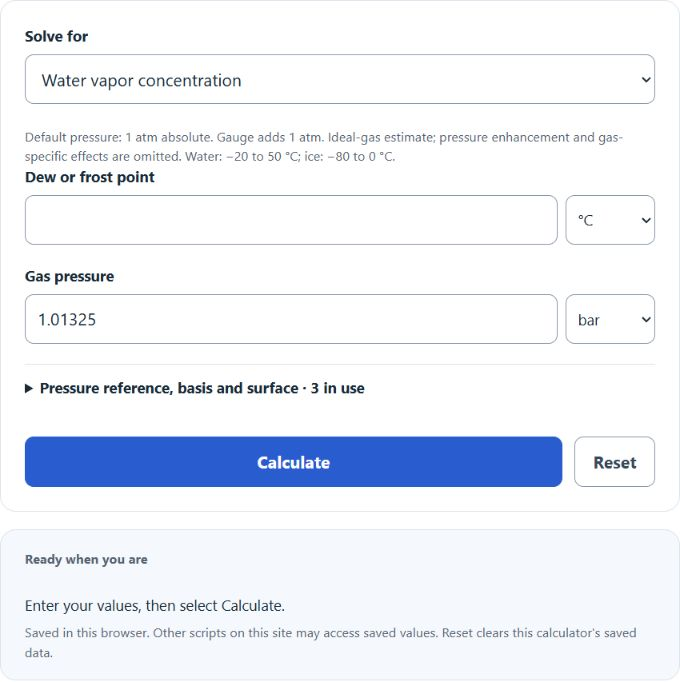
Convert dew or frost point to water vapor ppm(v), or ppm(v) back to dew point, using absolute or gauge pressure in °C, °F, K, bar, kPa, psi, and atm.
Quick overview: Dew Point to PPM
For a gas mixture at total pressure ptotal, the dew point identifies the temperature where water vapor becomes saturated. At that temperature, the water partial pressure equals the saturation vapor pressure. The volume mixing ratio is then estimated by ppm(v) ≈ 10⁶ × pH₂O / ptotal.
- At 0 °C and 1 atm: psat ≈ 0.61 kPa → ≈ 6,000 ppm
- At 10 °C and 1 atm: psat ≈ 1.23 kPa → ≈ 12,000 ppm
- At 20 °C and 1 atm: psat ≈ 2.34 kPa → ≈ 23,000 ppm
- At 30 °C and 1 atm: psat ≈ 4.25 kPa → ≈ 42,000 ppm
The calculator uses Buck Research saturation-pressure equations over water or ice. It estimates ideal-gas wet- or dry-basis ppm(v), omitting pressure enhancement and gas-specific corrections. Accurate compressed-gas work requires a validated real-gas model.
- Temperature To Ma Calculator
- Temperature to Frequency Calculator
- ug/l to ng/ml Converter
- mg/l to lb/gal Converter
- All Unit Converters
Dew Point to PPM Formula
The following Buck equations estimate saturation pressure in Pa, with temperature in °C. The calculator supports liquid water from −20 to 50°C and ice from −80 to 0°C. Automatic mode uses ice below 0°C and water at or above 0°C. These are chosen calculator support limits, not a claim of uniform measurement accuracy.
Variables:
- psat,w or psat,i is the estimated saturation pressure in Pa over water or ice, used as water partial pressure e
- Td is dew point and Tf is frost point, both in °C
- ptotal is absolute gas pressure in Pa; use the same pressure units in every ratio
- Wet ppm(v) = 10⁶ e/ptotal; dry ppm(v) = 10⁶ e/(ptotal−e). Water partial pressure must be below total pressure
Use the selected water or ice saturation pressure as e. Wet basis divides by total pressure; dry basis divides by dry-gas pressure. Gauge inputs add an assumed standard atmosphere of 101,325 Pa. The inverse solves the same selected equation; automatic mode has a small 611.15–611.21 Pa gap at 0°C, where an explicit surface choice is required.
What is Dew Point to PPM Conversion?
Dew point to ppm conversion is the process of translating a measured dew point temperature into an approximate water vapor concentration in a gas stream. Since dew point represents the temperature at which water vapor becomes saturated, it can be used to determine the water partial pressure. That partial pressure is then compared with the total pressure of the gas mixture to estimate ppm(v).
This relationship is widely used in engineering, environmental monitoring, laboratory work, compressed gas systems, and industrial drying applications where moisture content may be reported as dew point, partial pressure, or ppm(v).
How to Calculate Dew Point to PPM?
The following steps outline how to convert dew point to ppm(v).
- First, determine the dew point temperature Td in °C.
- Next, determine the total gas pressure ptotal in kPa.
- Calculate saturation pressure with the selected Buck water or ice equation; convert it to the same pressure unit as the absolute total pressure.
- Finally, use wet ppm(v) ≈ 10⁶ × e / ptotal, or dry ppm(v) ≈ 10⁶ × e / (ptotal−e).
- After inserting the values and calculating the result, check your answer with the calculator above.
Example Problem:
Use the following values as an example problem to test your knowledge.
Dew Point (Td) = 10 °C
Total Pressure (ptotal) = 101.325 kPa
At 10 °C, the saturation vapor pressure is about 1.228 kPa, so the approximate concentration is:
Dew Point to PPM Conversion Table
The table below gives ideal-gas wet-basis concentrations at 1 atm = 101.325 kPa, using automatic surface selection (frost point below 0°C, dew point otherwise).
| Dew/Frost Point (°C) | Saturation Vapor Pressure (kPa) | Approximate Water Vapor Concentration (ppm) |
|---|---|---|
| -10 | 0.260 | ≈ 2,600 ppm |
| 0 | 0.611 | ≈ 6,000 ppm |
| 10 | 1.228 | ≈ 12,000 ppm |
| 20 | 2.338 | ≈ 23,000 ppm |
| 30 | 4.245 | ≈ 42,000 ppm |
Values are rounded for clarity but follow the same formulas used in the calculator. Increasing total pressure at the same dew point lowers the ppm(v) value because the same water partial pressure is diluted into a higher overall pressure.
Understanding this conversion helps compare moisture readings reported as dew point, relative humidity, or ppm(v), and supports consistent interpretation across different instruments and reference tables.