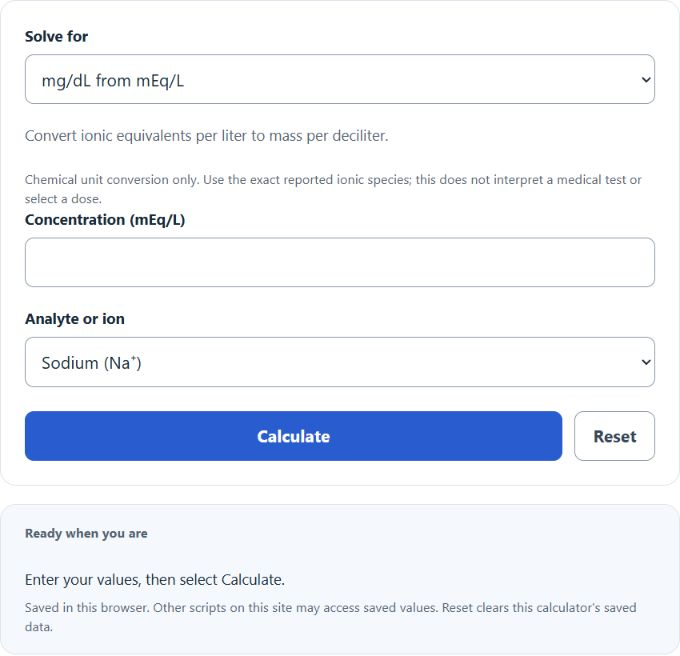
Convert mEq/L to mg/dL or mg/dL to mEq/L for sodium, potassium, calcium, magnesium and other ions, or convert an mEq amount such as KCl to mg.
Calculator Functions
| Function | What it does | What it requires |
|---|---|---|
| mg/dL from mEq/L | Converts a concentration in milliequivalents per liter to milligrams per deciliter | Requires the concentration in mEq/L and the analyte or ion |
| mEq/L from mg/dL | Converts a concentration in mg/dL or mg/L to milliequivalents per liter | Requires the concentration in mg/dL or mg/L and the analyte or ion |
| mg from mEq (amount) | Converts an amount in milliequivalents, such as a 20 mEq tablet, to milligrams | Requires the amount in mEq and the analyte or ion |
| mEq from mg (amount) | Converts an amount in milligrams to milliequivalents | Requires the amount in mg and the analyte or ion |
The analyte list covers sodium, potassium, calcium, magnesium, chloride, bicarbonate and potassium chloride salt. A custom ion takes a molar mass in g/mol and an ionic charge. Every result also shows the amount in mmol or mmol/L and the equivalent weight in mg per mEq.
mEq/L to mg/dL Formulas
(z × 10)
| M | Molar mass of the ion or compound (g/mol, the same number as mg/mmol) [1] |
| z | Charge of the ion as a positive number, such as 2 for Ca²⁺ [2] |
| 10 | Deciliters in one liter |
mEq/L and mg/dL are not the same unit and have no single conversion factor. A milliequivalent counts electrical charge and a milligram measures mass, so the factor depends on the ion’s molar mass and charge. Dividing mEq/L by the charge gives mmol/L, multiplying by the molar mass gives mg/L, and dividing by 10 gives mg/dL. The calculator uses these values, as of the 2024 IUPAC table of standard atomic weights [1]:
| Analyte | Molar mass (g/mol) | Charge | 1 mEq/L in mg/dL | 1 mEq in mg |
|---|---|---|---|---|
| Sodium (Na⁺) | 22.9898 | 1 | 2.299 | 22.99 |
| Potassium (K⁺) | 39.0983 | 1 | 3.91 | 39.098 |
| Calcium (Ca²⁺) | 40.078 | 2 | 2.004 | 20.039 |
| Magnesium (Mg²⁺) | 24.305 | 2 | 1.215 | 12.153 |
| Chloride (Cl⁻) | 35.45 | 1 | 3.545 | 35.45 |
| Bicarbonate (HCO₃⁻) | 61.0168 | 1 | 6.102 | 61.017 |
| Potassium chloride (KCl salt) | 74.5513 | 1 | 7.455 | 74.551 |
mg/dL from mEq/L
The main formula applies directly. A calcium level of 4 mEq/L is 4 × 40.078 ÷ (2 × 10) = 8.016 mg/dL. A sodium level of 140 mEq/L is 140 × 22.9898 ÷ 10 = 321.857 mg/dL.
mEq/L from mg/dL
This is the main formula reversed. A calcium level of 9 mg/dL is 9 × 10 × 2 ÷ 40.078 = 4.491 mEq/L. A value in mg/L is divided by 10 first, because 1 mg/dL equals 10 mg/L.
mEq/dL to mEq/L
mEq/dL is milliequivalents per deciliter. A deciliter is one tenth of a liter, so 1 mEq/dL equals 10 mEq/L. A value in mEq/dL is multiplied by 10 before it goes into the calculator.
mg from mEq (amount)
This function is for an amount, not a concentration. Twenty mEq of potassium is 20 × 39.0983 = 781.966 mg of the element. The same 20 mEq supplied as potassium chloride weighs 20 × 74.5513 = 1,491.026 mg of salt, because the chloride is part of that mass [3].
mEq from mg (amount)
A 1,500 mg quantity of potassium chloride is 1,500 ÷ 74.5513 = 20.12 mEq of potassium.
Limits of This Estimate
- This is a unit conversion. It does not interpret a laboratory result, give a reference range or suggest a dose. Those questions belong with a clinician or pharmacist.
- The ion and the salt are different masses. A result is only right when the selected analyte matches what the laboratory report or product label measures.
- A custom species needs the molar mass of the exact form, including any water of hydration, and a whole-number charge.
Sources
- IUPAC Commission on Isotopic Abundances and Atomic Weights, Abridged Standard Atomic Weights 2024: atomic weights of hydrogen, carbon, oxygen, sodium, magnesium, chlorine, potassium and calcium
- Harvey, Analytical Chemistry 2.1, Appendix 1: Normality: equivalents, with the number of equivalents per mole of an ion equal to its charge
- National Library of Medicine, PubChem compound records: molar masses of potassium chloride and bicarbonate