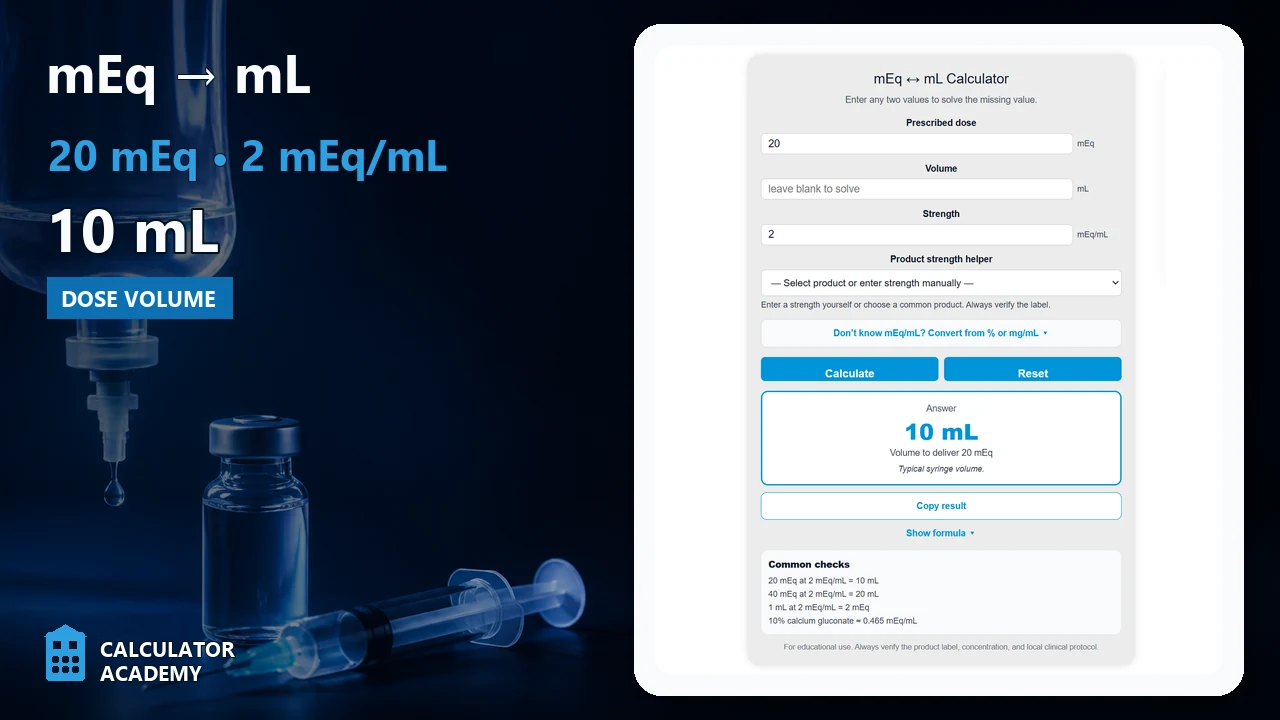
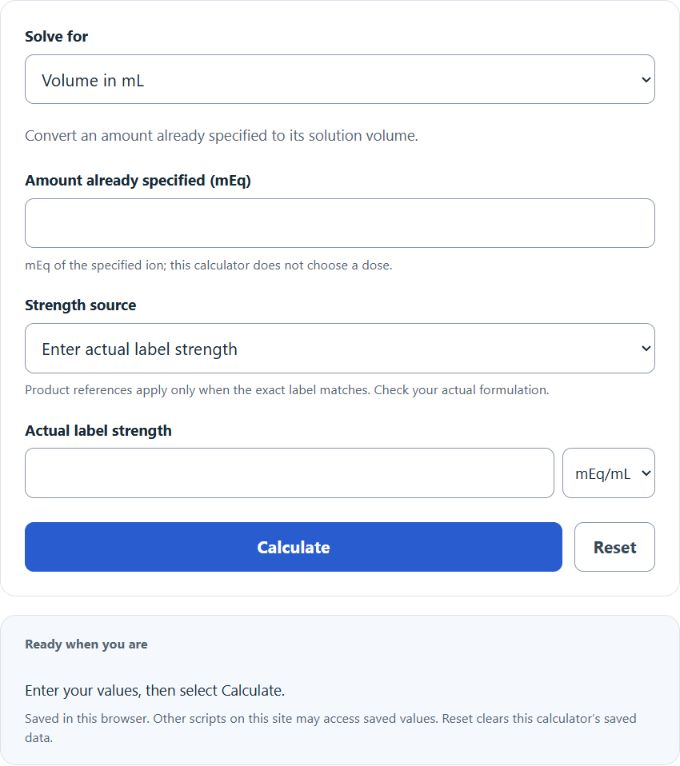
Convert a specified ion amount, solution volume or strength, and derive theoretical strength from % w/v or mg/mL. Choose the value to solve and enter the required known values. This tool does not select a dose or administration method.
- All Unit Converters
- All Medical and Health Unit Converters
- mEq To mg Calculator
- Grams To mEq Calculator
- ml to mg
| mEq to mL | mL to mEq |
|---|---|
| 5 mEq = 2.5 mL | 1 mL = 2 mEq |
| 10 mEq = 5 mL | 2 mL = 4 mEq |
| 15 mEq = 7.5 mL | 3 mL = 6 mEq |
| 20 mEq = 10 mL | 4 mL = 8 mEq |
| 25 mEq = 12.5 mL | 5 mL = 10 mEq |
| 30 mEq = 15 mL | 7 mL = 14 mEq |
| 40 mEq = 20 mL | 10 mL = 20 mEq |
| 50 mEq = 25 mL | 12 mL = 24 mEq |
| 60 mEq = 30 mL | 15 mL = 30 mEq |
| 80 mEq = 40 mL | 25 mL = 50 mEq |
| mL = mEq / (mEq/mL) and mEq = (mEq/mL) x mL. Strength = 2 mEq/mL. | |
| mEq to mL | mL to mEq |
|---|---|
| 10 mEq = 10 mL | 1 mL = 1 mEq |
| 25 mEq = 25 mL | 2 mL = 2 mEq |
| 50 mEq = 50 mL | 5 mL = 5 mEq |
| 75 mEq = 75 mL | 10 mL = 10 mEq |
| 100 mEq = 100 mL | 20 mL = 20 mEq |
| 150 mEq = 150 mL | 30 mL = 30 mEq |
| 200 mEq = 200 mL | 50 mL = 50 mEq |
| 250 mEq = 250 mL | 60 mL = 60 mEq |
| 300 mEq = 300 mL | 100 mL = 100 mEq |
| 500 mEq = 500 mL | 200 mL = 200 mEq |
| mL = mEq / (mEq/mL) and mEq = (mEq/mL) x mL. Strength = 1 mEq/mL. | |
mEq to mL Formulas
Two forms of the conversion are common depending on how the concentration is expressed.
When concentration is in mEq/mL (typical on vial labels):
When concentration is in mEq/L (typical in lab reports):
Variables:
- mL = volume of solution in milliliters
- mEq = milliequivalents of the solute (the amount of ionic charge)
- mEq/mL = concentration as printed on the product label
- C = concentration in mEq/L (divide by 1000 to get mEq/mL)
The calculator above uses the mEq/mL form directly, which matches how injectable electrolyte products are labeled in the United States.
What Is a Milliequivalent (mEq)?
A milliequivalent is one-thousandth of a chemical equivalent. Unlike milligrams, which measure mass alone, milliequivalents account for both the mass and the ionic charge (valence) of a substance. This makes mEq the preferred unit for electrolytes in clinical medicine because body fluid balance depends on charge, not weight.
The relationship between milligrams and milliequivalents is:
For monovalent ions (valence = 1) such as Na+, K+, and Cl-, one milliequivalent equals one millimole. For divalent ions (valence = 2) such as Ca2+ and Mg2+, one millimole equals two milliequivalents. This distinction matters when converting between lab values reported in mmol/L (common outside the US) and mEq/L (standard in the US).
Electrolyte Reference Data
The table lists exact salt formula masses and mass per target-ion mEq. Use the correct hydrate and multiply ion count by absolute ionic charge. For example, K2HPO4 contains two potassium ions. Calcium chloride dihydrate and magnesium sulfate heptahydrate have different formula masses from their anhydrous salts.
| Substance | Formula | MW (g/mol) | Valence | mg per 1 mEq |
|---|---|---|---|---|
| Sodium chloride | NaCl | 58.44 | 1 | 58.44 |
| Potassium chloride | KCl | 74.55 | 1 | 74.55 |
| Sodium bicarbonate | NaHCO3 | 84.01 | 1 | 84.01 |
| Calcium chloride (dihydrate) | CaCl2 2H2O | 147.01 | 2 | 73.51 |
| Calcium gluconate | C12H22CaO14 | 430.37 | 2 | 215.19 |
| Magnesium sulfate (heptahydrate) | MgSO4 7H2O | 246.47 | 2 | 123.24 |
| Potassium phosphate (dibasic) | K2HPO4 | 174.18 | 2 equivalents per formula unit (two K+) | 87.09 (salt per potassium mEq) |
| Sodium acetate (trihydrate) | CH3COONa 3H2O | 136.08 | 1 | 136.08 |
| Sodium phosphate (dibasic) | Na2HPO4 7H2O | 268.07 | 2 equivalents per formula unit (two Na+) | 134.04 (salt per sodium mEq) |
| Potassium acetate | CH3COOK | 98.14 | 1 | 98.14 |
Normal Serum Electrolyte Ranges
These example adult laboratory intervals are not replacement-dose targets. Use the interval, specimen type and units reported by the testing laboratory. This conversion calculator cannot infer a replacement dose from a serum concentration.
| Electrolyte | Normal Range (mEq/L) | Equivalent (mmol/L) |
|---|---|---|
| Sodium (Na+) | 136 to 145 | 136 to 145 |
| Potassium (K+) | 3.5 to 5.0 | 3.5 to 5.0 |
| Chloride (Cl-) | 98 to 106 | 98 to 106 |
| Bicarbonate (HCO3-) | 22 to 28 | 22 to 28 |
| Calcium (Ca2+, ionized) | 2.2 to 2.6 | 1.1 to 1.3 |
| Magnesium (Mg2+) | 1.3 to 2.1 | 0.65 to 1.05 |
| Phosphate (laboratory phosphorus reporting) | No fixed mEq conversion | 0.81 to 1.45 (example interval) |
For monovalent ions the mEq/L and mmol/L columns are identical. For divalent ions, mEq/L = mmol/L x 2. Labs in the United States typically report sodium, potassium, chloride, and bicarbonate in mEq/L; calcium and magnesium may appear in either mg/dL or mmol/L depending on the institution.
Common Injectable Electrolyte Concentrations
The table gives example labeled strengths. The calculator retains common product references; additional examples below are for comparison. Percent strength does not identify every formulation. Prefer the mEq/mL on the exact product label. Calcium chloride labels may round differently from formula-mass arithmetic; magnesium sulfate 50% is commonly labeled 4.06 mEq/mL. See calcium chloride labeling and magnesium sulfate labeling.
| Product | Label Strength | Primary Ion | Approx. mEq/mL |
|---|---|---|---|
| KCl injection | 2 mEq/mL | K+ | 2 |
| NaHCO3 8.4% | 84 mg/mL | Na+ | 1 |
| NaCl 23.4% | 234 mg/mL | Na+ | 4 |
| Calcium gluconate 10% | 100 mg/mL | Ca2+ | 0.465 |
| CaCl2 dihydrate 10% | 100 mg/mL | Ca2+ | 1.4 (selected label; theoretical 1.36045) |
| MgSO4 heptahydrate 50% | 500 mg/mL | Mg2+ | 4.06 (label; theoretical 4.05729) |
| KCl injection (dilute) | 0.1 mEq/mL | K+ | 0.1 |
| NaCl 0.9% (Normal Saline) | 9 mg/mL | Na+ | 0.154 |
| Lactated Ringer’s | mixed | Na+ | 0.130 (Na+) |
| Values are approximate. Always verify the concentration on the actual product label before dosing. | |||
How to Convert mEq to mL (Step by Step)
This educational example calculates a stock volume for an already specified amount using a matching 2 mEq/mL label. Potassium chloride concentrate must be diluted according to its product labeling; this arithmetic is not an administration instruction.
- Identify the already specified potassium amount: 40 mEq.
- Read the vial label for the concentration: 2 mEq/mL.
- Apply the formula: mL = mEq / (mEq/mL) = 40 / 2 = 20 mL.
- The calculation identifies 20 mL of stock solution containing 40 mEq potassium. Preparation, dilution and administration require the exact product label and clinical protocol.
- Choose Volume in mL, enter Amount = 40 and actual label Strength = 2 mEq/mL, then select Calculate to obtain 20 mL.
Example: Sodium Bicarbonate Dose
A physician orders 50 mEq of sodium bicarbonate. The available product is NaHCO3 8.4%, which provides approximately 1 mEq/mL.
mL = 50 mEq / 1 mEq/mL = 50 mL
The arithmetic gives 50 mL of that labeled stock solution, without determining whether or how to administer it. As a theoretical check: the 8.4% label means 84 mg/mL. The molecular weight of NaHCO3 is 84.01 g/mol with a valence of 1, so 84 mg / 84.01 mg/mmol x 1 = ~1 mEq/mL, close to the rounded label strength. Use the actual label for the conversion.
Why Electrolytes Use mEq Instead of mg
Milligrams measure mass. Milliequivalents measure the number of ionic charges in solution. Body fluids maintain electrical neutrality: the total positive charges (cations) must equal the total negative charges (anions). One mEq of elemental potassium is about 39.10 mg; one mEq of elemental sodium is about 22.99 mg. The 74.55 mg value applies to KCl salt per potassium mEq. Specifying the ion and salt form is essential; an mEq conversion alone does not establish a safe or appropriate replacement dose.
As a practical example, 40 mEq of potassium can be delivered as 2,982 mg of KCl (MW 74.55, valence 1) or as 9,370 mg of potassium gluconate (MW 234.25, one K+ per formula unit). Both contain 40 mEq potassium, but they are not interchangeable administration instructions.