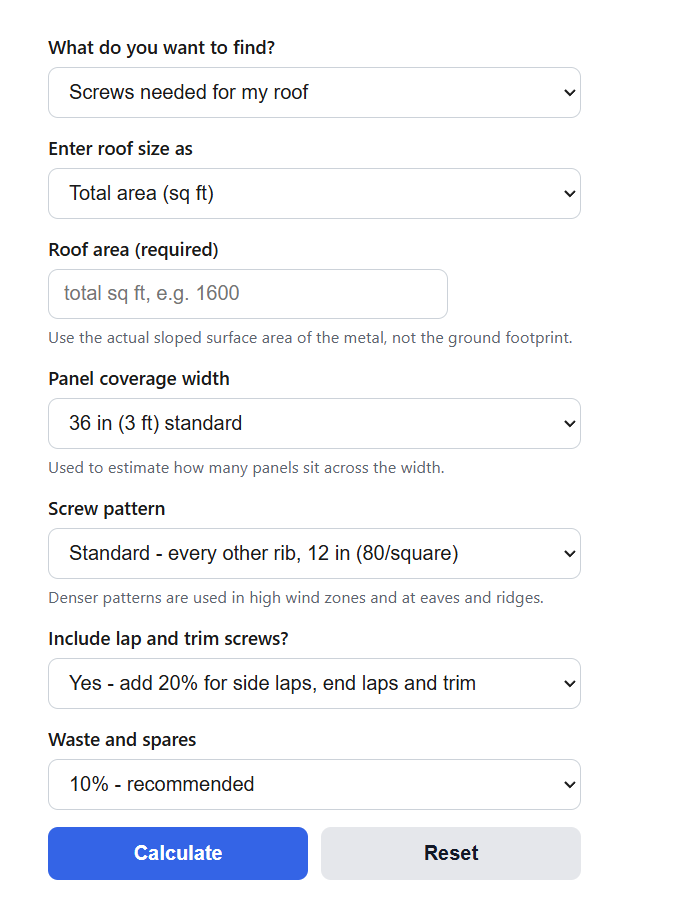
Calculate how many metal roof screws you need from your roof size and fastening pattern, get the boxes and weight to buy, or find the roof area a screw supply will cover.
Metal Roof Screw Formula
The screw count is estimated from your roof area, the fastening pattern, and allowances for laps and waste:
Screws = (Area / 100) * Rate * Lap * (1 + Waste)
To work the other way and find how much roof a supply of screws will cover, rearrange the same relationship:
Area = (Screws / (1 + Waste) / Lap) * 100 / Rate
Variables:
- Screws is the total number of fasteners
- Area is the roof surface area in square feet, measured along the slope rather than as the ground footprint
- Rate is the screws used per square (100 square feet): 70, 80, 100, or 130 depending on the pattern you pick
- Lap is 1.2 when side laps, end laps, and trim screws are included, or 1 for field screws only
- Waste is the spare fraction, so 10 percent is entered as 0.10
The calculator runs this in two directions. In the default mode you enter your roof size, choose a pattern, and it returns the total screws plus the number of 250-count boxes and the approximate weight. Switch the selector at the top to the coverage mode and you enter the screws you already have, and it returns the roof area that supply will fasten. The pattern rate is the main driver of both numbers, so match it to your panel maker instructions and your local wind zone before you buy.
Screw Pattern Rates and Coverage per Box
The first table shows the per-square rate behind each pattern and the across-panel spacing it assumes. A square is 100 square feet.
| Pattern | Field spacing | Screws per square | Typical use |
|---|---|---|---|
| Minimal | Every other rib, 18 in | 70 | Sheds, low wind |
| Standard | Every other rib, 12 in | 80 | Most homes and barns |
| High wind | Every rib, 12 in | 100 | Coastal and open sites |
| Heavy duty | Every rib, 8 in | 130 | Hurricane zones, code driven |
The second table turns those rates into coverage for one full 250-count box, which is handy when you already own screws and want to know how far they go. Field only assumes no laps; the last column reserves the same 20 percent lap and trim allowance the calculator uses.
| Pattern | Coverage per box, field only | Coverage per box, with laps and trim |
|---|---|---|
| Minimal (70) | 357 sq ft | 298 sq ft |
| Standard (80) | 313 sq ft | 260 sq ft |
| High wind (100) | 250 sq ft | 208 sq ft |
| Heavy duty (130) | 192 sq ft | 160 sq ft |
Example Problems
Example 1: Screws for a house roof.
Your metal roof measures 1,600 square feet of sloped surface. You use the standard pattern (80 per square), include laps and trim, and add 10 percent waste.
Screws = (1600 / 100) * 80 * 1.2 * 1.10 = 1,690 screws, which is about 7 boxes of 250 or roughly 22 pounds.
Example 2: Coverage from screws you already have.
You have 4 boxes on hand, so 1,000 screws. Using the standard pattern with laps and 10 percent held back for waste:
Area = (1000 / 1.10 / 1.2) * 100 / 80 = about 947 square feet, or roughly 9.5 squares of field fastening.
Frequently Asked Questions
How many screws do you need per square of metal roofing?
Plan on about 80 screws for each square (100 square feet) with a standard pattern. Lighter jobs on sheds run closer to 70, while high wind and code driven patterns climb to 100 or even 130 per square because you fasten every rib and space the screws tighter. Those field numbers do not include side laps, end laps, or trim, so add roughly 20 percent for a through-fastened panel roof.
What screw length do you need for metal roofing?
Pick a length that fully penetrates the panel and leaves enough thread in the framing. A common rule is panel rib height plus at least 3/4 inch into wood, plus about 1/4 inch of clearance. For a typical exposed fastener panel on 2x wood purlins that lands near a 1 to 1.5 inch screw; add the foam thickness if you fasten over rigid insulation, and step up to a longer screw and a sharper drill point for steel framing.
Why place screws in the flat of the panel and not the rib?
On through-fastened panels the screw is meant to seat in the low flat, where the rubber washer can compress flat against the metal and the framing sits right below it. Driving into the raised rib leaves the washer bridging an air gap, so it cannot seal and the panel can flex around the fastener. The high wind and heavy duty patterns still count ribs for spacing, but the screws themselves go in the pan next to each rib.