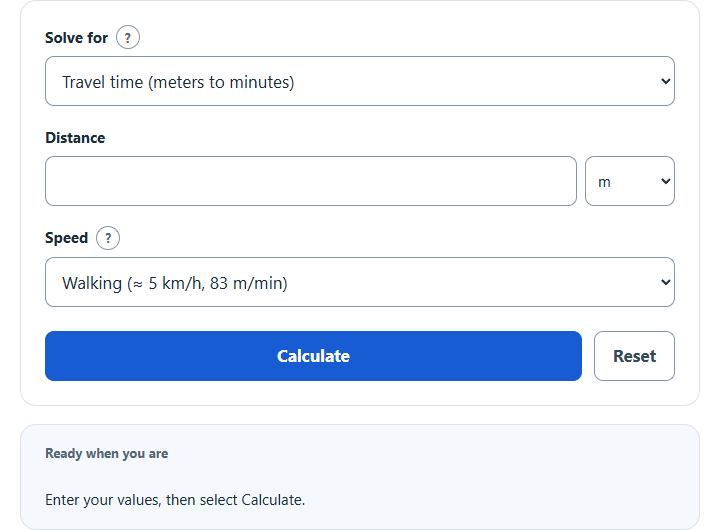
Convert meters to minutes: enter a distance and pick a walking, running or cycling speed, or your own, to get travel time. Minutes to meters works too.
- All Unit Converters
- Meters to Hours Calculator
- Meters to Seconds Calculator
- Velocity Calculator
- Constant Velocity Calculator
- Minutes to Miles Per Hour Calculator
Calculator Functions
| Function | What it does | What it requires |
|---|---|---|
| Travel time (meters to minutes) | Finds the minutes needed to cover a distance at a walking, running or cycling speed | Requires the distance and a speed choice |
| Distance (minutes to meters) | Finds the meters covered in a set time | Requires a speed choice and the travel time |
| Average speed | Finds the speed in meters per minute from a distance and the time it took | Requires the distance and the travel time |
The speed choice is walking, brisk walking, jogging, running, cycling or a custom speed in m/min, m/s, km/h, mph, ft/min or ft/s. Distance goes in as m, km, cm, ft, yd or mi, and time as minutes, seconds or hours. Time results also show seconds, hours and a clock reading. Distance results add km and miles, and speed results add m/s, km/h and mph.
Meters to Minutes Formulas
| t | Travel time (minutes) |
| d | Distance (meters) |
| v | Average speed (meters per minute) |
Meters measure distance and minutes measure time, so there is no fixed number of minutes in a meter. The answer depends on the speed. At a typical walking speed of 5 km/h, 500 meters takes 6 minutes.
Travel time (meters to minutes)
The main formula applies directly. The speed list uses these typical averages on flat ground, which fall within the speed bands that the Compendium of Physical Activities gives for each activity [1]:
| Speed choice | km/h | m/min | mph |
|---|---|---|---|
| Walking | 5 | 83.33 | 3.1 |
| Brisk walking | 6 | 100 | 3.7 |
| Jogging | 8 | 133.33 | 5.0 |
| Running | 12 | 200 | 7.5 |
| Cycling | 16 | 266.67 | 9.9 |
The table below gives the minutes for common distances at three of these speeds. Brisk walking takes five sixths of the walking time, and jogging takes one and a half times the running time.
| Meters | Walking (min) | Running (min) | Cycling (min) |
|---|---|---|---|
| 20 | 0.24 | 0.1 | 0.08 |
| 50 | 0.6 | 0.25 | 0.19 |
| 100 | 1.2 | 0.5 | 0.38 |
| 200 | 2.4 | 1 | 0.75 |
| 300 | 3.6 | 1.5 | 1.13 |
| 350 | 4.2 | 1.75 | 1.31 |
| 400 | 4.8 | 2 | 1.5 |
| 500 | 6 | 2.5 | 1.88 |
| 600 | 7.2 | 3 | 2.25 |
| 700 | 8.4 | 3.5 | 2.63 |
| 800 | 9.6 | 4 | 3 |
| 1,000 | 12 | 5 | 3.75 |
| 1,500 | 18 | 7.5 | 5.63 |
| 2,000 | 24 | 10 | 7.5 |
| 5,000 | 60 | 25 | 18.75 |
Distances in feet, yards and miles are converted to meters first, at 0.3048 m per foot, 0.9144 m per yard and 1,609.344 m per mile [3].
Distance (minutes to meters)
This is the main formula rearranged. Ten minutes at the walking speed covers 83.33 × 10 = 833.33 meters, and ten minutes at the running speed covers 2,000 meters.
Average speed
Covering 500 meters in 10 minutes is an average of 50 meters per minute. One meter per minute equals 0.0167 m/s, 0.06 km/h or 0.0373 mph, so 50 m/min is 0.83 m/s, 3 km/h or 1.86 mph. A time of zero is rejected.
Limits of This Estimate
- The speed choices are typical values for adults on level ground. Age, fitness, hills, crowds, stairs and road crossings change the real figure. These estimates are based on the best available data and estimations.
- Health guidance counts walking as brisk from 2.5 mph (4 km/h) and treats cycling below 10 mph (16 km/h) as moderate effort [2], so many riders are faster than the cycling value.
- The speed is an average for the whole trip. Stops are counted only if the speed entered already allows for them.
Sources
- 2024 Adult Compendium of Physical Activities, Walking: speed bands for moderate and brisk walking, with the matching running and bicycling lists for 5 mph, 7.5 mph and 10 mph
- CDC, How to Measure Physical Activity Intensity: brisk walking from 2.5 mph and bicycling slower than 10 mph as moderate activity
- NIST, Guide for the Use of the International System of Units (SP 811), Appendix B.8: foot, yard, mile and mile per hour in SI units