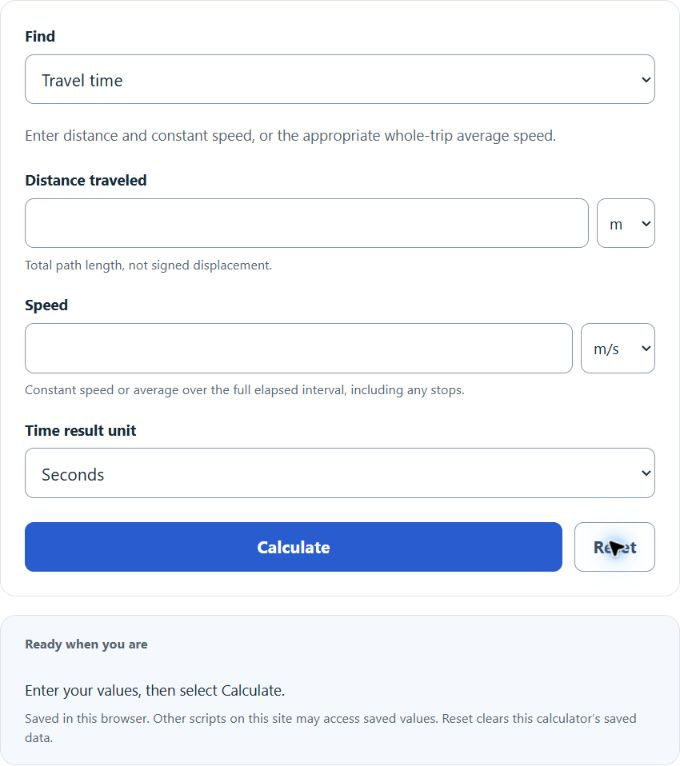
Calculate travel time in seconds from distance and speed, or solve for distance or speed with meters, kilometers, miles, feet, m/s, km/h, and mph.
| Pace (min/km) to Speed (km/h) | Speed (km/h) to Pace (min/km) |
|---|---|
| 3:00 min/km = 20.00 km/h | 6.0 km/h = 10:00 min/km |
| 3:30 min/km = 17.14 km/h | 7.5 km/h = 8:00 min/km |
| 4:00 min/km = 15.00 km/h | 8.0 km/h = 7:30 min/km |
| 4:30 min/km = 13.33 km/h | 9.0 km/h = 6:40 min/km |
| 5:00 min/km = 12.00 km/h | 10.0 km/h = 6:00 min/km |
| 5:30 min/km = 10.91 km/h | 11.0 km/h = 5:27 min/km |
| 6:00 min/km = 10.00 km/h | 12.0 km/h = 5:00 min/km |
| 6:30 min/km = 9.23 km/h | 14.0 km/h = 4:17 min/km |
| 7:00 min/km = 8.57 km/h | 16.0 km/h = 3:45 min/km |
| 8:00 min/km = 7.50 km/h | 18.0 km/h = 3:20 min/km |
| Formula: speed (km/h) = 60 ÷ pace (min/km). | |
| Pace (min/mi) to Speed (mph) | Speed (mph) to Pace (min/mi) |
|---|---|
| 4:00 min/mi = 15.00 mph | 4.0 mph = 15:00 min/mi |
| 5:00 min/mi = 12.00 mph | 4.5 mph = 13:20 min/mi |
| 6:00 min/mi = 10.00 mph | 5.5 mph = 10:55 min/mi |
| 7:00 min/mi = 8.57 mph | 6.2 mph = 9:41 min/mi |
| 8:00 min/mi = 7.50 mph | 7.0 mph = 8:34 min/mi |
| 9:00 min/mi = 6.67 mph | 8.0 mph = 7:30 min/mi |
| 10:00 min/mi = 6.00 mph | 9.0 mph = 6:40 min/mi |
| 11:00 min/mi = 5.45 mph | 10.0 mph = 6:00 min/mi |
| 12:00 min/mi = 5.00 mph | 11.0 mph = 5:27 min/mi |
| 13:00 min/mi = 4.62 mph | 13.0 mph = 4:37 min/mi |
| Formula: speed (mph) = 60 ÷ pace (min/mi). | |
Meters To Seconds Formula
Where t is time in seconds, d is total distance traveled in meters, and v is speed in m/s. Time = distance / speed uses constant speed or the appropriate average over the full interval. A curved path is allowed when d is path length; signed displacement and velocity are different quantities.
Speed, Distance, and Time
Distance, time, and average speed are linked by distance = average speed × elapsed time. Knowing two determines the third when the denominator is positive. Meters and seconds are SI base units; dividing meters by m/s leaves seconds. A zero distance at positive speed gives zero time, while zero distance over positive time gives zero average speed.
Meters measure length and seconds measure time, so a speed is required. For example, 100 m at an assumed 1.4 m/s takes about 71.43 seconds. At 299,792,458 m/s, the same distance takes about 3.33564e-7 seconds. Predictions depend on the supplied speed; a single instantaneous speed need not equal a whole-trip average.
Reference Speeds in Meters Per Second
The table below provides illustrative, rounded reference values. Speeds for people, animals and vehicles vary with conditions; these are assumptions for practicing time = distance / speed, not measured guarantees or recommended travel speeds. The duration column is rounded from the displayed m/s value.
| Object / Activity | Speed (m/s) | Speed (km/h) | Time for 100 m |
|---|---|---|---|
| Garden snail | 0.013 | 0.05 | ~2.1 hours |
| Human walking (average) | 1.4 | 5.0 | 71 s |
| Human jogging | 2.8 | 10.1 | 36 s |
| Recreational swimmer | 0.7 | 2.5 | 143 s |
| Recreational cyclist | 5.6 | 20.2 | 18 s |
| Olympic 100 m sprint (Bolt, WR) | 10.44 | 37.6 | 9.58 s |
| Bolt peak speed (60-80 m split) | 12.42 | 44.7 | 8.1 s |
| Greyhound | 18.3 | 65.9 | 5.5 s |
| Cheetah (top speed) | 33.3 | 119.9 | 3.0 s |
| City driving (30 mph) | 13.4 | 48.2 | 7.5 s |
| Highway driving (65 mph) | 29.1 | 104.8 | 3.4 s |
| Peregrine falcon (dive) | 108 | 389 | 0.93 s |
| Commercial jet (cruise) | 250 | 900 | 0.40 s |
| Speed of sound (20 °C in air) | 343 | 1,235 | 0.29 s |
| Rifle bullet (typical) | 900 | 3,240 | 0.11 s |
| ISS orbital speed | 7,660 | 27,576 | 0.013 s |
| Speed of light (vacuum) | 299,792,458 | ~1.08 billion | 0.00000033 s |
| Illustrative speed assumptions; exact vacuum light-speed constant. Time calculated as 100 / displayed speed and rounded. | |||
Track World Records: Speed by Distance
The table combines seven men’s senior outdoor track records with the men’s road marathon record, checked against World Athletics on October 6, 2026. Distance divided by race time gives a whole-race average, not a peak or constant speed. Sabastian Sawe’s 1:59:30 marathon was set on April 26, 2026 and ratified on July 23. The table’s average speed falls by about 44% from 100 m to marathon.
| Event | Record Holder | Time | Avg Speed (m/s) | Avg Pace (min/km) |
|---|---|---|---|---|
| 100 m | Usain Bolt | 9.58 s | 10.44 | 1:36 |
| 200 m | Usain Bolt | 19.19 s | 10.42 | 1:36 |
| 400 m | Wayde van Niekerk | 43.03 s | 9.30 | 1:48 |
| 800 m | David Rudisha | 1:40.91 | 7.93 | 2:06 |
| 1,500 m | Hicham El Guerrouj | 3:26.00 | 7.28 | 2:17 |
| 5,000 m | Joshua Cheptegei | 12:35.36 | 6.62 | 2:31 |
| 10,000 m | Joshua Cheptegei | 26:11.00 | 6.37 | 2:37 |
| Marathon (42,195 m) | Sabastian Sawe | 1:59:30 | 5.88 | 2:50 |
| Source: World Athletics records, checked October 6, 2026. Marathon ratification. Average speed = distance / elapsed seconds; pace rounded to the nearest second per km. | ||||
Practical Applications
Running and training. A runner targeting a 20-minute 5K needs to maintain 4.17 m/s (250 m per minute, or a 4:00/km pace). A swimmer completing a 50 m lap in 25 seconds moves at 2.0 m/s. Coaches use speed and distance data to set interval targets, monitor fatigue across splits, and quantify improvement over a training cycle.
Traffic engineering. At a constant 13.4 m/s, a vehicle covers 12 meters in about 0.90 seconds. This is a distance/speed arithmetic example. Actual signal timing and stopping-distance design require additional inputs and applicable engineering standards; vehicle crossing time alone does not determine pedestrian signal duration.
Physics: wave propagation. Using an assumed sound speed of 343 m/s, 1,700 meters corresponds to about 4.96 seconds of propagation time. A return echo travels the outgoing and returning paths, so use the total path length. Sound speed depends on the medium and its conditions; the calculator uses the speed you supply.
Manufacturing and automation. At a constant 0.5 m/s, a conveyor moves a product 3 meters in 6 seconds. A 200 mm move at 10 mm/s takes 20 seconds. These examples model steady motion; acceleration, positioning delays and other process steps can add to total cycle time.
Key Unit Conversions for Speed
The input menus convert units automatically. Exact definitions give 1 km/h = 1/3.6 m/s, 1 mph = 0.44704 m/s, 1 ft/s = 0.3048 m/s and 1 knot = 1852/3600 m/s. International feet and miles are used. The outputs are rounded for display.