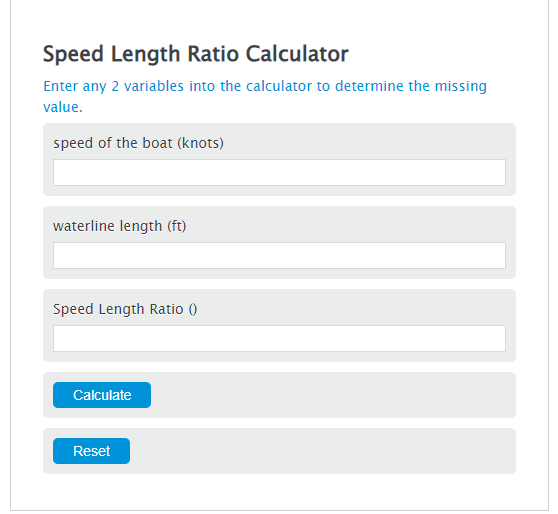
Calculate a boat’s speed length ratio, speed, or waterline length by entering any two values with units like knots, meters, feet, or mph.
Related Calculators
- Propeller Slip Calculator
- Hydrofoil Lift/Speed Calculator
- Drag Coefficient Calculator
- Maximum Velocity Calculator
- All Physics Calculators
Speed Length Ratio Formula
The speed length ratio compares a boat's speed to the square root of its waterline length. It is normally calculated using speed in knots and waterline length in feet.
- SLR = speed length ratio, unitless
- V = boat speed in knots
- LWL = waterline length in feet
If you enter speed and waterline length, the calculator finds the speed length ratio.
If you enter speed length ratio and waterline length, the calculator finds the boat speed.
If you enter speed and speed length ratio, the calculator finds the required waterline length.
The calculator converts speed units to knots and length units to feet before applying the formula. The final speed length ratio has no unit.
Common Speed Length Ratio Ranges
These ranges are general guides for displacement and semi-displacement boats. Actual performance depends on hull shape, displacement, power, sea state, and loading.
| Speed length ratio | Typical meaning | Notes |
|---|---|---|
| Below 1.0 | Low displacement speed | Usually efficient and well below hull speed. |
| 1.0 to 1.34 | Near typical displacement hull speed | Resistance often rises quickly as SLR approaches about 1.34. |
| 1.34 to 2.0 | Above normal displacement speed | May require a light, narrow, powerful, or semi-displacement hull. |
| Above 2.0 | High-speed or planing range | Common for planing craft, not typical for heavy displacement boats. |
Speed and Length Unit Reference
| Input type | Accepted units | Formula base unit |
|---|---|---|
| Boat speed | knots, meters per second, kilometers per hour, miles per hour | knots |
| Waterline length | feet, meters, centimeters, inches | feet |
| Speed length ratio | unitless | unitless |
Example Calculations
Example 1: Find speed length ratio
You have a boat speed of 7 knots and a waterline length of 25 feet.
The speed length ratio is 1.4.
Example 2: Find boat speed
You want a speed length ratio of 1.34 with a waterline length of 36 feet.
The boat speed is 8.04 knots.
FAQ
What is waterline length?
Waterline length is the length of the boat at the point where it sits in the water. It is not always the same as the total length of the boat. Overhangs, swim platforms, bowsprits, and transom shape can make overall length different from waterline length.
Is speed length ratio the same as hull speed?
No. Speed length ratio is the ratio between speed and the square root of waterline length. Hull speed is often estimated by multiplying the square root of waterline length by about 1.34. That means an SLR near 1.34 is often treated as the traditional displacement hull speed region.
Why does the formula use knots and feet?
The common marine speed length ratio formula is based on speed in knots and waterline length in feet. If you use other units, they need to be converted first. The calculator handles those conversions before solving for the missing value.