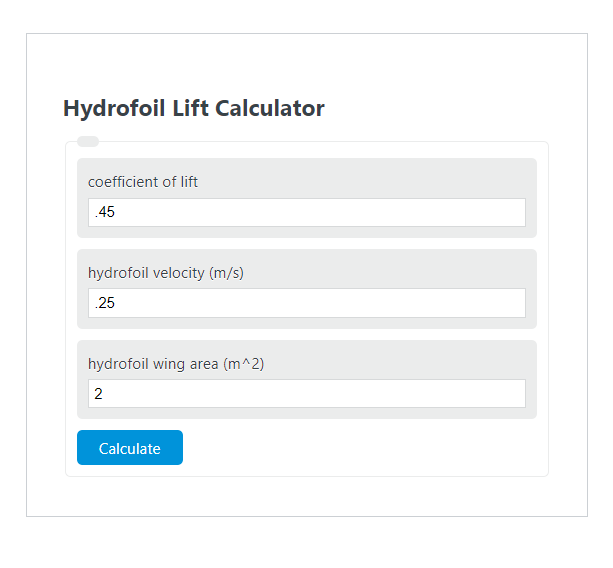
Calculate hydrofoil lift, takeoff speed, planform area, or required lift coefficient with fresh/seawater density and marine metric-imperial conversions.
Hydrofoil Lift Formula
The hydrofoil lift equation estimates the upward force produced by a foil moving through water. This calculator can be used in two directions: to estimate lift from a known speed, or to estimate the speed required to reach a target lift. It is most useful as a first-pass sizing and performance check for e-foils, surf foils, kite foils, sail foils, and other submerged wing systems.
In this relationship, lift depends on four main inputs: water density, speed, foil area, and lift coefficient. Because speed is squared, even a small increase in velocity can produce a large increase in lift.
Variable Definitions
| Symbol | Meaning | Why it matters |
|---|---|---|
| L | Lift force generated by the hydrofoil | Compare this to the total supported weight when estimating lift-off or steady foiling conditions. |
| ρ | Water density | Seawater is denser than freshwater, so the same foil at the same speed produces slightly more lift in salt water. |
| V | Hydrofoil speed through the water | This is the strongest driver because lift rises with the square of speed. |
| S | Foil wing area | Larger area increases lift at a given speed, but often increases drag and can reduce top-end efficiency. |
| CL | Coefficient of lift | Represents how effectively the foil shape and angle of attack convert flow into lift. |
How to Use the Calculator
- Select whether you want to solve for lift or velocity.
- Choose the correct water type, or enter a custom density if needed.
- Enter the foil wing area using consistent units.
- Enter a realistic lift coefficient for the foil and operating condition.
- Review the result together with dynamic pressure and equivalent supported mass for a more complete picture.
For lift-off estimates, target lift usually needs to at least match the supported weight, with some additional margin for trim changes, pumping, chop, rider movement, and transient losses.
Rearranged Formula for Required Speed
If you know the lift you need and want to estimate the required foil speed, rearrange the equation for velocity:
This is especially useful when sizing a foil for early takeoff. Increasing wing area or lift coefficient reduces the required speed, while denser water also lowers the speed needed for the same lift target.
Dynamic Pressure and Equivalent Supported Mass
Two additional outputs are helpful when interpreting results. Dynamic pressure indicates how strongly the moving water loads the foil, while equivalent supported mass expresses the lift as an approximate mass support value.
Equivalent supported mass is convenient for intuition, but it is still a force-based estimate. Real takeoff and ride behavior depend on balance, trim, drag, and how the foil is being loaded over time.
What Changes Hydrofoil Lift the Most?
- Speed: the dominant variable. Doubling speed increases lift by a factor of four.
- Wing area: a larger foil lowers required takeoff speed, but usually adds drag and can feel less loose at higher speeds.
- Lift coefficient: higher values increase lift, but only within stable operating limits. Pushing too high can lead to stall, ventilation, or poor control.
- Water density: seawater provides slightly more lift than freshwater under otherwise identical conditions.
Example 1: Estimating Lift
Suppose a hydrofoil is running in freshwater with a wing area of 0.12 m2, a lift coefficient of 0.60, and a speed of 6 m/s. The calculator returns approximately 1,293 N of lift, which corresponds to about 132 kg of equivalent supported mass. That is enough to show how rapidly lift builds once the foil reaches operating speed.
Example 2: Estimating Required Speed
If the target lift is 900 N in seawater, with a wing area of 0.10 m2 and a lift coefficient of 0.80, the required hydrofoil speed is about 4.69 m/s. That is approximately 16.9 km/h or 10.5 mph.
Common Input Mistakes
- Using total board size instead of foil wing area: only the hydrofoil wing area belongs in the equation.
- Mixing units: be careful when switching between m/s, mph, km/h, m2, and ft2.
- Choosing an unrealistic lift coefficient: very large values may look good numerically but may not be stable in practice.
- Ignoring water type: freshwater and seawater produce different results because density changes.
- Assuming exact real-world performance: the equation is an estimate, not a full hydrodynamic simulation.
Practical Interpretation
A hydrofoil that lifts early is not automatically the fastest foil, and a foil that requires more speed is not automatically worse. Larger, higher-lift wings generally favor easier takeoff and lower-speed riding, while smaller or lower-lift wings usually favor higher-speed efficiency and reduced drag. The calculator helps quantify those tradeoffs before testing on the water.
Use the result as a design and planning tool, then validate it against real operating conditions. Foil section shape, aspect ratio, rider stance, ride height, strut drag, surface ventilation, chop, and angle of attack all influence actual performance beyond the basic lift equation.