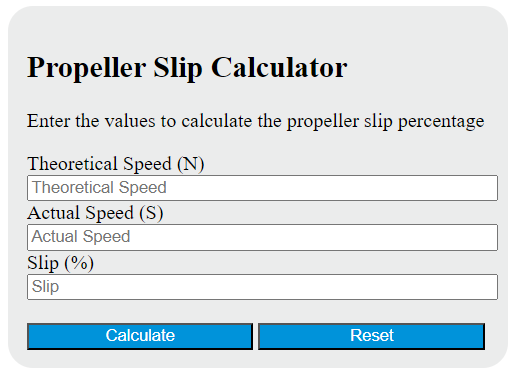
Calculate propeller slip, actual boat speed, or required pitch from engine RPM and gear ratio, with shaft RPM, theoretical speed, advance per turn, and hull benchmark.
Related Calculators
- Propeller Pitch Speed Calculator
- Propeller Thrust Calculator
- Propeller Torque Calculator
- Boat HP to Speed Calculator
- Boat Travel Time Calculator
- Tip Speed Calculator
- All Physics Calculators
Propeller Slip Formula
The following formula is used to calculate the propeller slip:
Variables:
- Slip is the propeller slip percentage
- N is the theoretical (no-slip) vessel speed based on propeller pitch and RPM
- S is the actual vessel speed (typically speed through the water)
To calculate the propeller slip, subtract the actual vessel speed from the theoretical (no-slip) vessel speed. Divide the result by the theoretical (no-slip) vessel speed, and then multiply by 100 to get the slip percentage.
What is a Propeller Slip?
Propeller slip refers to the difference between the theoretical distance a vessel would advance in one propeller revolution (based on the propeller’s pitch) and the actual distance it advances. This discrepancy occurs because water or air is a fluid medium: when a propeller rotates, it accelerates the fluid to generate thrust, and the resulting flow and losses mean the vessel advances less per revolution than the ideal “no-slip” case. The amount of slip is influenced by several factors, including the design and condition of the propeller, the speed and load of the vessel, and the condition of the fluid medium. It is usually expressed as a percentage, with 100% slip meaning there is no forward advance through the water, and 0% slip meaning the vessel advances exactly the theoretical distance per revolution.
How to Calculate Propeller Slip?
The following steps outline how to calculate the Propeller Slip.
- First, determine the engine RPM, the gear ratio (engine:prop), and the propeller pitch.
- Next, calculate the propeller shaft RPM: prop RPM = engine RPM ÷ gear ratio.
- Next, calculate the theoretical (no-slip) speed (N): N = (prop RPM ÷ 60) × pitch (with pitch converted to distance per revolution).
- Then, measure the actual vessel speed through the water (S) using a speed log or equivalent (speed over ground includes current and is not recommended for slip calculations).
- Finally, compute Slip (%) = (N − S) ÷ N × 100, and check your answer with the calculator above.
Example Problem:
Use the following variables as an example problem to test your knowledge.
Theoretical (no-slip) speed, N (knots) = 12
Actual speed through the water, S (knots) = 10
Slip = (12 − 10) / 12 × 100 = 16.7%