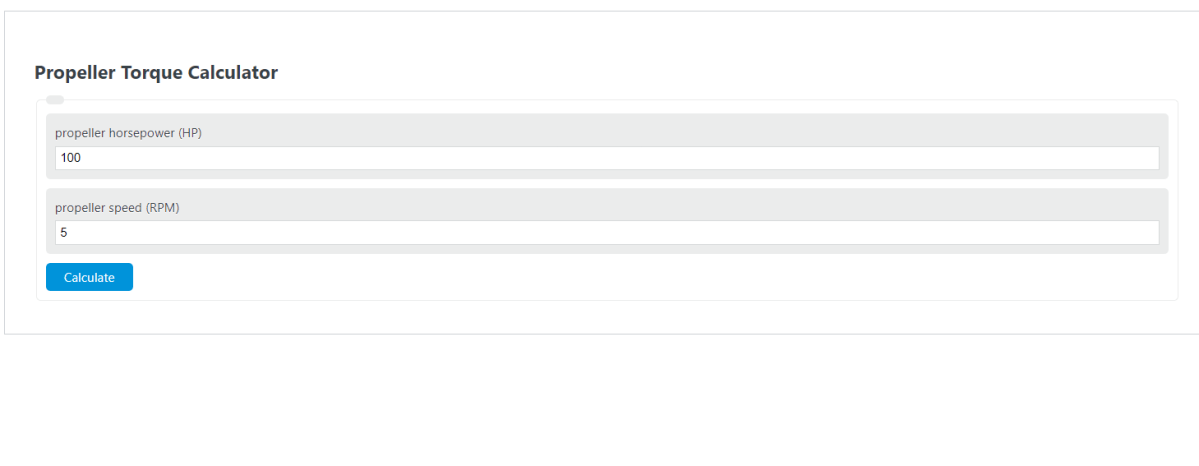
Calculate propeller torque, horsepower, or RPM by entering any two values and get the missing one in HP, kW, lb-ft, or N-m using standard formulas.
- All Torque Calculators
- HP to Torque Calculator
- Frictional Torque Calculator
- Flywheel Torque Calculator
- All Physics Calculators
Propeller Torque Formula
Propeller torque is the twisting force carried by the shaft to turn a propeller. If you know the power delivered to the propeller and the shaft speed, you can estimate torque directly. This is useful for sizing shafts, couplings, gearboxes, bearings, and for checking whether a motor or engine is operating in a reasonable range.
When power is entered in kilowatts and torque is needed in newton-meters, the metric form is:
The constant 5252 comes from the horsepower-to-torque unit conversion. In practical terms, torque increases as power increases and decreases as RPM increases.
| Variable | Meaning | Common Units |
|---|---|---|
| Tp | Propeller shaft torque | lb-ft, N·m |
| HP | Power delivered to the propeller shaft | horsepower |
| kW | Metric power delivered to the propeller shaft | kilowatts |
| RPM | Propeller rotational speed | revolutions per minute |
How to Calculate Propeller Torque
- Determine the actual power reaching the propeller shaft.
- Determine the actual propeller RPM.
- Use the imperial formula if power is in HP and torque is needed in lb-ft.
- Use the metric formula if power is in kW and torque is needed in N·m.
If the system uses a reduction gearbox, use the propeller shaft RPM, not engine RPM. If drivetrain losses are meaningful, use the power that actually reaches the propeller rather than the engine’s advertised output.
Rearranged Forms
The same relationship can be rearranged if you need to solve for power or shaft speed instead of torque:
Unit Conversion
If you need to switch between imperial and metric torque units, use:
Examples
If a propeller shaft delivers 120 HP at 2500 RPM, the torque is:
That same torque in metric units is:
If a propeller system delivers 75 kW at 1800 RPM, the torque is:
Why Propeller Torque Matters
- Shaft sizing: Higher torque means higher torsional stress in the shaft.
- Gearbox selection: Gear reductions change RPM and torque, so shaft-side torque must be checked.
- Motor and engine matching: A drivetrain can have the same power at different combinations of RPM and torque.
- Component protection: Couplings, keys, hubs, and bearings all have torque limits.
Torque vs. Thrust
This calculator estimates mechanical shaft torque. It does not calculate propeller thrust. Torque is the rotational force at the shaft, while thrust is the axial force the propeller produces in air or water. Two propellers can require similar shaft torque while generating different thrust depending on diameter, pitch, blade shape, efficiency, and operating conditions.
Common Input Mistakes
- Using engine RPM instead of propeller RPM when a reduction drive is installed.
- Using rated engine horsepower instead of shaft horsepower delivered to the propeller.
- Mixing HP with N·m or kW with lb-ft without converting units.
- Confusing torque with thrust or assuming they are interchangeable.
Quick Interpretation Tips
- At a fixed power level, lower RPM means higher torque.
- At a fixed RPM, more power means more torque.
- If RPM doubles while power stays the same, torque is cut roughly in half.
Frequently Asked Questions
Should I use motor power or propeller power?
Use the power actually reaching the propeller shaft whenever possible.
Can this be used for marine and aircraft propellers?
Yes. The calculation is based on shaft power and shaft speed, so the same torque relationship applies to any rotating propeller drive.
Why does torque get very large at low RPM?
Because the same amount of power delivered at a lower rotational speed requires more twisting force at the shaft.