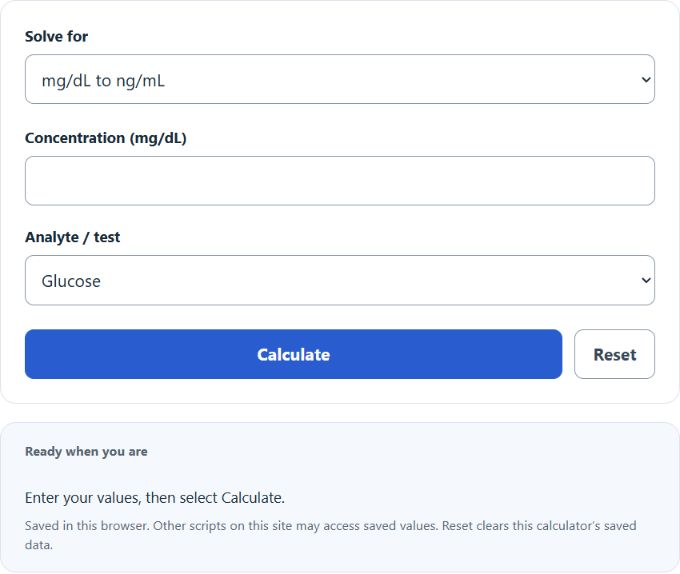
Convert mg/dL to ng/mL for glucose, cholesterol, triglycerides, creatinine, bilirubin, uric acid, and lactate with instant results.
- mEq/L To mg/L Calculator
- Micromolar To ppm Calculator
- cc to mg Converter
- vitamin D IU to mcg Converter
- All Unit Converters
mg/dL to ng/mL Formula
The following formula is used to convert a concentration from milligrams per deciliter to nanograms per milliliter.
The reverse conversion can also be written as:
Variables:
- ng/mL is the concentration in nanograms per milliliter
- mg/dL is the concentration in milligrams per deciliter
- 10,000 is the conversion factor between the two units
To convert mg/dL to ng/mL, multiply the value in mg/dL by 10,000.
What is mg/dL to ng/mL Conversion?
mg/dL and ng/mL are both units of concentration that express mass per volume. The difference is only in the scale of the units being used. A milligram is much larger than a nanogram, and a deciliter is larger than a milliliter, so converting between the two creates a constant multiplier.
This relationship comes from the metric definitions:
- 1 mg = 1,000,000 ng
- 1 dL = 100 mL
- Therefore, 1 mg/dL = 10,000 ng/mL
Because this is a unit conversion rather than a substance-specific formula, the same factor works for glucose, cholesterol, triglycerides, creatinine, bilirubin, uric acid, lactate, and any other analyte reported in these units.
How to Calculate mg/dL to ng/mL?
The following steps outline how to convert mg/dL to ng/mL.
- First, determine the concentration in mg/dL.
- Next, use the conversion factor of 10,000.
- Multiply the mg/dL value by 10,000 to find the equivalent concentration in ng/mL.
- After calculating the result, verify your answer with the calculator above.
mg/dL to ng/mL Conversion Table
The table below lists example conversions using the relationship ng/mL = mg/dL × 10,000.
| Analyte / Test | Example Value (mg/dL) | Equivalent in ng/mL |
|---|---|---|
| Glucose | 90 | 900,000 ng/mL |
| Total Cholesterol | 200 | 2,000,000 ng/mL |
| Triglycerides | 150 | 1,500,000 ng/mL |
| Creatinine | 1.0 | 10,000 ng/mL |
| Total Bilirubin | 1.2 | 12,000 ng/mL |
| Uric Acid | 7.0 | 70,000 ng/mL |
| Lactate | 2.0 | 20,000 ng/mL |
In routine lab reporting, many values are presented in mg/dL, while some research or reference materials use ng/mL. Knowing the factor of 10,000 makes it easy to compare measurements across sources.
Example Problem
Use the following variables as an example problem to test your knowledge.
Concentration = 1.2 mg/dL
Using the formula:
The final answer is 12,000 ng/mL.