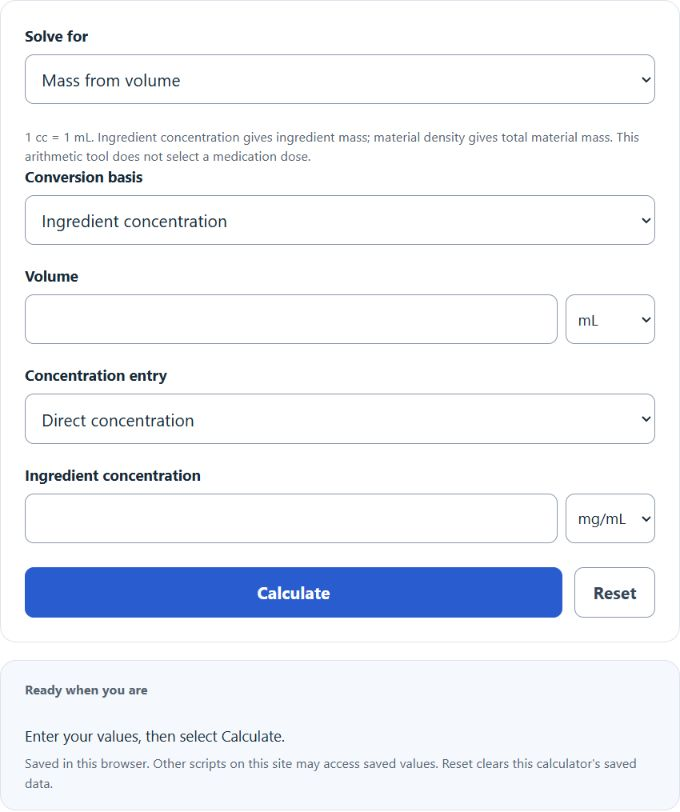
Convert cc or mL to milligrams using medication concentration or material density, or solve for volume, concentration, and density with common metric units.
- cc/rev to in3/rev Converter
- C To Fluid Ounce Calculator
- mEq To mL Calculator
- HCl to molarity Converter
- kg to Cups of Flour Conversion Calculator
- All Unit Converters
CC to mg Formula
The following formula is used to convert cubic centimeters to milligrams for a specific liquid or substance.
Variables:
- mg is the mass in milligrams
- cc is the volume in cubic centimeters
- density is the substance density in mg/cc
For total material mass, multiply volume in cc by material density in mg/cc. For the mass of a dissolved ingredient, multiply volume in mL by that ingredient’s concentration in mg/mL instead. Inverse volume = mass / factor, and factor = mass / volume. A label stating an amount per volume gives concentration = labeled ingredient amount / corresponding volume. Because 1 cc = 1 mL, no volume conversion factor is needed between them.
What is CC to mg Conversion?
CC to mg conversion changes a measurement of volume into a measurement of mass. Since cubic centimeters measure space and milligrams measure weight, the conversion depends on the density of the material being measured. Different liquids produce different results for the same number of cc.
Assuming water density of 1 g/mL, 1 cc has about 1000 mg total mass. This is not a rule for active ingredients in water. For example, a 0.9% sodium chloride product label lists 9 mg sodium chloride per mL; that is ingredient concentration, not total solution density. Verify the actual product label.
- Water: ≈ 1000 mg/cc
- 0.9% sodium chloride: 9 mg sodium chloride per mL (ingredient concentration, not material density)
- Ethanol: ≈ 789 mg/cc
- Olive oil: ≈ 910 mg/cc
- Glycerin: ≈ 1260 mg/cc
How to Convert CC to mg?
The following steps outline how to convert cubic centimeters to milligrams.
- First, determine the volume in cubic centimeters (cc).
- Next, identify the density of the liquid in mg/cc.
- Multiply the volume by the density using the formula mg = cc × density.
- After calculating the result, check your answer with the converter above.
Example Problem :
Use the following variables as an example problem to test your knowledge.
Volume = 5 cc
Liquid = Water
Total water mass ≈ 5 × 1000 = 5000 mg, assuming 1 g/mL density. This does not state the mass of any dissolved ingredient.
CC to mg Conversion Table
The table distinguishes assumed total-liquid densities from ingredient concentration. Whole-liquid values are illustrative approximations and vary with conditions; they must not be used as medication concentrations.
| Material or ingredient basis | Factor (mg/mL) | Mass in 1 mL |
|---|---|---|
| Water | 1000 | 1000 mg |
| Sodium chloride ingredient in labeled 0.9% solution | 9 | 9 mg sodium chloride |
| Ethanol | 789 | 789 mg |
| Olive oil | 910 | 910 mg |
| Glycerin | 1260 | 1260 mg |
Choose the conversion basis before calculating: total material density for whole-material mass, or the exact ingredient concentration for ingredient mass. This arithmetic converter does not determine a safe dose or suitability for administration. Confirm medication instructions, ingredient and units with a clinician or pharmacist.