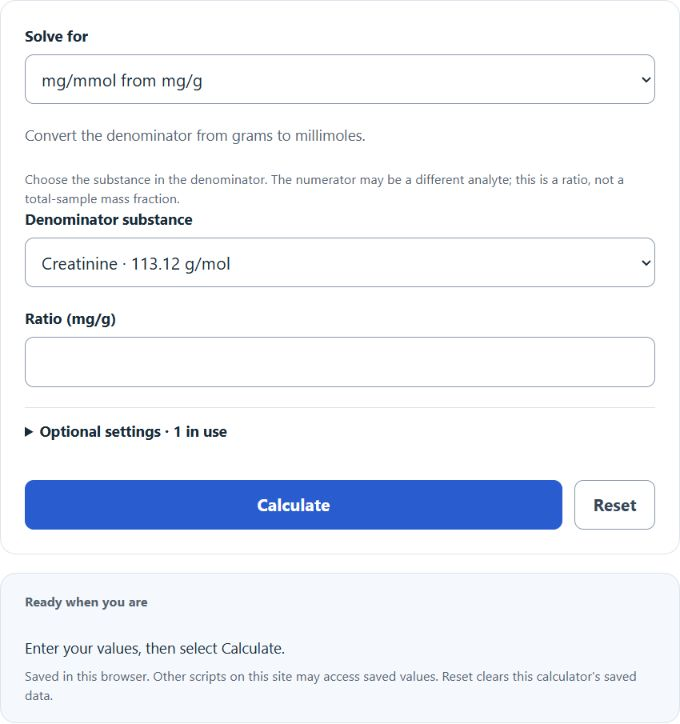
This page shows how to convert milligrams per gram (mg/g) to milligrams per millimole (mg/mmol). Enter a value in mg/g and select the denominator compound or enter a custom molar mass to calculate the equivalent value in mg/mmol.
Quick overview: mg/g to mg/mmol
mg/g means milligrams per gram, while mg/mmol means milligrams per millimole. To convert between them, you need the molar mass of the denominator compound.
- Creatinine (113.12 g/mol): 30 mg/g = 3.3936 mg/mmol
- Glucose (180.16 g/mol): 30 mg/g = 5.4048 mg/mmol
- Urea (60.06 g/mol): 30 mg/g = 1.8018 mg/mmol
- Calcium (40.08 g/mol): 30 mg/g = 1.2024 mg/mmol
A higher molar mass produces a larger mg/mmol value for the same mg/g input.
mg/g to mg/mmol Formula
To convert from milligrams per gram to milligrams per millimole, multiply the mg/g value by the number of grams per millimole of the denominator compound.
If the molar mass is given in g/mol, divide it by 1000 first to convert it to g/mmol. This gives the working formula used in the calculator above:
Variables:
- mg/mmol is the converted value in milligrams per millimole
- mg/g is the starting value in milligrams per gram
- molar mass is the molecular or atomic weight of the denominator compound in g/mol
This conversion is useful whenever results may be reported relative to mass in one context and relative to amount of substance in another. The correct conversion depends entirely on the molar mass used.
What is mg/g to mg/mmol Conversion?
mg/g to mg/mmol conversion is the process of changing a concentration or ratio from a mass-per-mass basis into a mass-per-amount-of-substance basis. Because one gram of a compound does not represent the same number of millimoles for every substance, you must know the compound’s molar mass to make the conversion correctly.
How to Calculate mg/g to mg/mmol?
The following steps outline how to convert mg/g to mg/mmol.
- First, determine the value in mg/g.
- Next, determine the molar mass of the denominator compound in g/mol.
- Then, divide the molar mass by 1000 to convert it to g/mmol.
- Finally, multiply the mg/g value by the g/mmol value to get mg/mmol.
Example Problem:
Convert 30 mg/g to mg/mmol using creatinine as the denominator compound.
mg/g = 30
Molar mass of creatinine = 113.12 g/mol
g/mmol = 113.12 ÷ 1000 = 0.11312 g/mmol
mg/mmol = 30 × 0.11312 = 3.3936 mg/mmol
mg/g to mg/mmol Conversion Table
The table below shows example conversions for a 100 mg/g value using several common denominator compounds.
| Denominator Compound | Molar Mass (g/mol) | 100 mg/g in mg/mmol |
|---|---|---|
| Creatinine | 113.12 | 11.312 mg/mmol |
| Glucose | 180.16 | 18.016 mg/mmol |
| Urea | 60.06 | 6.006 mg/mmol |
| Calcium | 40.08 | 4.008 mg/mmol |
| Cholesterol | 386.65 | 38.665 mg/mmol |
Because the denominator compound changes the factor, the same mg/g value can convert to very different mg/mmol values. Always confirm that the molar mass matches the exact compound or analyte used in your application.