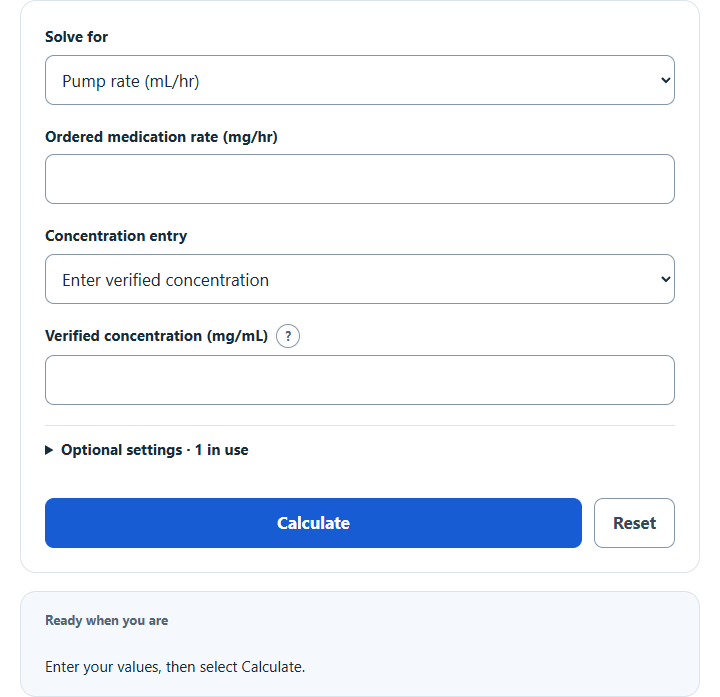
Convert a verified medication rate in mg/hr to pump rate in mL/hr using concentration in mg/mL, or solve for medication rate and solution concentration.
Related Calculators
- Units to mL Calculator (U-100, U-40, + More)
- Therapeutic Index Calculator
- BSA Calculator – Body Surface Area
- Adjusted Body Weight & Ideal Body Weight Calculator
- All Health and Medical Calculators
mg/hr to mL/hr Conversion Formula
The following formula is used to convert a dosage from mg/hr to ml/hr.
Variables:
- Dosage is the prescribed amount of medication in milligrams per hour (mg/hr)
- Concentration is the concentration of the medication in milligrams per milliliter (mg/ml)
To convert a dosage from mg/hr to ml/hr, divide the dosage by the concentration.
| Dose rate (mg/hr) | Volume rate (mL/hr) |
|---|---|
| 0.5 | 0.500 |
| 1 | 1.000 |
| 2 | 2.000 |
| 3 | 3.000 |
| 5 | 5.000 |
| 7.5 | 7.500 |
| 10 | 10.000 |
| 12.5 | 12.500 |
| 15 | 15.000 |
| 20 | 20.000 |
| 25 | 25.000 |
| 30 | 30.000 |
| 40 | 40.000 |
| 50 | 50.000 |
| 60 | 60.000 |
| 75 | 75.000 |
| 100 | 100.000 |
| 150 | 150.000 |
| 200 | 200.000 |
| 250 | 250.000 |
| * Rounded to 3 decimals. Assumes concentration = 1 mg/mL. Formula: mL/hr = (mg/hr) ÷ (mg/mL). Note: 1 mL/hr = 0.001 L/hr. | |
What is Dosage Conversion?
This dimensional conversion translates a verified prescribed medication rate in mg/hr to a calculated volume rate in mL/hr using the verified final concentration in mg/mL. It does not select a dose or establish that administration is appropriate. Confirm the patient, active order/MAR, medication label, units, concentration and pump settings, including the independent check required by facility policy.
How to Calculate Dosage Conversion?
The following steps outline how to calculate the dosage conversion from mg/hr to ml/hr.
- First, determine the prescribed dosage in milligrams per hour (mg/hr).
- Next, determine the concentration of the medication in milligrams per milliliter (mg/ml).
- Use the formula from above to calculate the flow rate in milliliters per hour (ml/hr).
- Finally, independently recalculate and compare the result with the active order, medication label, approved concentration, smart-pump drug library and device increment before programming.
Example Problem :
Use the following variables as an example problem to test your knowledge.
Prescribed dosage (mg/hr) = 50 mg/hr
Medication concentration (mg/ml) = 2 mg/ml