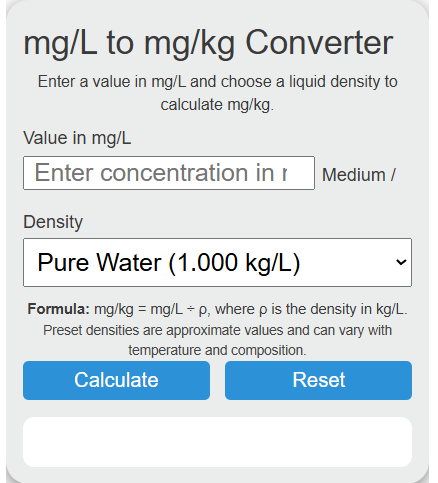
Convert mg/L to mg/kg using liquid density, with presets for water, seawater, milk and other liquids or a custom density selection.
- mg/g to mg/ml Converter
- g/ml to molarity Converter
- ug/ml to ng/ul Converter
- mol/L To kg/m3 Calculator
- All Unit Converters
mg/L to mg/kg Formula
The following formula is used to convert a concentration from milligrams per liter to milligrams per kilogram.
The reverse relationship can also be written as:
Variables:
- mg/kg is the concentration in milligrams per kilogram
- mg/L is the concentration in milligrams per liter
- ρ is the density of the liquid in kilograms per liter
To calculate mg/kg, divide the concentration in mg/L by the density of the solution in kg/L. If the liquid has a density of 1.000 kg/L, such as pure water, the numerical values in mg/L and mg/kg are the same.
What is mg/L to mg/kg Conversion?
Milligrams per liter (mg/L) describes the mass of a substance contained in one liter of a solution, while milligrams per kilogram (mg/kg) describes the mass of that substance per kilogram of the same solution. The relationship between these units depends on density because one liter of liquid does not always weigh exactly one kilogram. For water-based solutions, the values are often very close, but for liquids such as ethanol, oils, or seawater, the difference can be significant.
This type of conversion is commonly used in laboratories, environmental monitoring, toxicology, water quality analysis, and regulatory reporting. A result may be published in mg/L in one source and mg/kg in another, so using the liquid density allows the two measurements to be compared correctly.
How to Convert mg/L to mg/kg?
The following steps outline how to convert mg/L to mg/kg.
- First, determine the concentration in milligrams per liter (mg/L).
- Next, determine the density of the liquid in kilograms per liter (kg/L).
- Divide the mg/L value by the density using the formula mg/kg = mg/L ÷ ρ.
- Check your answer with the calculator above.
Example Problem:
Use the following values as an example problem to test your understanding.
Concentration = 100 mg/L
Density = 1.025 kg/L
mg/kg = 100 ÷ 1.025 = 97.56 mg/kg
mg/L to mg/kg Conversion Table
The table below shows how a concentration of 100 mg/L converts to mg/kg for several common liquids.
| Medium | Density ρ (kg/L) | 100 mg/L in mg/kg |
|---|---|---|
| Pure Water | 1.000 | 100.00 mg/kg |
| Seawater | 1.025 | 97.56 mg/kg |
| Ethanol | 0.789 | 126.74 mg/kg |
| Vegetable Oil | 0.910 | 109.89 mg/kg |
| Whole Blood | 1.060 | 94.34 mg/kg |
For pure water, 1 liter weighs approximately 1 kilogram, so mg/L and mg/kg are numerically equal. For denser liquids such as seawater or blood, the mg/kg value is slightly lower than the mg/L value. For lighter liquids such as ethanol or oil, the mg/kg value becomes larger because one liter weighs less than one kilogram.
Understanding this density-based relationship helps ensure accurate interpretation of concentration values across scientific, environmental, and industrial applications.