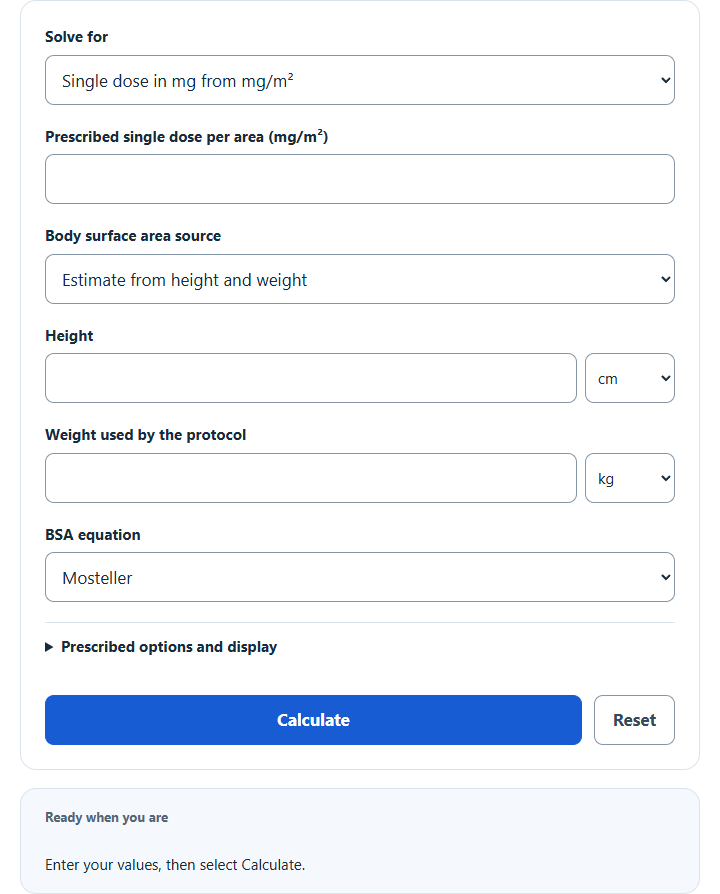
Convert an mg/m² dose to mg using body surface area from height and weight, or a mg dose to mg/m² and mg/kg. Always verify doses with a clinician.
- All Health and Medical Calculators
- mg to Tablets Calculator
- mmol/L to mg/dL Calculator
- BSA Calculator (Body Surface Area)
- DuBois Formula Calculator
- mg to mL Calculator
- Medication Days Supply Calculator
- mg per kg Calculator
Calculator Functions
| Function | What it does | What it requires |
|---|---|---|
| Single dose in mg from mg/m² | Converts a dose prescribed in mg/m² to the single dose in mg for one patient | Requires the prescribed dose per area in mg/m², plus either the height and weight or a known body surface area |
| Dose per area from a known mg dose | Converts a single dose in mg to the dose per area in mg/m² | Requires the known dose in mg, plus either the height and weight or a known body surface area |
| Estimate body surface area | Estimates body surface area with the Mosteller, Du Bois, Haycock or Gehan–George equation and compares all four | Requires the height in cm or in, the weight in kg or lb, and the equation |
Height and weight can be entered in centimeters or inches and in kilograms or pounds. The two dose functions have an optional BSA cap, for protocols that set one, and Single dose in mg from mg/m² can also multiply the dose by a number of equal doses. When height and weight are entered, the result also shows the dose as mg/kg for that patient.
mg/m² Dose Formulas
| Dose | Single dose (mg) |
| D | Prescribed dose per area (mg/m²) |
| BSA | Body surface area (m²) |
Single dose in mg from mg/m²
The dose per area is multiplied by the body surface area. A dose of 375 mg/m² for a BSA of 1.8 m² is 375 × 1.8 = 675 mg. When a BSA cap is entered, the smaller of the cap and the patient’s BSA is used. With a number of equal doses, the single dose is multiplied by that number.
The mg/kg figure in the result is the single dose divided by the weight entered. It applies to that patient only. There is no fixed factor between mg/m² and mg/kg, because the ratio of surface area to weight changes with body size.
Dose per area from a known mg dose
A 50 mg dose for a patient 170 cm tall weighing 60 kg, with a Mosteller BSA of 1.6833 m², is 50 ÷ 1.6833 = 29.70 mg/m².
Estimate body surface area
H is the height in centimeters and W is the weight in kilograms. Each equation returns square meters [1].
BSA = √(H × W ÷ 3,600)
BSA = 0.007184 ×
H0.725 × W0.425
BSA = 0.0235 ×
H0.42246 × W0.51456
For 170 cm and 60 kg the four give 1.68, 1.69, 1.68 and 1.69 m². The Haycock equation was fitted to measurements of 81 people from premature infants to adults [3].
What Does mg/m² Mean?
mg/m² is milligrams of drug for each square meter of body surface area. A dose written this way is not the amount to give. It becomes an amount in milligrams only when it is multiplied by the patient’s BSA, so 100 mg/m² is 150 mg for a BSA of 1.5 m² and 200 mg for a BSA of 2.0 m². Chemotherapy doses are commonly set this way. BSA cannot be measured directly and is estimated from height and weight with one of the equations above [2].
How to Calculate an mg/m² Dose
First estimate the BSA from height and weight, then multiply it by the dose per area. For a patient 170 cm tall weighing 60 kg, the Mosteller BSA is √(170 × 60 ÷ 3,600) = 1.6833 m². At 50 mg/m² the single dose is 50 × 1.6833 = 84.16 mg.
Limits of This Estimate
- The result is arithmetic, not a prescription. It leaves out drug-specific dose limits, kidney and liver function, toxicity, dose rounding and the treatment schedule.
- The equations agree closely for an average build and differ significantly above a body mass index of 30, where Du Bois and Mosteller give lower values than the others. One study recommends that an institution use a single equation throughout [2].
- The treatment protocol decides which equation, which weight and whether a BSA cap applies. The cap is used only when one is entered.
Sources
- Hepatobiliary Surgery and Nutrition (2014), Potential use of Doppler perfusion index in detection of occult liver metastases from colorectal cancer, Table 2: the Du Bois, Gehan–George, Haycock and Mosteller equations with their constants
- Faisal et al., Journal of Global Oncology (2016), Not All Body Surface Area Formulas Are the Same, but Does It Matter?: BSA-based chemotherapy dosing and how the equations differ
- Haycock, Schwartz and Wisotsky, The Journal of Pediatrics (1978), abstract: the Haycock equation and the people it was fitted to