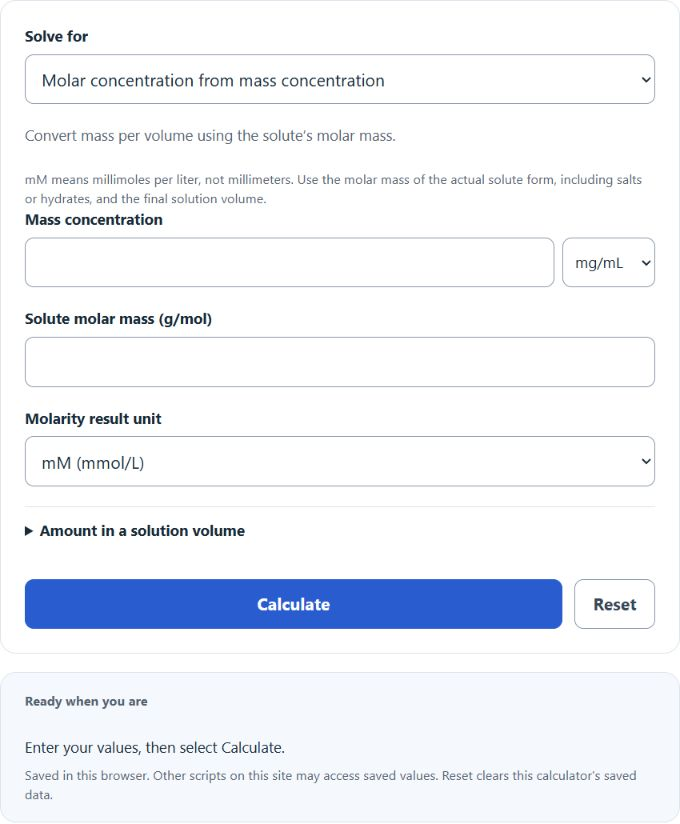
Convert mg/ml or g/L to mM or µM using molecular weight, or calculate the missing concentration, molarity, or MW from any two values.
| mg/mL to mM | mM to mg/mL |
|---|---|
| 0.05 mg/mL = 0.856 mM | 1 mM = 0.05844 mg/mL |
| 0.1 mg/mL = 1.711 mM | 2 mM = 0.11688 mg/mL |
| 0.25 mg/mL = 4.278 mM | 5 mM = 0.2922 mg/mL |
| 0.5 mg/mL = 8.556 mM | 10 mM = 0.5844 mg/mL |
| 1 mg/mL = 17.112 mM | 20 mM = 1.1688 mg/mL |
| 2 mg/mL = 34.223 mM | 25 mM = 1.461 mg/mL |
| 5 mg/mL = 85.558 mM | 50 mM = 2.922 mg/mL |
| 10 mg/mL = 171.116 mM | 100 mM = 5.844 mg/mL |
| 20 mg/mL = 342.231 mM | 200 mM = 11.688 mg/mL |
| 50 mg/mL = 855.578 mM | 500 mM = 29.22 mg/mL |
| Formulas: mM = (mg/mL x 1000) / MW and mg/mL = (mM x MW) / 1000. | |
| mg/mL to mM | mM to mg/mL |
|---|---|
| 0.05 mg/mL = 0.278 mM | 1 mM = 0.18016 mg/mL |
| 0.1 mg/mL = 0.555 mM | 2 mM = 0.36032 mg/mL |
| 0.25 mg/mL = 1.388 mM | 5 mM = 0.9008 mg/mL |
| 0.5 mg/mL = 2.775 mM | 10 mM = 1.8016 mg/mL |
| 1 mg/mL = 5.551 mM | 20 mM = 3.6032 mg/mL |
| 2 mg/mL = 11.101 mM | 25 mM = 4.504 mg/mL |
| 5 mg/mL = 27.753 mM | 50 mM = 9.008 mg/mL |
| 10 mg/mL = 55.506 mM | 100 mM = 18.016 mg/mL |
| 20 mg/mL = 111.012 mM | 200 mM = 36.032 mg/mL |
| 50 mg/mL = 277.531 mM | 500 mM = 90.08 mg/mL |
| Formulas: mM = (mg/mL x 1000) / MW and mg/mL = (mM x MW) / 1000. | |
| Compound | Formula | MW (g/mol) | 1 mg/mL = |
|---|---|---|---|
| Sodium chloride | NaCl | 58.44 | 17.11 mM |
| Potassium chloride | KCl | 74.55 | 13.41 mM |
| Calcium chloride | CaCl2 | 110.98 | 9.01 mM |
| Tris base | C4H11NO3 | 121.14 | 8.25 mM |
| Glucose | C6H12O6 | 180.16 | 5.55 mM |
| Sucrose | C12H22O11 | 342.30 | 2.92 mM |
| HEPES | C8H18N2O4S | 238.30 | 4.20 mM |
| EDTA (disodium, dihydrate) | C10H14N2Na2O8 · 2H2O | 372.24 | 2.69 mM |
| DMSO | (CH3)2SO | 78.13 | 12.80 mM |
| SDS | C12H25NaO4S | 288.38 | 3.47 mM |
| Urea | CH4N2O | 60.06 | 16.65 mM |
| BSA | Protein | 66,463 | 0.015 mM |
| IgG antibody (typical) | Protein | ~150,000 | 0.0067 mM |
| All rows use mM = 1000/M for 1 mg/mL, with molar mass M in g/mol. Protein molar masses are illustrative averages. Molecular mass in Da is numerically approximately the molar mass in g/mol for routine laboratory use; these are different physical quantities and not identical units. | |||
- All Unit Converters
- M to mg/mL Calculator
- mM to mg/mL Calculator
- mg/mL to Molarity Calculator
- Molarity Calculator
- Molarity to Moles Calculator
- Weight to Molarity Converter
mg/mL to mM Conversion Formula
The core formula for converting a mass concentration (mg/mL) to a molar concentration (mM) is:
Here c_mM is concentration in mM (mmol/L), c_mass is mass concentration in mg/mL (numerically g/L), and M is molar mass in g/mol. The factor 1000 converts mol/L to mmol/L. The capital M used as a molarity unit means mol/L; mM is not the length unit mm.
To reverse the calculation, rearrange the formula: mg/mL = (mM x MW) / 1000. This form is useful when a protocol specifies a molar concentration and you need to weigh out a mass of compound.
Why This Conversion Matters in the Lab
Reagent suppliers typically list concentrations in mg/mL because it reflects what was physically weighed and dissolved. Biological assays, on the other hand, report working concentrations in mM (or uM) because cellular responses depend on the number of molecules present, not their mass. Converting between the two is a daily task in any wet lab.
Stock solution preparation is the most common use case. If a protocol calls for a 10 mM working concentration of a compound, you need to know the solute mass per milliliter of final solution. The molecular weight of the compound bridges the gap between mass and moles. For small molecules (MW under ~500 g/mol), a 1 mg/mL solution yields a relatively high mM value. For proteins and large biomolecules (MW in the tens of thousands), the same 1 mg/mL solution corresponds to a very low mM concentration, often in the micromolar range.
Molar Concentration Unit Scale
Molar concentration units span a wide range. Understanding where mM sits in this hierarchy helps prevent unit errors when reading protocols or papers:
| Unit | Symbol | Relative to 1 M | Typical Use |
|---|---|---|---|
| Molar | M | 1 | Stock solutions, strong acids/bases |
| Millimolar | mM | 10^-3 | Buffers, salts, small molecule reagents |
| Micromolar | uM | 10^-6 | Drug compounds, enzyme substrates |
| Nanomolar | nM | 10^-9 | Antibodies, high-affinity ligands |
| Picomolar | pM | 10^-12 | Trace analytes and very dilute solutions |
Common Conversion Pitfalls
Using Da vs. kDa without adjusting. Protein molecular weights are often listed in kilodaltons (kDa). A 66.5 kDa protein has a MW of 66,500 g/mol. Plugging in 66.5 instead of 66,500 produces a result that is off by a factor of 1,000.
Confusing mg/mL with ug/mL. A concentration listed as 500 ug/mL is 0.5 mg/mL. Forgetting to convert micrograms to milligrams before applying the formula produces a 1,000-fold error in the final mM value.
Ignoring salt or hydrate forms. Many lab chemicals are sold as hydrates (e.g., CaCl2 * 2H2O, MW 147.01) or as sodium/potassium salts. The molecular weight on the bottle label, not the anhydrous MW from a textbook, is the correct value to use in the conversion.
Assuming mg/mL equals mM. These two units are only numerically equal when the molecular weight happens to be exactly 1,000 g/mol. For all other compounds, they differ, sometimes by orders of magnitude.
Worked Example
Problem: A final solution volume of 1 mL contains 5 mg of HEPES (molar mass 238.30 g/mol). What is its molar concentration in mM?
Solution: mM = (5 mg/mL ÷ 238.30 g/mol) × 1000 ≈ 20.98195552 mM, or 20.98 mM at two decimal places.
Reverse check: Using the full-precision concentration recovers 5 mg/mL. Substituting the rounded 20.98 mM gives 4.999534 mg/mL, which rounds to 5.00; it is an approximate check. Sources: IUPAC amount concentration and NIST SI prefixes. Molar mass can also be inferred from positive matching concentrations as 1000 × (mg/mL) ÷ mM; two zeros do not determine a unique molar mass.