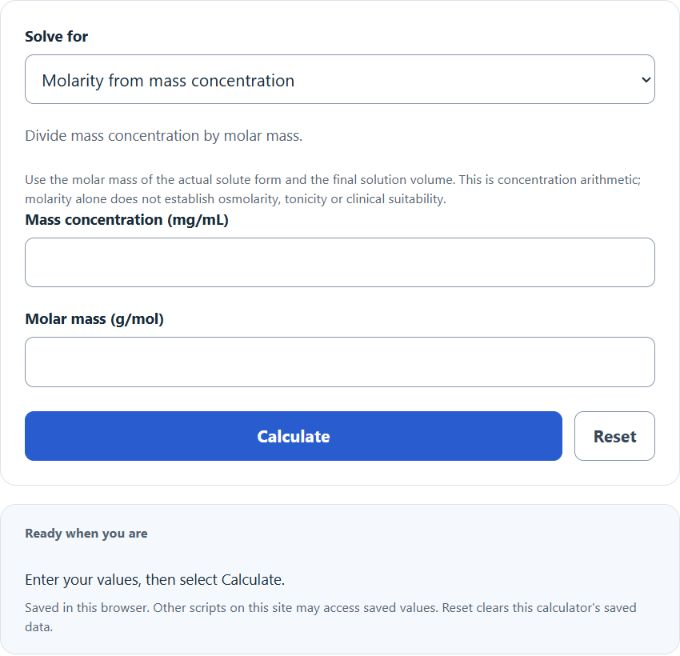
Calculate molarity from concentration in mg/mL and molecular weight, or solve for concentration or molecular weight in common chemistry units.
- All Chemistry Calculators
- All Medical and Health Unit Converters
- mg/mL To mM Calculator
- M To mg/mL Calculator
- ml to mg
| mg/mL to mol/L (M) | mol/L (M) to mg/mL |
|---|---|
| 0.1 mg/mL = 0.001711 M | 0.01 M = 0.5844 mg/mL |
| 0.25 mg/mL = 0.004278 M | 0.05 M = 2.922 mg/mL |
| 0.5 mg/mL = 0.008556 M | 0.1 M = 5.844 mg/mL |
| 1 mg/mL = 0.01711 M | 0.15 M = 8.766 mg/mL |
| 2 mg/mL = 0.03422 M | 0.2 M = 11.688 mg/mL |
| 3 mg/mL = 0.05133 M | 0.25 M = 14.61 mg/mL |
| 5 mg/mL = 0.08556 M | 0.3 M = 17.532 mg/mL |
| 10 mg/mL = 0.1711 M | 0.5 M = 29.22 mg/mL |
| 20 mg/mL = 0.3422 M | 1 M = 58.44 mg/mL |
| 50 mg/mL = 0.8556 M | 2 M = 116.88 mg/mL |
| Formula: M (mol/L) = (mg/mL) ÷ (MW in g/mol). Reverse: mg/mL = M × MW. (Note: mg/mL is numerically equal to g/L.) | |
| mg/mL to mol/L (M) | mol/L (M) to mg/mL |
|---|---|
| 0.1 mg/mL = 0.000555 M | 0.001 M = 0.18016 mg/mL |
| 0.5 mg/mL = 0.002775 M | 0.01 M = 1.8016 mg/mL |
| 1 mg/mL = 0.00555 M | 0.05 M = 9.008 mg/mL |
| 2.5 mg/mL = 0.01388 M | 0.1 M = 18.016 mg/mL |
| 5 mg/mL = 0.02775 M | 0.25 M = 45.04 mg/mL |
| 10 mg/mL = 0.0555 M | 0.5 M = 90.08 mg/mL |
| 25 mg/mL = 0.1388 M | 0.75 M = 135.12 mg/mL |
| 50 mg/mL = 0.2775 M | 1 M = 180.16 mg/mL |
| 100 mg/mL = 0.555 M | 2 M = 360.32 mg/mL |
| 200 mg/mL = 1.11 M | 5 M = 900.8 mg/mL |
| Formula: M (mol/L) = (mg/mL) ÷ (MW in g/mol). Reverse: mg/mL = M × MW. (Note: mg/mL is numerically equal to g/L.) | |
mg/mL to Molarity Formula
The core formula for converting mg/mL to molarity:
Where M is molarity in mol/L, C is concentration in mg/mL, and MW is molecular weight in g/mol. This works without any conversion factor because 1 mg/mL is numerically identical to 1 g/L. Dividing g/L by g/mol yields mol/L directly.
To reverse the calculation (molarity to mg/mL): mg/mL = M x MW.
When to Use mg/mL vs. Molarity
Concentration in mg/mL (a gravimetric unit) is measured by weighing on a balance. It appears on drug labels, IV bags, protein stock solutions, and clinical lab reports because mass is what you physically dispense. Molarity is the amount of the specified solute, in moles, per liter of final solution. Reaction stoichiometry, equilibrium constants, enzyme kinetics (Km, Vmax), and buffer recipes all require molar concentrations because chemical reactions proceed molecule-to-molecule, not gram-to-gram.
In practice, pharmaceutical compounding uses mg/mL; analytical chemistry and biochemistry use molarity. The conversion between the two always requires the molecular weight of the solute.
Molecular Weights of Common Laboratory Compounds
Reference table of frequently encountered compounds. The rightmost column shows molarity at a mass concentration of 1 mg/mL in the final solution. Match the stated salt or hydrate form; protein molar masses are approximate. The glycine average molar mass is 75.07 g/mol (PubChem).
| Compound | MW (g/mol) | 1 mg/mL = |
|---|---|---|
| Sodium chloride (NaCl) | 58.44 | 17.11 mM |
| Glucose | 180.16 | 5.551 mM |
| Sucrose | 342.30 | 2.921 mM |
| Tris base | 121.14 | 8.255 mM |
| EDTA disodium dihydrate | 372.24 | 2.686 mM |
| HEPES | 238.30 | 4.196 mM |
| Potassium chloride (KCl) | 74.55 | 13.41 mM |
| Calcium chloride (anhydrous) | 110.98 | 9.011 mM |
| Sodium hydroxide (NaOH) | 40.00 | 25.00 mM |
| Urea | 60.06 | 16.65 mM |
| Glycine | 75.07 | 13.32 mM |
| BSA (bovine serum albumin) | ~66,430 | ~15.05 uM |
| Insulin (human) | ~5,808 | ~172.2 uM |
| ATP disodium salt | 551.14 | 1.814 mM |
| Caffeine | 194.19 | 5.150 mM |
| Sodium bicarbonate | 84.01 | 11.90 mM |
| DMSO | 78.13 | 12.80 mM |
| Magnesium sulfate (anhydrous) | 120.37 | 8.308 mM |
| SDS (sodium dodecyl sulfate) | 288.38 | 3.468 mM |
| Ammonium sulfate | 132.14 | 7.568 mM |
Worked Examples
Example 1: Physiological saline. Normal saline (0.9% NaCl) is 9 mg/mL. MW of NaCl = 58.44 g/mol. Molarity = 9 / 58.44 = 0.1540 M (154.0 mM). This is the isotonic concentration used in IV fluids and cell culture media.
Example 2: Check the labeled dextrose form. The cited 5% Dextrose Injection label specifies 50 mg/mL dextrose hydrous (monohydrate), with molar mass 198.17 g/mol. Its molarity is 50 / 198.17 ≈ 0.252308624 M (252.308624 mM). A hypothetical 50 mg/mL anhydrous glucose solution using 180.16 g/mol instead gives ≈ 0.277531083 M. Match the actual labeled form and reporting basis. Molarity alone does not establish osmolarity, tonicity or clinical suitability.
Example 3: BSA in a binding assay. A 2 mg/mL BSA solution (MW ~66,430 g/mol): Molarity = 2 / 66,430 = 0.0000301 M = 30.1 uM. Protein concentrations are typically reported in mg/mL because their molecular weights are large and often approximate.
Common Conversion Pitfalls
Confusing mg/mL with mg/L. These differ by a factor of 1,000. A value of 1 mg/mL equals 1,000 mg/L equals 1 g/L. If your source concentration is in mg/L (sometimes written as ppm in dilute aqueous solutions), divide by 1,000 first, or equivalently, divide by MW and then by 1,000.
Using kDa directly as g/mol. Protein molecular masses are often reported in kilodaltons. For routine calculations, a molecular mass in kDa multiplied by 1,000 is numerically approximately the molar mass in g/mol; 66.4 kDa corresponds to approximately 66,400 g/mol. Molecular mass and molar mass are different quantities, so this is not an exact identity of units. Enter the specified molar mass in g/mol in this calculator. See the SI mole definition.
Hydrated vs. anhydrous forms. For hydrated salts (e.g., CaCl2 * 2H2O at 147.01 g/mol vs. anhydrous CaCl2 at 110.98 g/mol), always use the molecular weight of the form you actually weighed out. The size and direction of the error depend on the actual forms and the concentration reporting basis.