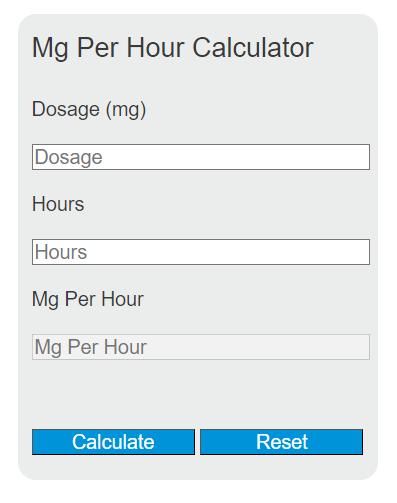
Calculate mg per hour, total mass, or time using mcg, mg, g, minutes, hours, and days; add a labeled concentration to convert mg/h to mL/h.
- All Health and Medical Calculators
- mL Per Dose Calculator
- Price Per mg Calculator
- mg/m² Dose Calculator
mg Per Hour Formula
The mg per hour rate expresses how many milligrams of a medication are delivered each hour. This calculator is useful when you know any two of the three core values: total dose, administration time, or hourly rate.
Rearranged Formulas
If you need to solve for a different variable, use the equivalent forms below.
| Unknown Value | Formula |
|---|---|
| Hourly rate | mg / h = (Dose (mg)) / (Hours) |
| Total dose | Dose (mg) = mg / h × Hours |
| Administration time | Hours = (Dose (mg)) / (mg / h) |
How to Calculate mg Per Hour
- Identify the total amount of medication in milligrams.
- Identify the total administration time in hours.
- Divide the total dose by the number of hours.
- Interpret the result as a mass delivery rate in mg/h.
This means a larger dose increases the mg/h rate, while a longer administration time decreases it.
Example
If a patient receives 600 mg over 12 hours, the hourly rate is:
The medication is being delivered at 50 mg/h.
Time and Unit Conversions
Accurate unit conversion matters. A correct calculation depends on having dose in milligrams and time in hours before interpreting the final rate.
| Conversion | Formula |
|---|---|
| Minutes to hours | Hours = (Minutes) / (60) |
| Grams to milligrams | mg = g × 1000 |
| Kilograms to milligrams | mg = kg × 1,000,000 |
| Convert mass rate to volume rate when concentration is known | mL / h = (mg / h) / (mg / mL) |
What the Calculator Tells You
- mg/h is a mass-based administration rate.
- It does not by itself tell you the volume rate unless concentration is also known.
- It can be used to check whether a total dose is being spread over the intended time interval.
- It is especially helpful for comparing different infusion durations for the same total dose.
Common Input Mistakes
- Entering minutes as if they were hours.
- Mixing up mg and mL.
- Using grams or kilograms without converting the dose properly.
- Using the wrong time interval for the ordered dose.
- Rounding too early before finishing the calculation.
Practical Interpretation
A rate in mg/h answers a simple question: how much drug mass is delivered each hour? If the total dose stays the same and the infusion time is shortened, the mg/h value rises. If the same dose is delivered over a longer time, the mg/h value falls. That makes mg/h a helpful way to compare dosing schedules and verify rate calculations.
Quick Reference
| If You Know | You Can Find | Use |
|---|---|---|
| Total dose and time | Hourly rate | mg / h = (Dose (mg)) / (Hours) |
| Hourly rate and time | Total dose | Dose (mg) = mg / h × Hours |
| Total dose and hourly rate | Time required | Hours = (Dose (mg)) / (mg / h) |
This calculator is best used as a fast arithmetic check for dose-rate relationships, especially when switching between total dose, rate, and infusion time.