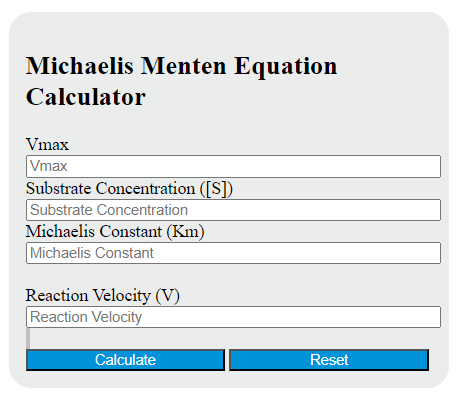
Calculate Michaelis-Menten reaction velocity from Vmax, Km, and substrate concentration [S], with results shown as a velocity and % of Vmax.
Michaelis-Menten Equation Formula
The Michaelis-Menten equation describes how the initial velocity of an enzyme-catalyzed reaction changes as substrate concentration increases. This calculator is useful when you want to solve for reaction velocity (V), maximum velocity (Vmax), Michaelis constant (Km), or substrate concentration ([S]) from the other three known values.
In enzyme kinetics, the equation captures a common saturation pattern: the rate rises quickly at low substrate concentration and then gradually levels off as the enzyme approaches its maximum catalytic capacity.
Variable Definitions
| Variable | Meaning | Typical Units | Interpretation |
|---|---|---|---|
| V | Reaction velocity | µM/s, mM/s, M/s, or similar rate units | The observed reaction rate at a given substrate concentration |
| Vmax | Maximum reaction velocity | Same rate units as V | The limiting rate reached when the enzyme is saturated with substrate |
| Km | Michaelis constant | Same concentration units as [S] | The substrate concentration at which the reaction runs at half of Vmax |
| [S] | Substrate concentration | µM, mM, M, or similar concentration units | The amount of substrate available to the enzyme |
Key Relationships
Several important enzyme-kinetics ideas fall directly out of the Michaelis-Menten model:
At half-maximal velocity:
Fraction of maximum velocity:
Low-substrate region: when substrate concentration is much smaller than Km, the rate is nearly proportional to [S].
High-substrate region: when substrate concentration is much larger than Km, the enzyme becomes saturated and the rate approaches its maximum.
Rearranged Forms
Because this calculator can solve for any one missing variable, the Michaelis-Menten equation can be rearranged as follows.
Solve for maximum velocity:
Solve for Michaelis constant:
Solve for substrate concentration:
For physically meaningful results, all quantities should be positive, [S] and Km must use the same concentration units, and V must be less than Vmax when solving for [S].
How to Use the Calculator
- Enter any three known values: V, Vmax, Km, and [S].
- Use matching units for [S] and Km.
- Use matching rate units for V and Vmax.
- Calculate the missing variable and interpret whether the enzyme is operating far below saturation, near half-saturation, or close to Vmax.
Example
If the maximum velocity is 50 µM/s, the substrate concentration is 10 mM, and the Michaelis constant is 5 mM, then the reaction velocity is:
So the reaction is proceeding at 33.33 µM/s. In this case, the enzyme is operating at about two-thirds of its maximum rate, which indicates substantial but not complete substrate saturation.
How to Interpret the Result
- Low Km: less substrate is needed to reach half of Vmax, which usually indicates stronger effective binding between enzyme and substrate.
- High Km: more substrate is needed before the enzyme reaches the same relative rate.
- V near Vmax: adding more substrate will have only a small effect on rate because the enzyme is already close to saturation.
- V much smaller than Vmax: the enzyme is operating in a substrate-limited region where rate is still sensitive to changes in [S].
Assumptions and Limitations
The Michaelis-Menten equation is a simplified model, so results are most reliable when the underlying assumptions are reasonably satisfied:
- The reaction is measured using initial velocity, before substantial product accumulates.
- The enzyme follows single-substrate, non-cooperative behavior.
- Substrate concentration is much larger than total enzyme concentration.
- Conditions such as pH, temperature, and ionic strength remain constant during measurement.
- The model does not directly account for allosteric regulation, substrate inhibition, product inhibition, or multi-substrate mechanisms.
Common Input Checks
- If [S] and Km use different concentration units, the result will be incorrect.
- If V is greater than Vmax, the inputs are not consistent with the model.
- If any entered value is negative, the result has no physical meaning in standard enzyme kinetics.
- If [S] is extremely large compared with Km, expect the answer for V to be very close to Vmax.