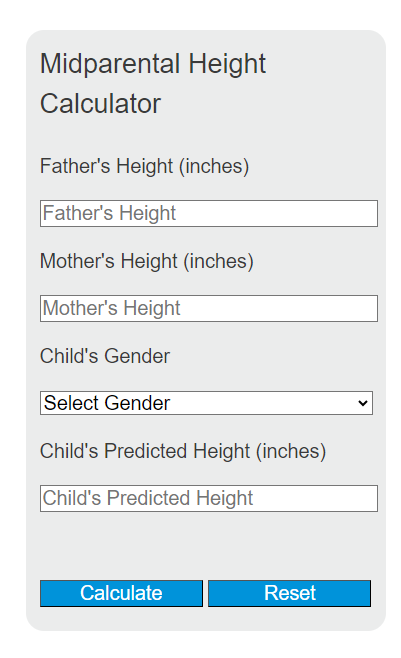
Calculate a child’s target adult height from the father’s and mother’s heights plus the child’s sex, with the expected 3rd to 97th percentile range.
Midparental Height Formula
Midparental height is a quick way to estimate a child’s likely adult height from parental height. It is best treated as a family-based target height, not an exact forecast. The calculator is most useful for understanding whether a child’s growth is broadly consistent with the family’s overall height pattern.
Standard Midparental Height Equations
| Child | Imperial Formula | Metric Formula |
|---|---|---|
| Boy |
MPH = (F + M + 5) / (2) in |
MPH = (F + M + 13) / (2) cm |
| Girl |
MPH = (F + M - 5) / (2) in |
MPH = (F + M - 13) / (2) cm |
F = father’s height and M = mother’s height. If you calculate manually, keep both parent heights in the same unit before applying the formula.
What This Calculator Does
This calculator estimates adult height by averaging parental height and then applying a sex-based adjustment. That makes it useful for:
- estimating a child’s expected adult height range center,
- comparing projected growth with family height patterns,
- checking whether a result appears reasonably aligned with parental stature, and
- supporting conversations about growth trends, bone age, and development.
How to Use the Midparental Height Calculator
- Enter the father’s height.
- Enter the mother’s height.
- Select the child’s sex.
- Read the predicted adult height in inches, centimeters, meters, or feet.
For the most reliable estimate, use measured heights rather than rounded guesses. Even a small error in either parent’s height can shift the final result.
Examples
Boy example: father = 72 in, mother = 64 in.
Girl example: father = 180 cm, mother = 165 cm.
How to Interpret the Result
- It is an estimate, not a guarantee. Final adult height can end up above or below the calculated value.
- It is a midpoint target. The number is best used as a central expectation based on family height.
- Trend matters more than one number. A child’s long-term growth curve is more informative than a single prediction.
What the Formula Includes and Excludes
| Category | Included? | Details |
|---|---|---|
| Parental height | Yes | The estimate is built directly from the father’s and mother’s heights. |
| Sex-based adjustment | Yes | The formula adjusts the average to reflect whether the child is male or female. |
| Nutrition and health | No | Long-term nutrition, chronic illness, and overall health can influence final height. |
| Puberty timing | No | Early or late puberty can affect growth tempo and final adult stature. |
| Individual genetic variation | No | Siblings can differ because each child inherits a different mix of height-related genes. |
Why Actual Adult Height Can Differ
- Genetics: parental height explains part of growth potential, but not every inherited factor.
- Pubertal timing: children who mature earlier or later may follow different growth paths.
- Medical factors: endocrine conditions, chronic disease, and some medications can affect growth.
- Measurement quality: inaccurate parent heights create inaccurate predictions.
- Environment: sleep, nutrition, and general childhood health also matter.
Best Practices When Using This Calculator
- Measure adult heights without shoes.
- Use the same unit system if calculating by hand.
- Double-check unusually high or unusually low entries before interpreting the answer.
- Use the result as one part of a broader growth assessment, not as a standalone diagnosis.
Common Questions
- Is midparental height exact?
- No. It is a screening estimate designed to summarize likely adult height potential based on parental stature.
- Does the unit matter?
- No. Inches, centimeters, meters, and feet can all be used as long as the calculation is done consistently.
- Can siblings have different predicted adult heights?
- Yes. Children with the same parents may still finish at noticeably different adult heights.
- When should the result be interpreted cautiously?
- Use extra caution when parental heights are uncertain or when a child has atypical growth, very early or late puberty, or a significant medical history that may affect growth.