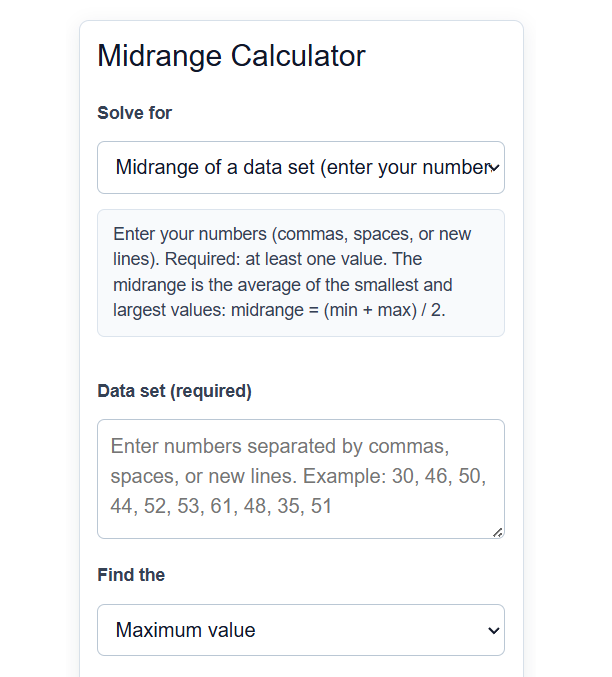
Calculate the midrange of any data set by averaging its maximum and minimum values, or solve for a missing max or min from a known midrange.
Midrange Formula
The midrange is the average of the highest and lowest values in a data set. It is found with a single formula:
Midrange = (Max + Min) / 2
If you already know the midrange and one extreme value, you can rearrange the same formula to solve for the missing maximum or minimum:
Max = (2 * Midrange) - Min
Min = (2 * Midrange) - Max
- Midrange is the midpoint between the largest and smallest numbers, expressed in the same units as your data.
- Max is the largest value in the data set.
- Min is the smallest value in the data set.
The calculator works in two ways. In data set mode you paste your numbers and it scans them to find the maximum and minimum, then applies (Max + Min) / 2 to return the midrange. Only the two extreme values affect the result, so every value in between is ignored. In missing value mode you supply a known midrange and one extreme, and the calculator solves the rearranged formula above to recover the value you are missing. The optional extended statistics toggle also reports the mean, median, mode, range, and sum so you can compare the midrange against the other common measures of center.
Midrange Compared to Other Measures of Center
The midrange is one of several ways to describe the center of a data set. The table below shows how it differs from the mean and median and when each is most useful.
| Measure | How it is found | Sensitive to outliers? |
|---|---|---|
| Midrange | Average of the max and min | Very, it uses only the extremes |
| Mean | Sum of all values divided by the count | Yes, but less than the midrange |
| Median | Middle value when the data is sorted | No, it resists outliers |
The next table shows worked midrange values for a few sample data sets so you can see the formula in action.
| Data set | Min | Max | Midrange |
|---|---|---|---|
| 2, 5, 9, 11 | 2 | 11 | 6.5 |
| 30, 46, 50, 61, 35 | 30 | 61 | 45.5 |
| -4, 0, 7, 12 | -4 | 12 | 4 |
Example Problems
Example 1. Find the midrange of the data set 30, 46, 50, 44, 52, 53, 61, 48, 35, 51. The smallest value is 30 and the largest is 61. Apply the formula: Midrange = (61 + 30) / 2 = 91 / 2 = 45.5. The midrange is 45.5.
Example 2. A data set has a known midrange of 50 and a minimum of 18. Find the maximum. Rearrange the formula: Max = (2 * 50) - 18 = 100 - 18 = 82. The maximum value is 82.
FAQ
What is the midrange in statistics? The midrange is a measure of central tendency equal to the average of the largest and smallest values in a data set. Because it depends only on the two extremes, it is quick to compute but is strongly affected by outliers.
Is the midrange the same as the mean or median? No. The mean averages every value in the set, and the median is the middle value once the data is sorted. The midrange averages only the maximum and minimum, so it usually differs from both unless the data is perfectly symmetric.
Can the midrange be negative or a decimal? Yes. If the maximum and minimum add to a negative number, the midrange is negative, and any data set whose extremes sum to an odd number produces a decimal midrange, such as 45.5 in the example above.