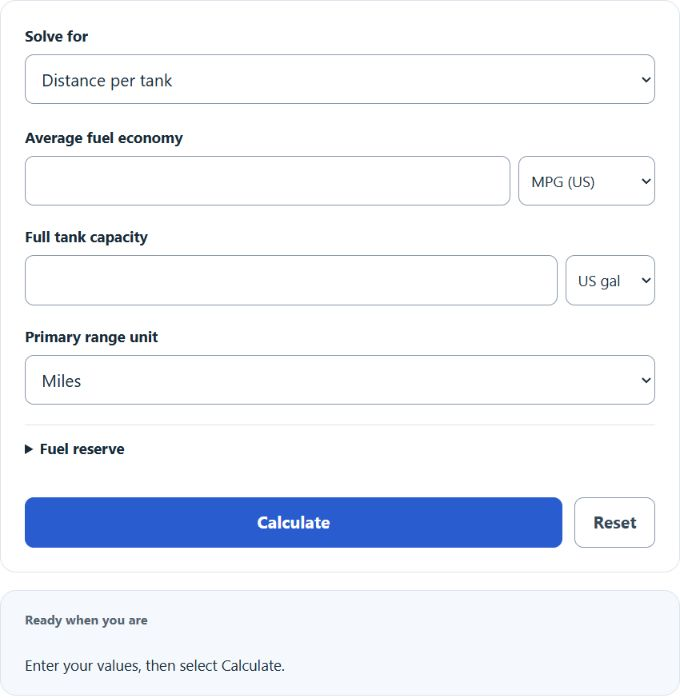
Calculate miles per tank from fuel economy and tank size, or solve for MPG or fuel capacity with US, Imperial, metric, and reserve options.
Miles Per Tank Formula
Miles per tank estimates the theoretical distance a vehicle can travel on a full tank of fuel when average fuel efficiency stays constant.
Where:
- MPT = miles per tank
- MPG = fuel efficiency in miles per gallon
- TS = tank size in gallons, using the same US or Imperial gallon definition as MPG
If you are solving for a different value, the same relationship can be rearranged:
How to Calculate Miles Per Tank
- Determine the vehicle’s average fuel efficiency.
- Find the fuel tank capacity.
- Multiply fuel efficiency by tank size.
- Interpret the result as an estimated full-tank driving range.
This calculation is most accurate when the MPG value reflects your actual driving habits rather than a best-case rating.
Variable and Unit Guide
| Input | Meaning | Common Units | Notes |
|---|---|---|---|
| Fuel Efficiency | How far the vehicle travels per unit of fuel | mpg, km/L | Use average real-world efficiency for better estimates |
| Tank Size | Total fuel capacity | gal, L, mL | Nominal tank size may differ slightly from usable fill volume |
| Distance Per Tank | Estimated full-tank range | mi, km | Represents ideal range before the tank is empty |
Common Unit Pairings
| Fuel Efficiency | Tank Size | Distance Output |
|---|---|---|
| Miles per gallon (mpg) | Gallons (gal) | Miles (mi) |
| Kilometers per liter (km/L) | Liters (L) | Kilometers (km) |
Examples
Example 1: A vehicle averaging 25 mpg with a 12-gallon tank has an estimated range of 300 miles per tank.
Example 2: A vehicle averaging 32 mpg with a 15-gallon tank has an estimated range of 480 miles per tank.
Example 3: A vehicle averaging 11 km/L with a 50 L tank has an estimated range of 550 km per tank.
Using a Reserve for Safer Trip Planning
Most drivers do not plan to use every drop of fuel. A more conservative estimate keeps a reserve amount in the tank.
Where:
- UR = usable range
- R = reserve fuel volume you do not plan to use. The calculator accepts a percentage: R = TS × reserve% / 100.
This is especially useful for long trips, rural driving, towing, winter travel, or routes with limited fuel stations.
What Affects Real-World Miles Per Tank?
The calculator gives a theoretical estimate. Actual range can be lower or higher depending on operating conditions.
- City vs. highway driving: Stop-and-go traffic usually reduces fuel economy.
- Speed: Higher sustained speeds often increase fuel consumption.
- Vehicle load: Passengers, cargo, and towing decrease range.
- Terrain: Hills and mountain driving use more fuel than flat roads.
- Idle time: Long idling burns fuel without adding distance.
- Tire pressure and maintenance: Poor maintenance can reduce efficiency.
- Weather: Cold temperatures, wind, and air conditioning can change fuel use.
Miles Per Tank vs. Fuel Economy
Fuel economy measures efficiency, such as miles per gallon. Miles per tank measures total driving range from a full tank. Two vehicles can have similar tank sizes but different ranges because their fuel efficiency differs. Likewise, two vehicles can have similar MPG values but different ranges because one has a larger tank.
Miles Per Tank vs. Distance to Empty
Miles per tank is a static estimate based on fuel economy and full tank capacity. Distance to empty is a dynamic estimate that changes as fuel level, driving style, traffic, grade, and recent consumption change. For planning purposes, miles per tank is useful as a simple baseline; for active driving, distance to empty is often more responsive.
Tips for Better Estimates
- Use your average MPG from recent trips instead of relying only on label ratings.
- Recalculate when carrying heavy loads or towing.
- Plan a refueling stop before your theoretical maximum range.
- Track seasonal MPG changes if you drive in very hot or cold climates.
- Use consistent units so the output stays in miles or kilometers as expected.
Frequently Asked Questions
Is miles per tank the same as miles until empty?
No. Miles per tank is a full-tank estimate. Miles until empty depends on how much fuel remains right now and how the vehicle is currently being driven.
Why is my actual range lower than the calculator result?
The result assumes fuel economy remains constant across the full tank. Real driving conditions often reduce efficiency, so actual range is commonly lower than the ideal estimate.
Should I use rated MPG or measured MPG?
Measured MPG is usually better for planning because it reflects your real routes, speed, climate, and vehicle condition.
Can this be used with metric units?
Yes. Enter fuel efficiency in kilometers per liter and tank size in liters; both miles and kilometers are shown. Select Kilometers as the primary range unit if preferred.