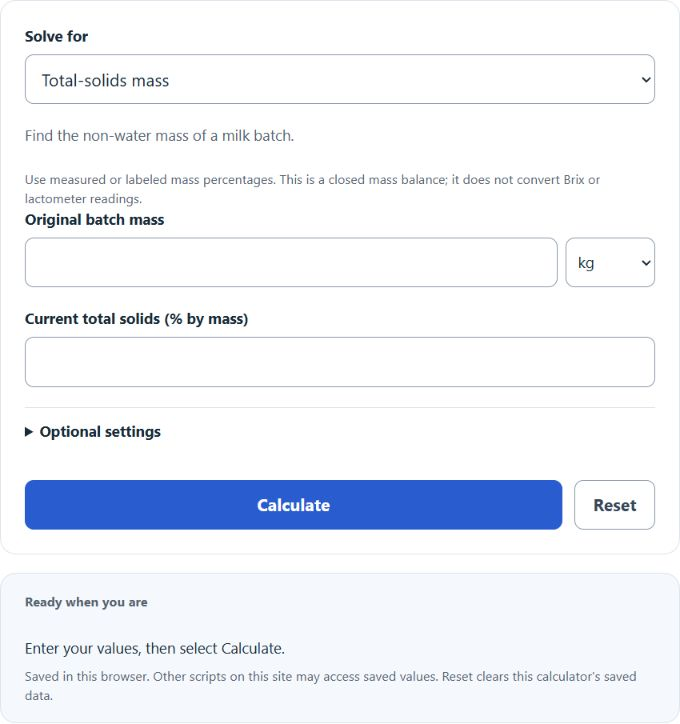
Calculate milk-solids mass or concentration and solve powder addition for a target using an exact mass balance with water, fat, and solids-not-fat detail.
Related Calculators
- Paneer Yield Calculator
- Dry Matter Calculator
- Moisture Ratio Calculator
- Moisture Loss Calculator
- All Food and Cooking Calculators
Milk Solids Formula
The following two example problems outline the steps and information needed to calculate the Milk Solids.
Variables:
- MS is the Milk Solids (g)
- WM is the total weight of milk (g)
- S is the total percentage solids (%)
To calculate milk solids, multiply the mass of the milk by the total-solids percentage divided by 100. Reverse mode uses S = 100 × MS / WM. For powder addition, x = M(T − C)/(P − T), where C, T and P are current, target and powder total-solids percentages on the same mass basis; for an increase, P must exceed T. The added powder changes the final batch mass.
How to Calculate Milk Solids?
The following steps outline how to calculate the Milk Solids.
- First, determine the total weight of milk (g).
- Next, determine the total percentage solids (%).
- Next, gather the formula from above = MS = WM * S/100.
- Finally, calculate the Milk Solids.
- After inserting the variables and calculating the result, check your answer with the calculator above.
Example Problem :
Use the following variables as an example problem to test your knowledge.
total weight of milk (g) = 50
total percentage solids (%) = 12.5
MS = WM * S/100 = 50 × 12.5/100 = 6.25 g