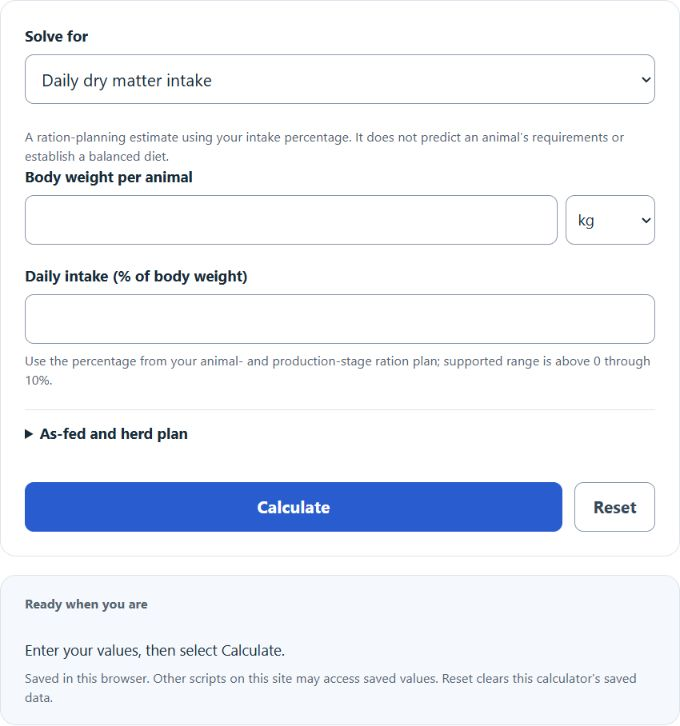
Calculate livestock dry matter intake from body weight, reverse-solve weight, and plan as-fed feed for a herd with dry matter and loss adjustments.
Related Calculators
- Dry Matter Calculator
- Carrying Capacity Calculator
- FCR Calculator
- Energy Corrected Milk (ECM) Calculator
- Fat Corrected Milk Calculator
- All Biology Calculators
Dry Matter Intake Formula
The calculator estimates intake from a user-supplied percentage or reverse-solves the body weight consistent with known intake. It does not implement a dairy prediction model.
Daily dry matter intake:
Reverse body weight:
Optional as-fed offering:
- DMI: dry matter consumed per animal per day.
- BW: body weight in the same mass unit as DMI.
- DMpercent: measured dry matter percentage of the feed or whole ration.
- LossPercent: fraction of offered feed lost or refused, assuming the same dry matter fraction.
Enter body weight or known DMI and an intake percentage from your ration plan. To use the optional as-fed and herd plan, enter feed dry matter. Blank loss means zero; blank animal count and days mean one animal and one day. Group inventory equals as-fed offered per day multiplied by animal count and planning days.
Typical DMI Values and Feed Dry Matter
These broad illustrative ranges vary with species, diet, stage, and conditions; they are not ration recommendations or validation limits. Use an appropriate animal-specific ration plan and measured feed composition.
| Animal / stage | DMI, % of body weight |
|---|---|
| Beef cow, maintenance | 2.0 – 2.5% |
| Growing beef steer | 2.2 – 2.8% |
| Lactating dairy cow | 3.0 – 4.0% |
| Dry dairy cow | 1.8 – 2.0% |
| Mature horse, light work | 1.5 – 2.0% |
| Sheep or goat | 2.5 – 3.5% |
| Feed | Typical DM % | Moisture % |
|---|---|---|
| Grass or alfalfa hay | 88 – 90 | 10 – 12 |
| Corn silage | 30 – 38 | 62 – 70 |
| Haylage | 40 – 55 | 45 – 60 |
| Fresh pasture | 18 – 25 | 75 – 82 |
| Grain mix | 88 – 90 | 10 – 12 |
| Wet brewers grains | 22 – 28 | 72 – 78 |
Worked Example and FAQ
Example: a planning scenario. For a 650 kg animal with an assumed intake of 2.5% of body weight, DMI = 650 × 0.025 = 16.25 kg/day. At 40% feed dry matter and 8% loss of offered feed, as-fed offered = 16.25 / 0.40 / 0.92 ≈ 44.16 kg/day. For 25 animals over 30 days, inventory is approximately 33,118.21 kg as-fed. These inputs are a worked example, not a feeding recommendation.
Example: as-fed to DMI. A steer eats 55 lb/day of corn silage at 32% DM. DMI = 55 × 0.32 = 17.6 lb/day. If the steer weighs 750 lb, that is 17.6 / 750 × 100 ≈ 2.35% of body weight. This arithmetic example is not an animal-specific intake recommendation.
Why use dry matter instead of as-fed? Removing water from the comparison basis helps compare feed solids. Two feeds with the same as-fed weight can have different energy and protein concentrations. A DM basis does not by itself establish a balanced ration.
What if the estimate looks unusual? Recheck mass units, actual feed dry matter, intake records, and the percentage from your ration plan. An unusual result cannot identify an animal’s condition; consult an appropriate livestock nutrition professional when needed.
Does the calculator predict dairy-cow requirements? No. It applies your intake percentage and optional feed/loss assumptions. It does not implement NRC, NDF-based, or energy-balance prediction models.
Does DMI include water? No. DMI is feed weight after all moisture is removed. Drinking-water requirements are separate and depend on the animal, production, diet, and environment. This calculator does not estimate them.