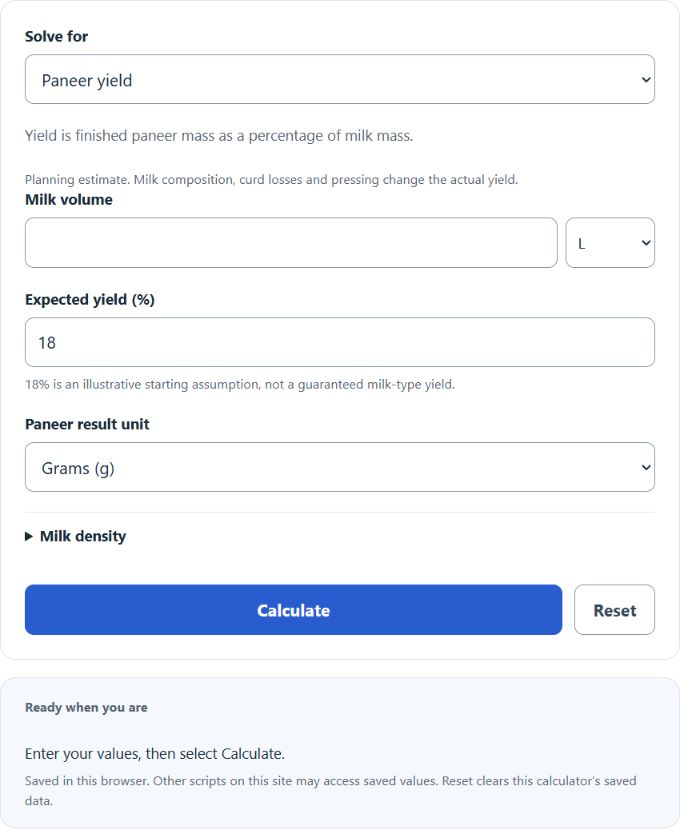
Estimate paneer yield from milk volume and an expected mass yield, or estimate the milk needed for a desired paneer amount. Yield and milk density are editable planning assumptions.
- Milk Solids Calculator
- Product Yield Calculator
- Batch Size Calculator
- Milk Usage Calculator
- Food Quantity Calculator
- All Food and Cooking Calculators
Paneer Yield Formula
The paneer yield calculator estimates the final weight of paneer from a known amount of milk and a chosen yield rate. For practical kitchen planning, the default milk density is approximately 1030 grams per liter; then the yield percentage is applied to milk mass. The optional density setting can be changed; actual yield varies with milk composition and processing.
| Variable | Meaning | Typical Unit |
|---|---|---|
| PY | Total paneer yield | grams |
| V | Volume of milk | liters |
| Y | Yield rate by weight of milk | percent |
If you already know the milk weight rather than the milk volume, the same calculation can be written directly from milk mass.
This version is useful when you are weighing milk in grams or kilograms instead of measuring it by volume.
How to Calculate Paneer Yield
- Measure the amount of milk you are using.
- Select a realistic yield rate for your milk type and process.
- Convert the yield percentage into a fraction by dividing by 100.
- Convert milk volume to mass with the selected density, multiply by the yield fraction, then select Calculate. To estimate milk needed, choose that solve mode and enter the paneer mass.
In practice, richer milk and higher moisture retention usually increase paneer yield, while leaner milk and stronger pressing usually reduce it. If you make paneer often, using your own historical yield rate will give the most reliable estimate.
Example Calculation
If you start with 20 liters of milk and expect a 20% yield rate, the calculation is:
That is approximately 4.12 kilograms of paneer with the default density.
What the Yield Rate Represents
The yield rate is the percentage of the original milk weight that remains in the final paneer. It reflects how much of the milk solids and moisture are captured in the finished curd.
If you know how much paneer you obtained from a previous batch, you can use this equation to calculate your actual yield rate and reuse it in future estimates.
Factors That Change Paneer Yield
- Milk composition: Higher fat and protein levels generally produce more paneer.
- Milk type: Whole milk usually yields more than low-fat milk.
- Coagulation efficiency: Proper heat and acid balance help more solids separate into curd.
- Curd handling: Rough stirring or excessive breaking can cause curd loss into the whey.
- Draining time: Longer draining removes more moisture and lowers final weight.
- Pressing pressure: Firmer pressing creates a denser paneer but usually reduces measured yield.
- Moisture retention: Softer paneer weighs more because it holds more water.
| Condition | Effect on Yield | Reason |
|---|---|---|
| Richer milk | Higher | More milk solids are captured in the curd. |
| Low-fat milk | Lower | Less fat and fewer solids remain after coagulation. |
| Light pressing | Higher | More moisture stays in the paneer block. |
| Heavy pressing | Lower | More whey is expelled from the curd. |
| Gentle curd handling | Higher | Less curd is lost during draining and transfer. |
| Extended draining | Lower | Water loss reduces final weight. |
Unit Notes
The calculator supports common kitchen and production units. Be sure the milk input and paneer output units match what you intend to use.
When switching between units, the calculator handles the conversions for you, but understanding the relationships helps you check whether an output looks reasonable.
How to Improve Estimate Accuracy
- Use the same milk brand or milk source when comparing batches.
- Record the actual finished paneer weight after draining and pressing.
- Track whether you prefer firm paneer or soft, moist paneer.
- Reuse your real batch yield rate instead of guessing a new one each time.
- Plan with a slightly conservative percentage if the batch is for serving counts or sales forecasting.
Common Input Mistakes
- Entering a decimal instead of a percent: Enter 18 for 18%, not 0.18 unless a calculator specifically asks for decimal form.
- Confusing milk volume with paneer weight: Paneer-yield mode uses milk volume and returns paneer mass. Milk-needed mode reverses that calculation.
- Ignoring moisture differences: Two batches can come from the same milk volume but weigh differently after pressing.
- Expecting exact repeatability: Small changes in milk solids, temperature, acid amount, and handling can shift yield.
Why Actual Paneer May Differ From the Estimate
This calculator provides a planning estimate, but actual yield can vary from batch to batch. Differences in milk solids, heating profile, coagulation point, cloth loss, draining time, and pressing intensity all affect the final paneer weight. If precision matters, measure your actual output over several batches and use the average yield rate for future calculations.