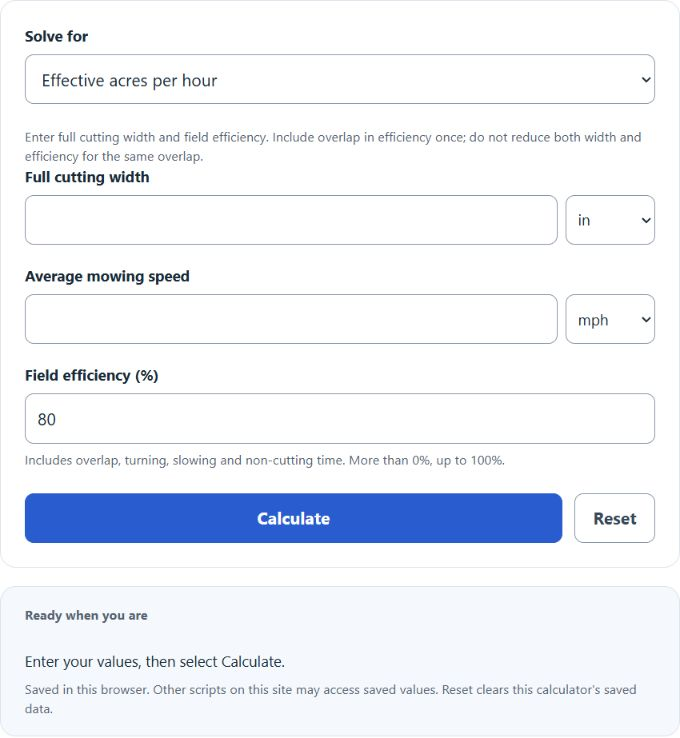
Calculate effective mowing acres per hour, job time, or required speed from deck width, travel speed, field efficiency, and area in US or metric units.
- Every Day Life And Education Calculators
- Grass Seed Calculator
- Basal Area Calculator
- GDU (Growing Degree Units) Calculator
- Sod Calculator
- Harvest Yield Calculator
- Cost Per Acre Calculator
Acres Per Hour Formula
The calculator uses one core productivity formula and rearranges it for each mode.
- Width(in) = full cutting width of the deck or implement, in inches
- Speed(mph) = average ground speed while cutting, in miles per hour
- Efficiency = entered field efficiency percentage. For example, 80% means a fraction of 0.80 and a combined loss allowance of 20%. Include overlap once in this efficiency estimate.
- 99 = exact unit conversion divisor: 12 in/ft × 43,560 ft²/acre ÷ 5,280 ft/mile = 99
The constant 99 only works when width is in inches and speed is in mph. The calculator converts other units before applying the formula. The field-efficiency input covers overlap, turns and non-cutting time. Estimate it from comparable jobs; the appropriate value depends on equipment and site conditions. Do not reduce both width and efficiency for the same overlap.
The two rearranged forms used by the other modes:
Mode summary:
- Cut rate: You enter width, speed, and field efficiency. The calculator returns acres per hour and minutes per acre.
- Mowing time: You enter area along with width, speed, and field efficiency. It computes the rate, then divides area by rate to give finish time.
- Required pace: You enter area and available time. It returns the acres/hour you need to hit. Add width and field efficiency to solve for the required average ground speed. This mathematical result does not establish a safe operating speed.
Illustrative Mowing Rates and Reference Values
These are illustrative input combinations, not manufacturer specifications or safe-speed recommendations. The first table assumes 90% field efficiency. The second shows hypothetical loss allowances; use measured job data for actual estimates.
| Mower type | Deck width | Example speed | Acres/hour (90% efficiency) |
|---|---|---|---|
| Push mower | 22 in | 3 mph | 0.60 |
| Wide-area walk-behind | 30 in | 3 mph | 0.82 |
| Lawn tractor | 42 in | 4 mph | 1.53 |
| Residential zero-turn | 48 in | 6.5 mph | 2.84 |
| Commercial zero-turn | 60 in | 9 mph | 4.91 |
| Large commercial zero-turn | 72 in | 10 mph | 6.55 |
| Site condition | Illustrative loss allowance |
|---|---|
| Open field, long straight passes | 5% to 10% |
| Typical residential lawn | 10% to 15% |
| Lawn with trees, beds, or fences | 15% to 25% |
| Small or oddly shaped yard | 25% to 40% |
| Steep slopes or wet grass | Use measured site data; check equipment limits |
Worked Examples and FAQ
Example 1: 48 in width at 6 mph, 85% field efficiency.
Acres/hour = 48 × 6 × 0.85 ÷ 99 = 244.8 ÷ 99 = 2.47 acres/hour. A 1.5 acre lawn takes 1.5 ÷ 2.47 = 0.61 hours, or about 36 minutes.
Example 2: Required pace for 4 acres in 1.5 hours.
Target rate = 4 ÷ 1.5 = 2.67 acres/hour. With a 60 in deck and 90% field efficiency, keep the unrounded target rate: required speed = (4 ÷ 1.5) × 99 ÷ (60 × 0.90) = 264 ÷ 54 ≈ 4.89 mph. Check whether this speed is safe and practical for the equipment and site.
Why 99? An acre is 43,560 sq ft. One mph times one foot of width covers 5,280 sq ft per hour. Convert width from inches to feet (divide by 12) and area to acres (divide by 43,560), and the constants combine to exactly 99. So width in inches times mph divided by 99 gives acres per hour.
What efficiency should you use? Use comparable job records: field efficiency is actual capacity divided by theoretical capacity, multiplied by 100. The default 80% is an editable planning assumption, not a validated value for your site.
Does this account for trimming and blowing? No. The formula covers deck mowing time only. Add string trimming, edging, and cleanup separately. Estimate these additional tasks separately from your own service records. The calculator’s 10% time allowance is a hypothetical scenario, not a universal recommendation.
Why is your real rate lower than the spec sheet? Manufacturer “max productivity” numbers assume top speed with minimal overlap and no turns. Actual productivity depends on speed, turns, obstacles and downtime. Use measured job capacity to estimate field efficiency; trimming and cleanup time remain separate.