Calculate tree basal area from DBH for one tree or a stand, with results in ft², m², ft²/acre and m²/ha. Stocking adequacy requires additional forestry context.
- All Biology Calculators
- Tree Volume Calculator
- Stems Per Hectare Calculator
- Density Per Hectare Calculator
- Plants Per Hectare Calculator
- Oak Tree Value Calculator
Basal Area Formula
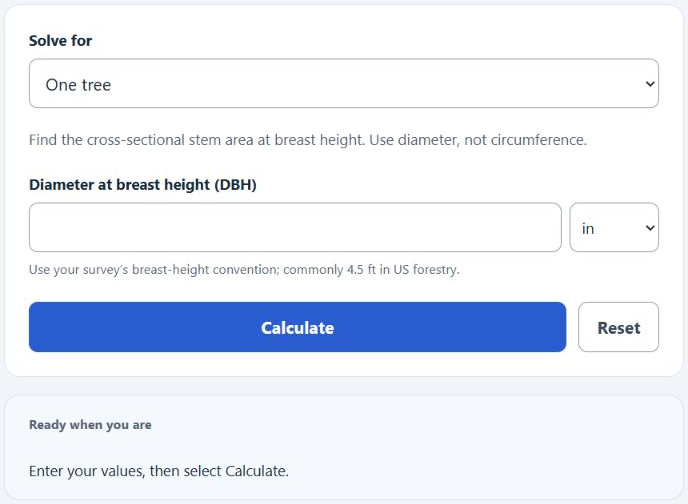
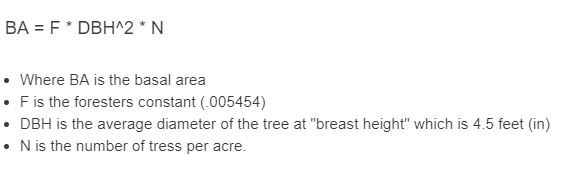
Basal area is the cross-sectional area of a tree stem at breast height, usually measured at DBH. For one tree, the calculator finds the area of a circle using the tree diameter. For a stand, it adds the basal area of all entered trees and scales that total to one acre or one hectare.
One tree, DBH in inches
One tree, DBH in meters
Stand basal area from a plot
- BA_ft2 = basal area of one tree in square feet
- BA_m2 = basal area of one tree in square meters
- DBH_in = tree diameter at breast height in inches
- DBH_m = tree diameter at breast height in meters
- sum(BA_tree_ft2) = total basal area of all measured trees in the plot
- Plot_acres = plot size converted to acres
- BA_acre = stand basal area in square feet per acre
- BA_ha = stand basal area in square meters per hectare
The one-tree mode converts your DBH entry to inches and meters, then reports basal area in both ft² and m². The stand mode calculates basal area for each diameter you enter, adds those tree values, converts the plot size to acres, and reports the result as ft²/acre and m²/ha.
Basal Area Stocking Ranges
The bands below only describe basal-area amounts. They are not universal stocking targets. Stocking adequacy depends on species, tree sizes, site quality, age and management objectives; use an applicable forestry stocking guide.
| Basal area | Basal-area band | Stocking assessment |
|---|---|---|
| Less than 40 ft²/acre | Below 40 | Requires species and size information |
| 40 to 79.9 ft²/acre | 40–80 | Requires species and size information |
| 80 to 119.9 ft²/acre | 80–120 | Not a universal healthy range |
| 120 to 159.9 ft²/acre | 120–160 | Crowding cannot be inferred from this value alone |
| 160 ft²/acre or more | 160 or above | Stress cannot be inferred from this value alone |
Common Plot Size Conversions
| Plot size | Acres | Hectares |
|---|---|---|
| 1/10 acre | 0.1 acre | 0.0405 ha |
| 1/4 acre | 0.25 acre | 0.1012 ha |
| 400 m² | 0.0988 acre | 0.04 ha |
| 1000 m² | 0.2471 acre | 0.1 ha |
| 1 hectare | 2.4711 acres | 1 ha |
Basal Area Examples
Example 1: Basal area of one 12-inch tree
For a tree with a DBH of 12 inches:
The tree has a basal area of about 0.785 ft².
Example 2: Stand basal area from a 0.1-acre plot
Suppose your plot is 0.1 acre and the measured DBH values are 10, 12.5, 8, 14, and 11 inches.
The stand basal area is about 34.8 ft²/acre. This value alone does not establish whether the stand is understocked.
FAQ
What is DBH?
DBH means diameter at breast height. In forestry, it is usually measured at 4.5 feet above the ground on the uphill side of the tree. Basal area depends on DBH, so a small diameter measurement error can noticeably affect the result because the formula squares the diameter.
What does basal area per acre mean?
Basal area per acre is the total cross-sectional area of tree stems on one acre of land. For example, 100 ft²/acre means that if all tree stems were cut at DBH and their cross sections were added together, they would cover 100 square feet on each acre.
Why does the stand mode use a plot size?
A plot is only a sample of the stand. Dividing the total tree basal area in the plot by the plot area scales the measurement to a per-acre or per-hectare value. If your plot is 0.1 acre, the calculator effectively multiplies the plot total by 10 to estimate ft²/acre.