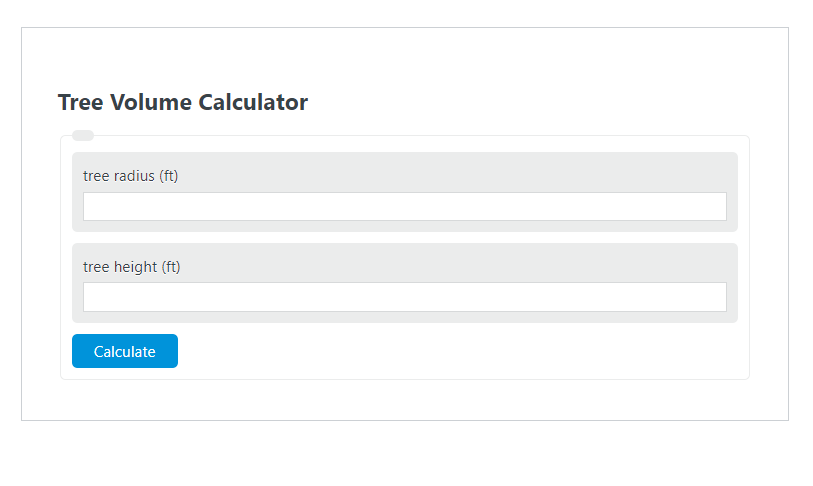
Calculate standing tree volume from DBH, height, and form factor, or reverse-solve DBH, height, or form factor, with cubic meter and cubic foot results.
Related Calculators
- Doyle Log Rule Calculator
- Scribner Log Scale Calculator
- Tree Log Weight Calculator
- Green Log Weight Calculator
- Basal Area Calculator
- Oak Tree Value Calculator
- All Construction Calculators
Tree Trunk Volume (Cylindrical Approximation) Formula
This calculator estimates the volume of a tree trunk or log section by modeling it as a right circular cylinder. It is most useful when you need a fast volume estimate for timber checks, firewood planning, biomass comparisons, transport planning, or general material estimation.
- TV: estimated trunk volume
- TR: trunk radius
- TH: trunk height or trunk section length being modeled
If you measured diameter instead of radius, convert diameter first:
If you measured circumference around the trunk, convert circumference to radius:
You can also express the same volume relationship directly in terms of diameter:
How to Measure for the Calculator
| Input | How to Measure It | Why It Matters |
|---|---|---|
| Trunk radius | Measure trunk diameter across the section you care about, then divide by two. | Radius drives the cross-sectional area, so small diameter errors can create large volume errors. |
| Trunk height or length | Use the actual length of the trunk section, log, or merchantable stem segment being estimated. | The calculator assumes that the measured radius continues through the full modeled length. |
| Units | Keep both measurements in the same unit before calculating. | Consistent units prevent distorted results. |
For standing trees, many users measure diameter at breast height and then pair that measurement with an estimated merchantable height. This is convenient, but it usually produces a higher volume than the true stem volume because real trunks narrow as height increases.
Unit Guidance
- If radius and height are entered in feet, the result is in cubic feet.
- If radius and height are entered in meters, the result is in cubic meters.
- If radius and height are entered in centimeters, the raw result is in cubic centimeters.
- If radius and height are entered in inches, the raw result is in cubic inches.
Helpful conversions for interpreting the result:
- One cubic foot corresponds to about 28.3168 liters.
- One cubic meter corresponds to 1,000 liters.
- One cubic meter corresponds to about 35.3147 cubic feet.
Examples
Example 1: Radius and length in feet
A trunk section with a radius of 1.5 feet and a length of 20 feet has an estimated volume of:
The estimated trunk volume is about 141.37 cubic feet.
Example 2: Diameter-based estimate
If a log has a diameter of 24 inches, its radius is 12 inches. For a log length of 96 inches:
This corresponds to about 43,429.38 cubic inches, or about 25.13 cubic feet after conversion.
Why This Calculator Is an Approximation
A cylinder model is simple and fast, but real trees are not perfect cylinders. The estimate can differ from actual wood volume because of:
- natural trunk taper from base to top
- butt swell near the base
- elliptical or irregular cross-sections
- bark thickness
- hollows, rot, and internal defects
- crook, flare, or swelling around knots and branch zones
The estimate is typically most accurate for short, fairly uniform log sections and least accurate for full standing trunks with noticeable taper.
Adjusting for Taper or Form Factor
If you already know a local form factor or a forestry adjustment factor for the species and measurement method you are using, you can scale the cylindrical estimate:
In this expression, f is an adjustment factor that reduces the pure cylinder estimate to better reflect the shape of an actual trunk.
When to Use This Calculator
- Estimating the volume of a cut log section
- Comparing trunk sizes across multiple trees
- Planning hauling space or storage capacity
- Approximating stem wood volume for inventory work
- Checking whether a measured trunk section is in a reasonable range before using more advanced forestry rules
Practical Tips for Better Results
- Measure diameter in two directions at right angles and average the readings when the trunk is not perfectly round.
- Decide whether you are measuring inside bark or outside bark, then stay consistent.
- For logs, use the actual usable log length rather than a rough visual estimate.
- For standing trees, estimate only the trunk section you truly want to model instead of assuming the same diameter all the way to the tip.
- If you need a commercial log scale rather than a pure geometric volume, use a dedicated log rule calculator.
Common Questions
Can I use diameter instead of radius?
You can. Measure diameter and divide by two before entering the value, or use the diameter form of the equation shown above.
Can I use circumference instead of diameter?
Yes. Convert circumference to radius first, then calculate volume.
Does this include branches, roots, or foliage?
No. This calculator estimates only the trunk or trunk section you model.
Why does my result seem too large for a standing tree?
The cylinder method assumes the same trunk thickness across the full height or length entered. Since most trunks taper, full-tree estimates are often higher than the actual stem volume.