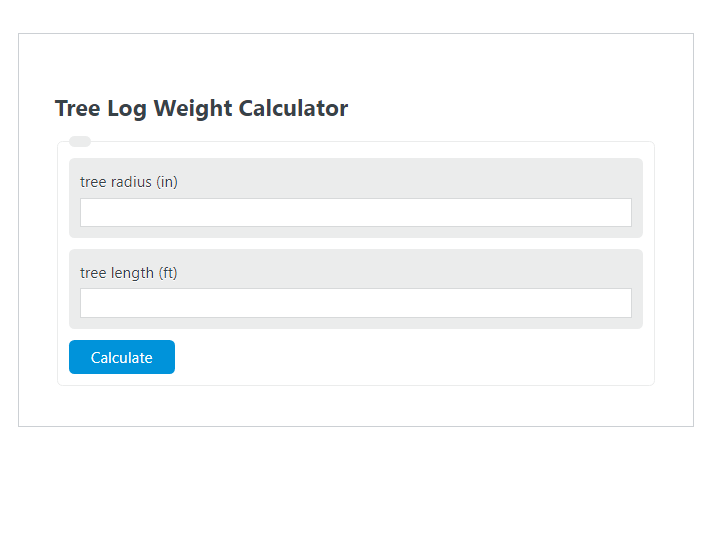
Estimate tapered tree-log weight from dimensions, density, moisture, and quantity, compare a midpoint approximation with Smalian, or reverse-solve length or density.
- All Construction Calculators
- All Weight Calculators
- Tree Volume Calculator
- Green Log Weight Calculator
Tree Weight Formula
The Tree Log Weight Calculator estimates the weight of a log by modeling it as a cylinder. Enter any two values—radius, length, or weight—and the calculator solves for the third. It accepts radius in inches or centimeters, length in feet or meters, and weight in pounds or kilograms. This calculator uses a fixed wood density of 93.6 lb/ft³, so the result should be treated as an estimate rather than an exact scale weight.
In this formula, the radius is divided by 12 so the cylinder calculation uses feet throughout. Once the log volume is found, it is multiplied by the assumed density to estimate total weight.
Variable Definitions
| Variable | Meaning | Units used by the calculator |
|---|---|---|
| TW | Estimated tree/log weight | lb or kg |
| R | Log radius | in or cm |
| TL | Log length | ft or m |
| ρ | Assumed wood density | 93.6 lb/ft³ (about 1499.3 kg/m³) |
| V | Log volume | ft³ or m³ |
How to Calculate Tree Log Weight
- Measure the log radius. If you measured diameter instead, divide it by 2 first.
- Measure the log length from one end to the other along the usable section.
- Convert the radius into feet when using the formula shown above.
- Calculate cylindrical volume.
- Multiply the volume by the assumed wood density to estimate weight.
This method works best for straight, solid logs with a fairly consistent diameter. If the log is tapered, using an average radius usually produces a better estimate than using only one end.
Rearranged Forms
Because the calculator can solve for any missing variable, these rearranged forms are useful when radius or length is unknown.
Example Calculation
For a log with a radius of 15 inches and a length of 40 feet, the estimated weight is found by substituting those values into the formula.
The estimated weight is approximately 18,378.3 lb, which is about 8,336.3 kg.
What Affects Real Log Weight
- Species: Different woods have different natural densities.
- Moisture content: Green logs are often much heavier than seasoned logs.
- Bark thickness: Thick bark adds weight that may not match a simple cylinder estimate.
- Taper: Logs that narrow from one end to the other are not perfect cylinders.
- Defects: Rot, hollows, splits, and voids can reduce true weight.
Tips for Better Estimates
- Use the most representative radius, not a flared or damaged end measurement.
- For tapered logs, average the small-end and large-end radii before calculating.
- For long stems, estimate weight section by section and add the results.
- If the number will be used for hauling, rigging, or crane planning, leave a safety margin above the calculated value.
Common Uses
- Estimating trailer or truck payload before transport
- Planning sawmill handling and storage capacity
- Checking whether lifting equipment can safely move a log
- Comparing how trimming length or reducing diameter changes total weight