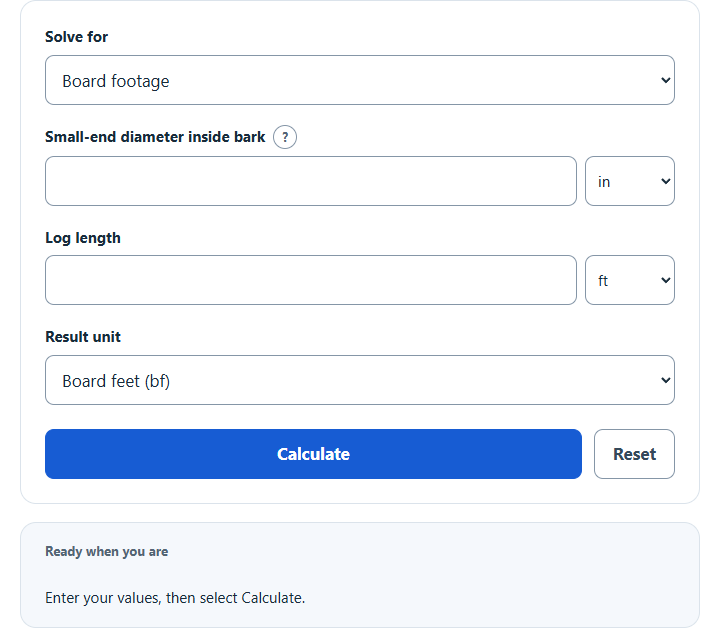
Calculate board feet in a log with the Doyle log rule from small-end diameter and length, with International and Scribner estimates for comparison.
Related Calculators
- Modulus Of Rupture Calculator
- Bending Stress Calculator
- Weight Per Foot Calculator
- Angle Cut Calculator
- All Construction Calculators
Doyle Log Rule Formula
The following formula is used to calculate the board footage using the Doyle Log Rule.
Variables:
- BF is the estimated lumber yield in board feet (bf)
- D is the small-end diameter inside bark in inches (in)
- L is the length of the log in feet (ft)
To calculate the board footage using the Doyle Log Rule, subtract 4 from the diameter of the log and square the result. Multiply this by the length of the log. Finally, divide the result by 16. This formula is considered conservative as it often underestimates the actual board footage, particularly for smaller logs.
What is a Doyle Log Rule?
A Doyle Log Rule is a mathematical formula used in the forestry industry to estimate the amount of lumber that can be obtained from a log. Developed by Edward Doyle in the mid-19th century, the rule is considered conservative as it often underestimates the actual board footage, particularly for smaller logs. It is commonly used in the Eastern United States.
How to Calculate Doyle Log Rule?
The following steps outline how to calculate the Doyle Log Rule.
- First, determine the small-end diameter inside bark (D) in inches (in).
- Next, determine the length of the log (L) in feet (ft).
- Next, use the formula BF = ((D – 4)2 * L) / 16 to calculate the board footage (BF).
- Finally, select Calculate. For D = 20 in and L = 10 ft, the estimate is 160 board feet (13.3333 ft³ of lumber).
- After inserting the variables and calculating the result, check your answer with the calculator above.
Example Problem :
Use the following variables as an example problem to test your knowledge.
diameter of the log (D) in inches (in) = 20
length of the log (L) in feet (ft) = 10