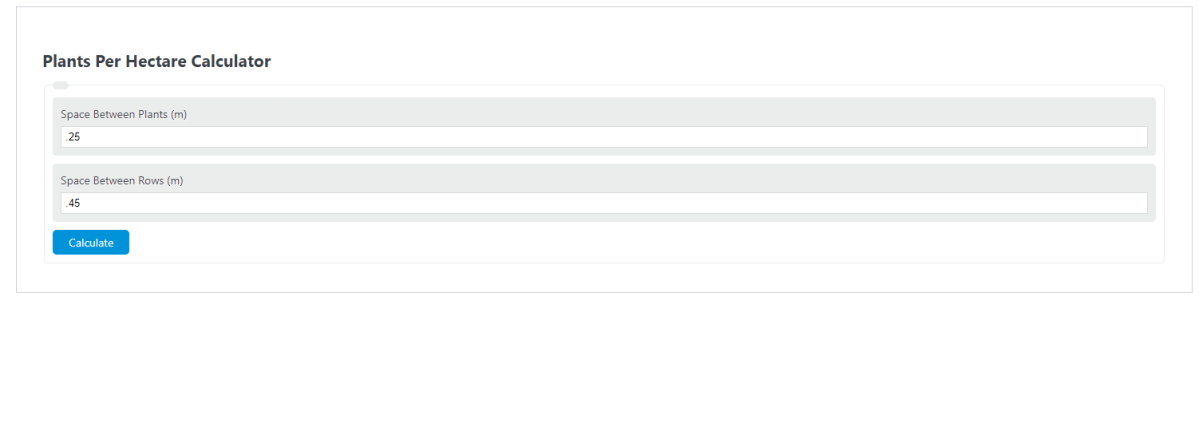
Calculate plants per hectare, plants per acre, or the row and in-row spacing needed for a target population, with metric and imperial units.
Related Calculators
- Stems Per Hectare Calculator
- Vine Density Calculator
- Percent Germination Calculator
- Land Equivalent Ratio Calculator
- All Biology Calculators
Plants Per Hectare Formula
Plants per hectare measures planting density over an area of 10,000 square meters. For rectangular spacing, each plant occupies a small rectangle defined by the distance between plants and the distance between rows. Once that area per plant is known, the total number of planting positions per hectare is found by dividing 10,000 by that occupied area.
- PPH = plants per hectare
- SBP = space between plants
- SBR = space between rows
- Ap = ground area allocated to each plant
This formula assumes a uniform grid pattern and full use of the planted area. If spacing becomes smaller, plant density increases. If rows or plant spacing become wider, plant density decreases.
How to Calculate Plants Per Hectare
- Measure the spacing between plants in the row.
- Measure the spacing between rows, ideally from center to center.
- Multiply those two values to get the area used by one plant.
- Divide 10,000 by that area to find plants per hectare.
Example: if plants are spaced 0.25 m apart and rows are 0.45 m apart, the occupied area per plant is:
The plant density is then:
That means the field can hold about 88,889 plants per hectare at that spacing.
Plants Per Acre Conversion
If you want the same idea expressed per acre instead of per hectare, use the area of one acre in square meters.
Use plants per hectare when planning metric field layouts and plants per acre when working with acre-based land records, budgets, or planting recommendations.
Common Spacing Reference
| Plant Spacing (m) | Row Spacing (m) | Area Per Plant (m²) | Plants Per Hectare | Plants Per Acre |
|---|---|---|---|---|
| 0.20 | 0.40 | 0.0800 | 125,000 | 50,586 |
| 0.25 | 0.45 | 0.1125 | 88,889 | 35,972 |
| 0.30 | 0.50 | 0.1500 | 66,667 | 26,979 |
| 0.40 | 0.75 | 0.3000 | 33,333 | 13,490 |
| 0.50 | 1.00 | 0.5000 | 20,000 | 8,094 |
These values represent ideal planting positions. Real field populations are often slightly lower because of gaps, headlands, pathways, wheel tracks, germination losses, and uneven establishment.
How to Estimate Total Plants for Any Field Size
Once density is known, total plant count for a specific field is straightforward. Multiply the density by the planted land area in matching units.
For example, a density of 88,889 plants per hectare on 2.5 hectares gives an estimated 222,223 planting positions before stand loss is considered.
Why Plant Density Matters
- Yield potential: too few plants can leave yield on the table, while too many can increase competition.
- Light interception: canopy closure changes with spacing and influences photosynthesis.
- Root competition: closer spacing raises competition for water and nutrients.
- Air movement: wider spacing can improve airflow and reduce humidity around foliage.
- Machinery access: row spacing must still fit cultivation, spraying, irrigation, and harvest operations.
- Weed suppression: denser stands often shade the soil faster and reduce open ground.
Planning Seed or Transplant Quantity
If actual establishment will be below 100%, seed or transplant quantity should be adjusted upward. Use the target final stand and divide by the expected establishment rate written as a decimal.
If the target is 20,000 final plants and expected establishment is 0.90, then more than 20,000 seeds or transplants are required to reach the desired stand.
Practical Tips When Using the Calculator
- Measure spacing from center to center, not edge to edge.
- Use the same unit basis for both spacing inputs; the calculator can help convert common units.
- Base row spacing on the actual planted pattern, especially for raised beds or paired rows.
- Remember that the calculator returns a theoretical density; final stand count may be lower in the field.
- For irregular fields, calculate only the true planted area rather than the total property area.
This calculator is most useful during crop planning, transplant ordering, seed budgeting, irrigation layout, fertility planning, and comparing alternative spacings before planting begins.