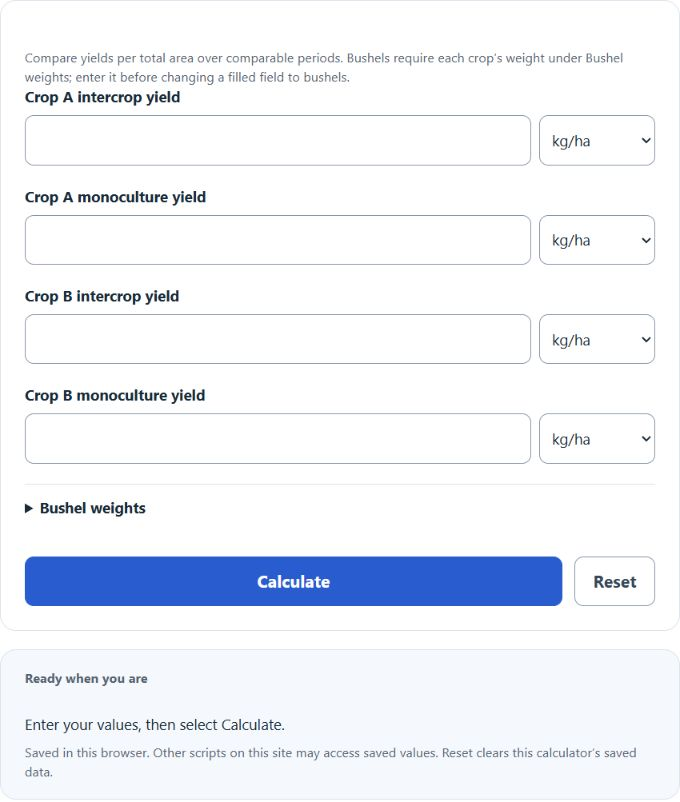
Calculate land equivalent ratio from intercropping and monoculture yields for two crops, with unit conversion to compare land-use efficiency.
Related Calculators
- Crop Coefficient Calculator
- Plant Available Water Calculator
- Field Capacity Calculator
- NDVI Calculator
- Land Survey Cost Calculator
- All Biology Calculators
Land Equivalent Ratio Formula
The land equivalent ratio, or LER, compares the productivity of an intercropping system with the same crops grown separately as monocultures.
- LER = land equivalent ratio
- YAI = yield of Crop A in intercropping
- YAM = yield of Crop A in monoculture
- YBI = yield of Crop B in intercropping
- YBM = yield of Crop B in monoculture
The calculator first converts all entered yields to kg/ha. Bushels require a crop-specific weight in lb/bu under Bushel weights; use the same reporting standard for that crop in both systems. It then divides each intercrop yield by its matching monoculture yield. These two partial ratios are added together to produce the final LER.
Monoculture yields must be greater than zero because they are divisors. Intercrop yields may be zero but cannot be negative. Compare yields per total system area and over comparable periods.
LER Interpretation and Unit Conversion Tables
| LER result | Meaning |
|---|---|
| Less than 1.00 | The intercrop uses land less efficiently than monocropping. |
| Equal to 1.00 | The intercrop and monocrop systems are equivalent in land use. |
| Greater than 1.00 | The intercrop uses land more efficiently than monocropping. |
| Input unit | Conversion used to kg/ha |
|---|---|
| kg/ha | Multiply by 1 |
| t/ha | Multiply by 1000 |
| bushels/acre | Multiply by crop weight (lb/bu) × 0.45359237 ÷ 0.40468564224; approximately 62.7677 for 56 lb/bu or 67.2511 for 60 lb/bu |
| short tons/acre | Multiply by approximately 2241.7023 (US short tons of 2000 lb per international acre) |
Example Land Equivalent Ratio Calculations
Example 1
Suppose Crop A yields 2,000 kg/ha in intercropping and 4,000 kg/ha in monoculture. Crop B yields 1,500 kg/ha in intercropping and 3,000 kg/ha in monoculture.
The LER is 1.0, so the intercrop and monocrop systems are equivalent in land use for these yields.
Example 2
Suppose Crop A yields 3 t/ha in intercropping and 5 t/ha in monoculture. Crop B yields 2 t/ha in intercropping and 3 t/ha in monoculture.
The LER is about 1.27. This means the intercropping system is more land-efficient than growing the two crops separately.
FAQ
What does an LER of 1.25 mean?
An LER of 1.25 means the intercrop produces the same combined yield on 1 hectare that would require 1.25 hectares under separate monocropping. It would require 25% more monoculture land than intercrop land, or the intercrop saves 20% of that monoculture area. LER alone does not account for cropping duration or profitability.
Do all yield values need to use the same unit?
No. You can enter different units for different yield fields. The calculator converts each input to kg/ha before applying the LER formula. Use the correct unit and, for bushels, the crop’s reporting weight. If changing a filled field to bushels, enter that weight first so the quantity can be converted.
Can LER be used for more than two crops?
Yes. For more than two crops, add one partial ratio for each crop. For example, with three crops, the formula becomes the sum of Crop A intercrop yield divided by Crop A monoculture yield, plus the same ratio for Crop B, plus the same ratio for Crop C.