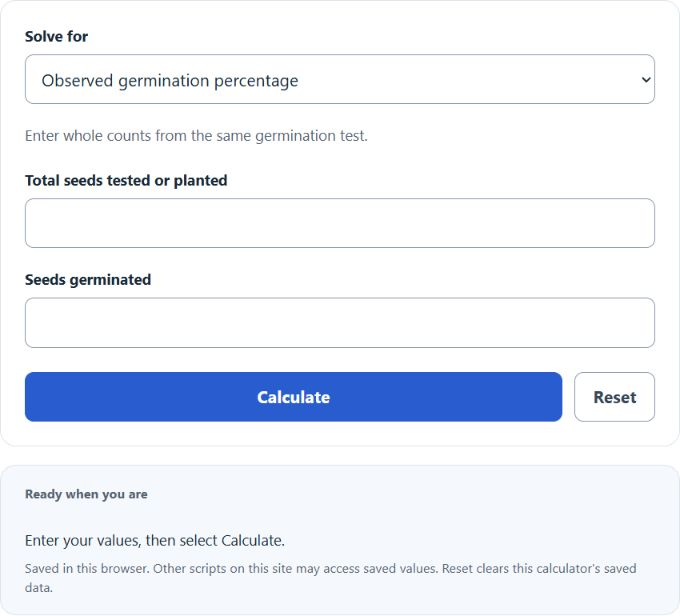
Calculate observed germination percentage, expected or implied seed counts, and a count-based sowing estimate. A Wilson sampling interval is shown only for an observed test.
- All Biology Calculators
- Thousand Seed Weight Calculator
- Seeds Per Hectare Calculator
- Plants Per Hectare Calculator
- Percent Viability Calculator
- Harvest Yield Calculator
Percent Germination Formula
The percent germination calculator uses the relationship between the number of seeds planted, the number of seeds that germinated, and the germination percentage.
- PG = percent germination
- SG = seeds germinated
- TS = total seeds planted
If you enter total seeds planted and seeds germinated, the calculator finds the percent germination.
If you enter total seeds planted and percent germination, the calculator estimates the expected number of seeds germinated. This mean can be fractional and is not an observed count.
If you enter seeds germinated and percent germination, the calculator finds an implied total. A rounded percentage may imply a fractional total; rounding it does not reconstruct an observed sample. A positive germinated count and positive rate are required.
Germination Percentage Guide
These ranges illustrate proportions only; they are not universal seed-quality grades or acceptance standards. Interpretation depends on species, seed lot, test protocol and intended use. For formal seed testing, follow the applicable definition of normal seedlings and the prescribed conditions.
| Percent Germination | General Meaning |
|---|---|
| 90% to 100% | 90 to 100 of every 100 tested seeds germinated; this is not a separate viability test. |
| 75% to 89% | 75 to 89 of every 100 tested seeds germinated. Compare with species- and method-specific criteria. |
| 50% to 74% | 50 to 74 of every 100 tested seeds germinated. A sowing estimate also requires field-condition evidence. |
| Below 50% | Fewer than 50 of every 100 tested seeds germinated. The percentage alone does not diagnose a cause. |
Sampling and Sowing Assumptions
The approximate 95% Wilson interval uses observed germinated and tested counts under an independent binomial sampling model. It does not account for systematic test error, establish acceptance, or predict field emergence. Expected counts and algebraically implied totals do not provide an observed sample, so those modes do not report this interval.
Seeds to sow = ceiling(target ÷ [(germination/100) × (relative field factor/100) × (desired-species count fraction/100)]). The field factor is the fraction of lab-germinable seeds expected to establish at the site; do not multiply by germination again if an absolute field rate already includes that loss. Purity on bag labels is usually by weight, which is not automatically a seed-count fraction. The default 100% assumes selected seeds. Rounding up makes the modeled expected count meet the target, without guaranteeing the realized count.
Common Germination Test Sizes
Larger representative samples usually reduce sampling uncertainty under comparable test conditions. The examples below are informal sample sizes, not a substitute for a prescribed testing protocol.
| Seeds Tested | Best Use | Example Result |
|---|---|---|
| 10 seeds | Quick home check | 8 germinated = 80% |
| 25 seeds | Small seed packet test | 20 germinated = 80% |
| 50 seeds | More reliable garden test | 40 germinated = 80% |
| 100 seeds | Easy percentage calculation | 80 germinated = 80% |
Example Problems
Example 1: Find percent germination
You planted 40 seeds. 34 seeds germinated.
The percent germination is 85%.
Example 2: Find seeds germinated
You planted 120 seeds. The germination rate was 75%.
The number of seeds germinated is 90.
FAQ
What does percent germination mean?
Percent germination is the percentage of planted or tested seeds that successfully sprout. For example, if 45 out of 50 seeds germinate, the germination percentage is 90%.
Can percent germination be over 100%?
No. Percent germination cannot be greater than 100% because the number of germinated seeds cannot be greater than the total number of seeds planted.
Why is my germination percentage low?
Low germination can happen because of old seeds, poor seed storage, too much or too little water, incorrect temperature, poor soil contact, or planting too deeply. Use species, seed-lot and test-condition evidence when interpreting a result. Seeds that did not germinate during a test are not necessarily dead; hard or dormant seeds and test conditions can matter. A laboratory result alone does not guarantee field establishment.