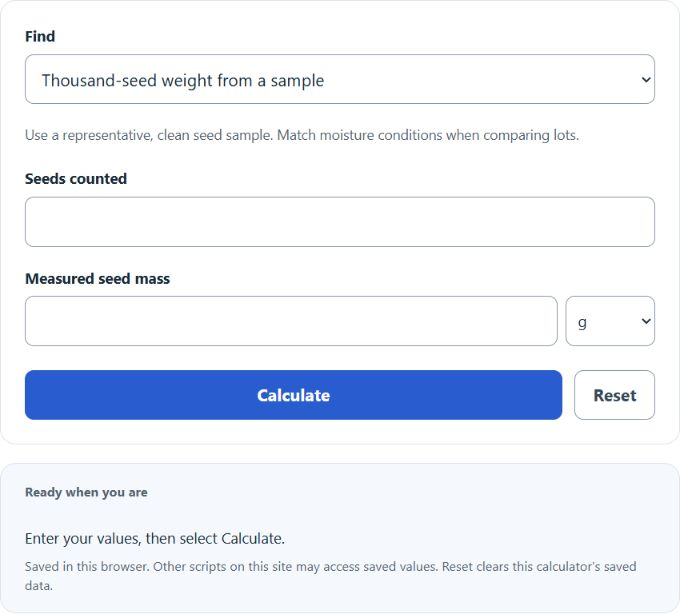
Calculate thousand seed weight (1000 grain or kernel weight) from a counted sample and its mass, or use a known TSW to find seed count or sowing rate.
Related Calculators
- Percent Viability Calculator
- Plants Per Hectare Calculator
- Crop Water Stress Index Calculator
- Field Capacity Calculator
- All Biology Calculators
Thousand Seed Weight Formula
The thousand seed weight calculator uses the relationship between total seed weight, total number of seeds, and the weight of 1,000 seeds.
- TSW = thousand seed weight in grams per 1,000 pure seeds
- W = weight of the same counted pure-seed sample, in grams
- N = number of seeds in that sample; measured counts must be positive whole numbers
To calculate the total number of seeds, the formula is rearranged:
To calculate the total weight, the formula is rearranged:
Choose the value to calculate explicitly. Enter the required values for that mode; leaving a field blank does not select the solve target.
- If you enter total weight and total number of seeds, it calculates thousand seed weight.
- If you enter thousand seed weight and total weight, it estimates the total number of seeds.
- If you enter thousand seed weight and total number of seeds, it calculates total weight.
Weight values are converted to grams for the calculation, then converted back to the unit you selected. A calculated seed count is an estimate from average seed mass and may be fractional; it is not a direct count of a physical lot.
Planning a Sowing Rate
The seeding mode starts from desired established plants per acre. It divides by laboratory germination and conditional field establishment, then converts the required pure-seed mass to bulk-lot mass using physical seed purity.
G, P and E are fractions from 0 to 1. G is germination; P is the pure-seed share of bulk mass; E is the share of germinable seeds expected to establish. Enter E as conditional establishment, not mortality or an overall emergence percentage that already includes germination. Otherwise losses are counted twice. These assumptions follow the separate germination and emergence approach described by Purdue Extension and the pure-live-seed mass adjustment explained by University of Wisconsin Extension.
Use TSW for clean pure seeds and purity for the corresponding bulk lot. With coated or pelleted seed, confirm compatible label conventions rather than counting coating weight twice. Field establishment is an estimate, not a guarantee of the final stand.
Optional extra seed is a purchase reserve: it increases the purchase quantity but leaves the target sowing rate unchanged. Blank extra seed means zero. Blank field acreage omits field totals. The mass-rate conversion uses the international acre: 1 lb/ac is approximately 1.120851 kg/ha.
Seed Weight Unit Conversions
The table gives rounded weight equivalents. Calculations use 1 lb = 453.59237 g and 1 oz = 28.349523125 g; 1 mg = 0.001 g.
| Unit | Equivalent in grams | Common use |
|---|---|---|
| 1 gram | 1 g | Small seed samples |
| 1 kilogram | 1,000 g | Larger seed lots |
| 1 ounce | 28.3495 g | Imperial weight measurements |
| 1 pound | 453.592 g | Bulk seed weight |
Illustrative Thousand Seed Weights
Thousand seed weight varies with the crop, variety, growing conditions, moisture and seed lot. The intervals below are illustrative examples, not verified typical bounds or seeding recommendations; actual lots can fall outside them. Use a representative measured lot value or a current seed test.
| Seed type | Illustrative example interval | Unit |
|---|---|---|
| Canola / rapeseed | 3 to 6 | g per 1,000 seeds |
| Wheat | 30 to 45 | g per 1,000 seeds |
| Barley | 35 to 50 | g per 1,000 seeds |
| Soybean | 120 to 200 | g per 1,000 seeds |
| Corn / maize | 250 to 400 | g per 1,000 seeds |
Examples
Example 1: Calculate thousand seed weight
You count 500 seeds and the total weight is 20 g.
The thousand seed weight is 40 g per 1,000 seeds.
Example 2: Calculate total number of seeds
You have 2 kg of seed. The thousand seed weight is 40 g.
First convert 2 kg to grams:
Then calculate the number of seeds:
The estimated total number of seeds is 50,000 seeds.
FAQs
What does thousand seed weight mean?
Thousand seed weight is the weight of 1,000 seeds from a seed lot. It is often used to compare seed size, estimate seed counts, and calculate planting rates.
Does seed moisture affect thousand seed weight?
Yes. Wetter seeds weigh more than drier seeds. If you compare two seed lots, the moisture level should be similar. Otherwise, the difference in thousand seed weight may partly come from water content instead of seed size.
How many seeds should you count for a sample?
The arithmetic can scale a positive whole counted sample, such as 100, 250, 500 or 1,000 seeds. Use clean pure seeds representative of the lot and weigh exactly the seeds counted; repeat samples help reveal variation. This calculator does not replace a prescribed laboratory sampling or seed-certification method.