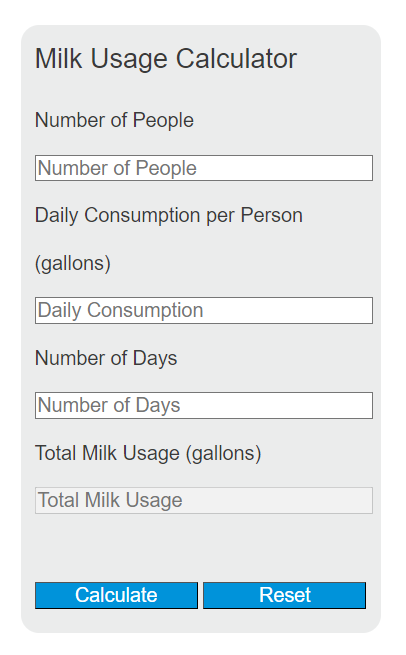
Calculate milk usage or reverse-solve people, daily consumption, or days, then add a buffer and round up practical purchase containers.
- All Food and Cooking Calculators
- Energy Corrected Milk (ECM) Calculator
- Milk Solids Calculator
- Food Quantity Calculator
- Servings Calculator
- Event Drink Calculator
Milk Usage Formula
The milk usage calculator estimates how much milk is needed for a group over a defined number of days. It is useful for household shopping, cafeteria planning, event preparation, meal service, and any situation where consumption can be estimated on a per-person, per-day basis.
- TMU = total milk usage
- P = number of people
- C = daily milk consumption per person
- D = number of days
Use a consistent unit system. If daily consumption is entered in gallons per person per day, the total will be in gallons. If daily consumption is entered in liters per person per day, the total will be in liters.
Rearranged Forms
Because the calculator can solve for any missing variable when the other three are known, the formula can also be rearranged as follows:
How to Calculate Milk Usage
- Determine the total number of people who will consume the milk.
- Estimate average daily milk consumption for each person.
- Set the number of days you want to plan for.
- Multiply people, daily consumption, and days to get the total requirement.
- If needed, convert the result into the purchasing unit you use most often, such as gallons or liters.
Unit Conversion
If you buy milk in a different unit than the one used for your estimate, convert before purchasing so ordering is accurate.
| Planning Item | What to Enter | Why It Matters |
|---|---|---|
| People | Total expected milk users | Underestimating group size causes shortages. |
| Daily consumption | Average amount used by one person per day | This is the main driver of the total. |
| Days | Length of time you are planning for | Useful for weekly shopping, events, or inventory cycles. |
| Unit | Gallons or liters | Keep the same unit from input through purchase planning. |
Examples
Example 1: Weekly household planning
A family of 4 uses 0.25 gallons of milk per person each day for 7 days.
The household should plan for 7 gallons of milk for the week.
Example 2: Office or event planning in liters
A group of 30 people is expected to use 0.3 liters per person each day for 5 days.
The total milk requirement is 45 liters.
Example 3: Finding daily consumption from a fixed supply
If you have 14 gallons available for 4 people over 7 days, you can estimate the allowable daily use per person.
Each person can use 0.5 gallons per day.
Adding a Safety Buffer
If demand may vary, a small purchasing buffer can help prevent running short. This is especially useful for parties, cafeterias, schools, and shared kitchens.
For a 10% buffer, use 0.10 for the buffer value.
If the estimated requirement is 45 liters, ordering 49.5 liters gives a 10% margin.
Common Uses for a Milk Usage Calculator
- Weekly grocery planning for families
- School, cafeteria, or dining hall inventory estimates
- Coffee stations, break rooms, and office kitchens
- Short-term event planning for meetings or receptions
- Recipe and meal-prep forecasting when milk is a recurring ingredient
Common Input Mistakes
- Mixing units: entering liters for daily consumption but reading the result as gallons.
- Using total group consumption as per-person consumption: the daily value should be for one person unless the formula is adjusted.
- Ignoring schedule length: a 3-day estimate and a 7-day estimate will produce very different totals.
- No allowance for uncertainty: for events or shared-use settings, consider a small buffer.
Practical Tips
- Use an average daily amount when individuals consume different quantities.
- Round up when milk is sold only in fixed container sizes.
- Separate drinking milk from cooking or baking milk if those uses vary significantly.
- Recalculate when attendance, duration, or serving plans change.
Frequently Asked Questions
Can this calculator be used for both gallons and liters?
Yes. The key requirement is to stay consistent with the chosen unit throughout the calculation.
What if not everyone drinks the same amount?
Use an average daily consumption per person. For more precision, estimate each subgroup separately and add the totals.
Can I use this for purchasing instead of consumption?
Yes. The result is a planning estimate for how much milk should be available, which makes it useful for purchasing and inventory management.
Should I round the final answer?
In most real-world situations, yes. Round to a practical package size and consider adding a small margin if running out would be a problem.