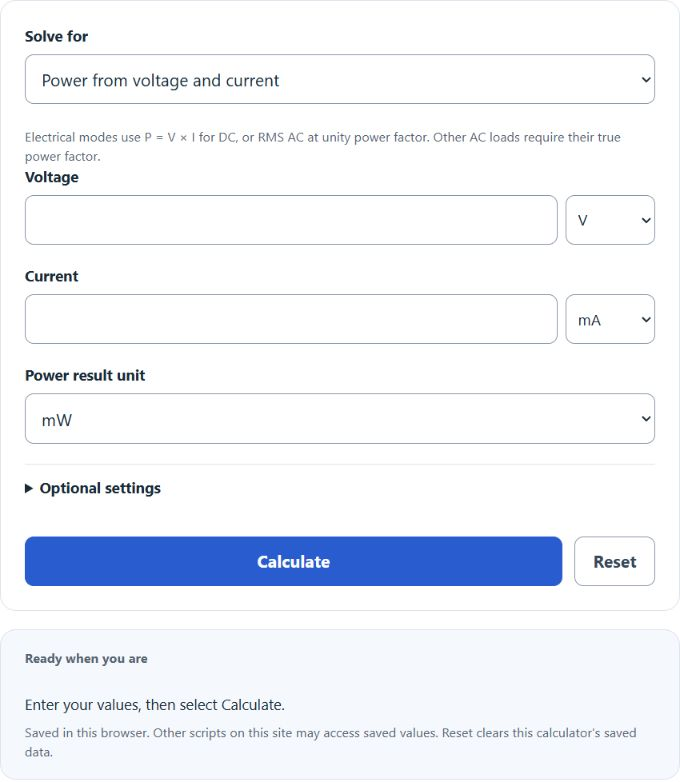
Calculate milliwatts from voltage and current, reverse-solve either value, or convert power between mW, W, microwatts, nanowatts, and dBm.
- All Unit Converters
- Milliamps Per Hour Calculator
- Watts Per Pound Calculator
- Speed To Watts Calculator
Milliwatt Formula
The following formulas are used to convert between milliwatts, watts, and dBm:
Variables:
- mW – power in milliwatts
- W – power in watts
- dBm – power in decibels relative to 1 mW (0 dBm = 1 mW by definition)
What is a Milliwatt?
A milliwatt (mW) is one thousandth of a watt (10-3 W), the SI derived unit of power. It is the standard working unit for RF signal strength, optical power in fiber systems, and power consumption in low-energy electronics. The symbol mW combines the SI prefix milli (m) with the unit watt (W), named after James Watt (1736-1819).
Illustrative Power Levels
The table below gives numerical power-conversion examples. These are reference values, not device specifications, medical output recommendations or regulatory limits.
| Reference power level | Typical Power (mW) | dBm |
|---|---|---|
| 0.1 µW reference | 0.0001 mW | -40 dBm |
| 0.1 µW reference (same power) | 0.0001 mW | -40 dBm |
| 10 nW reference | 0.00001 mW | -50 dBm |
| 1 µW reference | 0.001 mW | -30 dBm |
| 1 mW reference | 1 mW | 0 dBm |
| 1 mW reference (same power) | 1 mW | 0 dBm |
| 5 mW reference | 5 mW | 7 dBm |
| 100 mW reference | 100 mW | 20 dBm |
| 125–250 mW range | 125-250 mW | 21-24 dBm |
| 2 W reference | 2,000 mW | 33 dBm |
| 10–150 mW range | 10-150 mW | 10-22 dBm |
| 15–65 W range | 15,000-65,000 mW | 42-48 dBm |
dBm to mW Quick Reference
A 10 dB increase multiplies power by 10, while a 3 dB increase approximately doubles power. The table gives numerical conversions; wireless performance and legal limits depend on the specific system and applicable rules.
| dBm | mW | W | Power reference |
|---|---|---|---|
| -90 dBm | 0.000000001 mW | 0.000000000001 W | 1 pW |
| -70 dBm | 0.0000001 mW | 0.0000000001 W | 100 pW |
| -67 dBm | 0.0000002 mW | 0.0000000002 W | Approximately200pW |
| -50 dBm | 0.00001 mW | 0.00000001 W | 10 nW |
| -30 dBm | 0.001 mW | 0.000001 W | 1 µW |
| 0 dBm | 1 mW | 0.001 W | 1 mW reference |
| +10 dBm | 10 mW | 0.01 W | 10 mW |
| +20 dBm | 100 mW | 0.1 W | 100 mW |
| +30 dBm | 1,000 mW | 1 W | 1 W |
| +40 dBm | 10,000 mW | 10 W | 10 W |
Conversion Examples
Watts to milliwatts: 0.12 W x 1000 = 120 mW
Milliwatts to watts: 250 mW / 1000 = 0.25 W
Milliwatts to dBm: 100 mW = 10 x log10(100) = 20 dBm
dBm to milliwatts: 17 dBm = 10^(17/10) = 50.1 mW