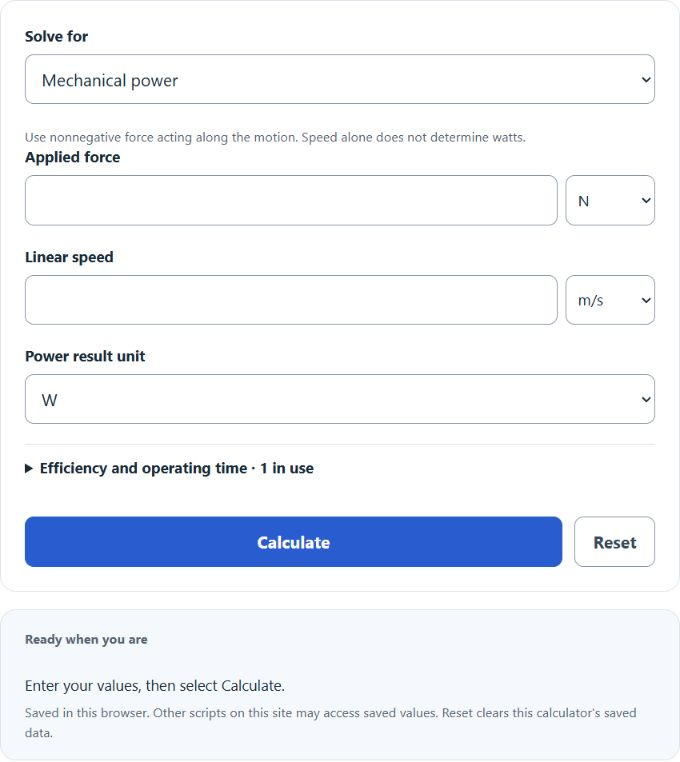
Convert force and speed to watts, or solve backward for force or velocity with N, lbf, m/s, mph, kW, hp, efficiency, and work totals.
- All Physics Calculators
- Watts to Voltage Calculator
- Amps to Watts Calculator
- Velocity to Work Calculator
Speed To Watts Formula
Variables:
- P is mechanical power (watts)
- F is the force acting along the motion (N)
- V is linear speed in the force direction (m/s)
To calculate mechanical power, multiply force acting along the motion by linear speed. Speed alone does not determine watts. This calculator uses nonnegative values with force aligned with motion; more generally, instantaneous power is the dot product P = F · v.
| Speed (km/h) | Power (W) |
|---|---|
| 1 | 27.778 |
| 2 | 55.556 |
| 3 | 83.333 |
| 4 | 111.111 |
| 5 | 138.889 |
| 6 | 166.667 |
| 8 | 222.222 |
| 10 | 277.778 |
| 12 | 333.333 |
| 15 | 416.667 |
| 18 | 500.000 |
| 20 | 555.556 |
| 25 | 694.444 |
| 30 | 833.333 |
| 35 | 972.222 |
| 40 | 1111.111 |
| 45 | 1250.000 |
| 50 | 1388.889 |
| 60 | 1666.667 |
| 80 | 2222.222 |
| Formula: P = F × v. Assumes constant force F = 100 N and v = speed × 0.277778 (m/s). Thus, 1 km/h ≈ 27.7778 W at 100 N. | |
How to Calculate Speed To Watts?
The following steps outline how to calculate the Speed To Watts.
- First, determine the force (N).
- Next, determine the velocity (m/s).
- Next, gather the formula from above = P = F*V.
- Finally, calculate the Speed To Watts.
- After inserting the variables and calculating the result, check your answer with the calculator above.
Example Problem :
Use the following variables as an example problem to test your knowledge.
force (N) = 4.5
velocity (m/s) = 6.756
With the force aligned with motion, mechanical power is P = 4.5 N × 6.756 m/s = 30.402 W.
Frequently Asked Questions
What is the significance of converting speed to watts?
Mechanical power is the rate at which a force transfers energy. Calculating it requires both force and motion; speed alone has no unique watt value. If mechanical efficiency is known, required input power can be estimated separately by dividing mechanical output power by efficiency as a fraction.
Can this formula be used for any type of motion?
For aligned linear force and motion, instantaneous mechanical power is P = F × V. If the force is at an angle to velocity, use the dot product P = F · v. For rotation, power is torque times angular velocity. This calculator models only nonnegative, aligned linear force and speed.
Are there any limitations to using the Speed to Watts calculator?
The calculator assumes force acts along the motion and does not infer forces such as drag or friction from speed. It does not model braking or regeneration. Optional efficiency estimates input demand without changing mechanical output power; the default 100% assumes no losses. Work totals require constant power over the entered time, so leave time blank when a duration is not known.
How can I increase the accuracy of my Speed to Watts calculations?
To increase accuracy, ensure that your force and velocity measurements are as precise as possible. For more complex systems, consider factors such as friction, air resistance, and mechanical inefficiencies. Using a more detailed model or simulation might be necessary for highly accurate predictions.