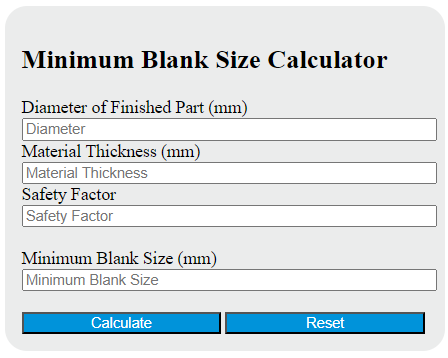
Calculate the minimum lens blank size from frame eyesize, bridge, PD, ED, and finishing allowance for binocular or monocular measurements.
- Mold Shrinkage Calculator
- Injection Molding Cooling Time Calculator
- All Math and Numbers Calculators
Minimum Blank Diameter Formula (Basic Tab)
The following simplified formula is used in the Basic tab to estimate the required round blank diameter for a flat part by adding an allowance based on material thickness. Actual required blank size depends on the specific process (blanking, trimming, forming, machining, kerf, bend allowance, draw depth, etc.).
Variables:
- MBD is the minimum blank diameter (use any consistent length unit)
- D is the diameter of the finished part (same unit as MBD)
- t is the material thickness (same length unit)
- k is the edge/trim allowance factor (unitless; k = 1 means 1× thickness per side)
To calculate the minimum blank diameter, multiply the material thickness by the allowance factor, double it (for both sides), and add it to the finished diameter.
What is a Minimum Blank Size?
A minimum blank size (or blank dimensions) refers to the smallest starting stock size that can be used to produce a part. The correct blank size depends on the part geometry and the manufacturing process (for example: trimming/kerf allowances, bend allowance/deduction, draw depth, corner radii, tooling clearances, and any machining stock). For simple flat round parts, it is often expressed as a required blank diameter.
How to Calculate Minimum Blank Size?
The following steps outline how to calculate the Minimum Blank Diameter using the simplified Basic-tab method.
- First, determine the diameter of the finished part (D).
- Next, determine the material thickness (t).
- Next, choose an edge/trim allowance factor (k) appropriate for your process (unitless).
- Next, use the formula MBD = D + 2 * k * t to calculate the minimum blank diameter (MBD).
- Finally, verify the result against your specific manufacturing process requirements (trim/kerf, tooling, forming/machining allowances).
Example Problem :
Use the following variables as an example problem to test your knowledge.
Diameter of the finished part (D) = 50 mm
Material thickness (t) = 5 mm
Edge/trim allowance factor (k) = 1.5
Minimum blank diameter (MBD) = 50 + 2 × 1.5 × 5 = 65 mm