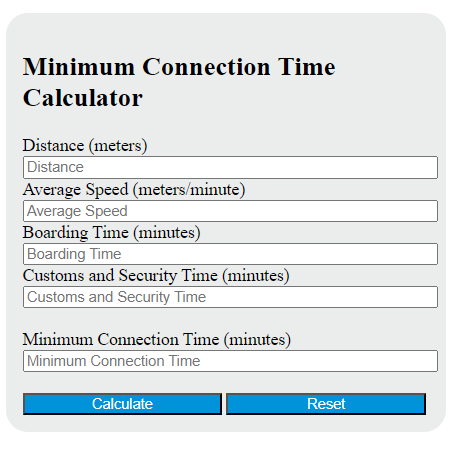
Estimate airport connection time from gate distance, average walking speed, boarding buffer, and security, immigration, or customs time.
Estimated Connection Time Formula (Personal Planning)
This calculator estimates how much connection time you should allow based on walking distance, walking speed, a gate-arrival buffer, and any extra checkpoint time. It is best used as a personal planning tool, not as an airline ticketing rule. A legal or ticketable itinerary can still require more time than your personal estimate.
Where:
| Variable | Meaning | Typical Unit |
|---|---|---|
| MCT | Estimated minimum connection time you should allow | minutes |
| D | Distance between arrival gate and departure gate | meters, kilometers, miles, or feet |
| S | Average travel speed through the airport | meters/minute, km/h, mph, or ft/s |
| B | Gate or boarding buffer time | minutes |
| C | Security, immigration, customs, or other checkpoint time | minutes |
What This Calculator Actually Measures
The formula separates connection time into two parts:
- Movement time: how long it takes to get from one point to another in the airport.
- Non-walking time: how much extra time you want to reserve for boarding cutoffs, queues, document checks, or screening.
The movement portion is:
The full planning estimate is then:
How to Use the Calculator
- Estimate the distance between your arrival gate and departure gate.
- Choose a realistic average speed for how quickly you move through terminals.
- Add a gate buffer for how early you want to reach the next gate before boarding closes.
- Add any expected security, immigration, customs, shuttle, or document-check time.
- Use the result as your personal target connection time.
If the calculator is solving for a missing value, these rearrangements are useful:
Rearranged Forms
To solve for distance:
To solve for average speed:
To solve for gate buffer:
To solve for checkpoint time:
Understanding Each Input
Distance Between Gates
Distance is often the hardest value to estimate accurately. In real airports, the path is rarely a straight line. Your actual travel path may include:
- long concourses, terminal bends, and moving walkways,
- stairs, escalators, elevators, and level changes,
- train, bus, or shuttle transfers between terminals,
- passport control or re-check areas that force detours.
If you are unsure, it is usually better to overestimate the distance rather than underestimate it.
Average Speed
Your selected speed should reflect real airport conditions, not ideal walking pace on an empty sidewalk. Speed can drop because of crowds, carry-on bags, children, mobility needs, fatigue, unfamiliar terminals, or stopping to check signs.
As a practical rule, slower but realistic assumptions produce safer plans than optimistic ones.
Gate / Boarding Buffer
This is the time you want to have remaining before departure when you arrive at the gate. Many travelers use this buffer to account for boarding cutoffs, seat assignment issues, overhead-bin competition, or simply the stress of arriving late.
Security / Immigration / Customs Time
This input should include any required post-arrival formalities during the connection. Depending on the airport and itinerary, that may include:
- security rescreening,
- passport control,
- customs processing,
- baggage collection and re-check,
- manual document verification.
Example
Suppose you estimate:
- distance between gates: 500 meters,
- average speed: 75 meters per minute,
- gate buffer: 10 minutes,
- security/immigration/customs time: 15 minutes.
First calculate the walking portion:
Then add the non-walking time:
So a reasonable personal estimate is about 31.7 minutes, which most travelers would round up to at least 32 to 35 minutes.
Why Your Real Connection Time May Need to Be Longer
This calculator is intentionally simple, which makes it useful but also means it does not automatically include every airport delay. Consider adding extra margin when any of the following are true:
- you are changing terminals, not just gates,
- you are connecting from domestic to international or international to domestic,
- you must clear immigration or customs,
- you need to collect and re-check baggage,
- your incoming flight often arrives late,
- the airport is large, unfamiliar, or frequently congested,
- you are traveling with children, elderly passengers, or a large group,
- you require mobility assistance or extra boarding time.
Personal Estimate vs. Published Minimum Connection Time
A key distinction is that this calculator estimates the time you may need, while airlines and reservation systems often use a separate published minimum connection time for itinerary validity. Those official rules may depend on the airport, airline, terminal, origin, destination, baggage handling process, and whether the connection is domestic or international.
That means:
- a connection can feel possible for you but still be too short under airline rules, or
- a connection can be ticketable but still feel uncomfortably tight in practice.
Planning Tips for Better Results
- Round up, not down. If the estimate is 31.7 minutes, planning for exactly 32 minutes leaves very little tolerance.
- Use conservative speed assumptions. Airports are rarely empty.
- Add extra time for unfamiliar airports. Wayfinding mistakes alone can cost several minutes.
- Include boarding cutoff time in the buffer. Departure time is not the same as the latest acceptable gate-arrival time.
- Account for deplaning delay. Sitting near the back of the aircraft can materially increase your effective connection time requirement.
- Think in process steps. Walk, queue, verify, transfer, then board.
Quick Interpretation Guide
| Estimated Result | General Interpretation |
|---|---|
| Very low buffer above the estimate | Tight connection with little margin for delays or wrong turns |
| Moderate buffer above the estimate | Usually manageable if the incoming flight is on time |
| Large buffer above the estimate | Lower stress and better tolerance for queues, crowds, and minor delays |
Frequently Asked Questions
Does this include flight delays?
No. The calculator assumes you are starting the connection process as planned. It does not predict late arrivals, gate changes, or operational disruptions.
Should I use straight-line distance?
No. Use the likely walking or transfer path through the airport, including terminal changes where possible.
What if I do not know my exact gate yet?
Use a conservative estimate based on terminal size and whether the connection stays within one concourse or crosses terminals.
Can I use this for international transfers?
Yes, but international connections often need more checkpoint time and more safety margin than domestic ones.
What is the safest way to apply the result?
Treat the result as a baseline personal estimate, then add margin for uncertainty, congestion, and operational variability.