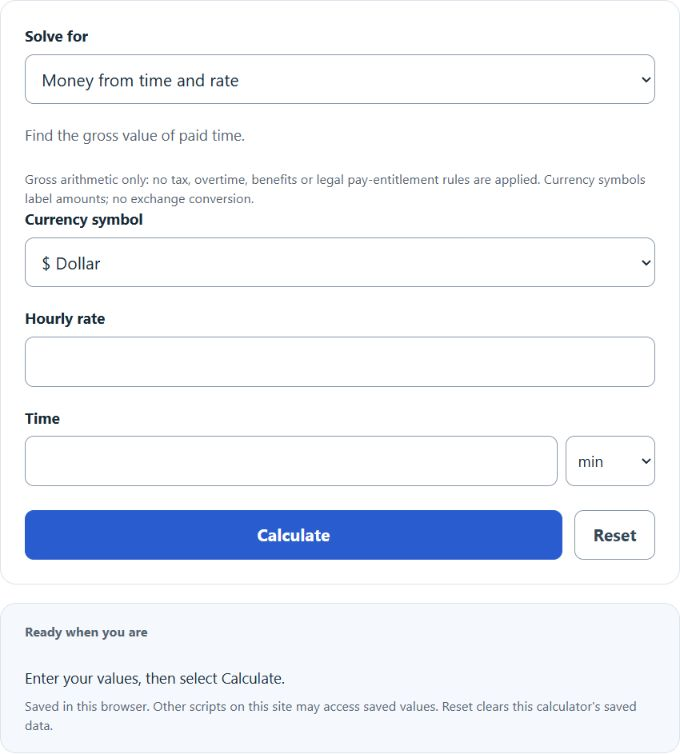
Calculate time value from hourly rate and minutes, estimate meeting costs by attendees and duration, or convert annual salary to hourly pay.
Watch the full explanation and transcript.
| Minutes to Money | Money to Minutes |
|---|---|
| 1 min = $0.42 | $1 = 2.4 min |
| 5 min = $2.08 | $5 = 12 min |
| 10 min = $4.17 | $10 = 24 min |
| 15 min = $6.25 | $15 = 36 min |
| 20 min = $8.33 | $20 = 48 min |
| 30 min = $12.50 | $25 = 60 min |
| 45 min = $18.75 | $30 = 72 min |
| 60 min = $25.00 | $40 = 96 min |
| 75 min = $31.25 | $50 = 120 min |
| 90 min = $37.50 | $75 = 180 min |
| 120 min = $50.00 | $100 = 240 min |
| 150 min = $62.50 | $150 = 360 min |
| 180 min = $75.00 | $200 = 480 min |
| 240 min = $100.00 | $250 = 600 min |
| 300 min = $125.00 | $300 = 720 min |
| 360 min = $150.00 | $400 = 960 min |
| 480 min = $200.00 | $500 = 1,200 min |
| 600 min = $250.00 | $750 = 1,800 min |
| 720 min = $300.00 | $1,000 = 2,400 min |
| 1,440 min = $600.00 | $2,000 = 4,800 min |
| Formulas (at $25/hour): Money = Rate x (Minutes / 60) and Minutes = (Money / Rate) x 60. | |
Minutes To Money Formula
The core formula for converting minutes into a dollar amount is:
Where MV is the money value ($), R is the hourly rate ($), and T is the time in minutes. To reverse the calculation and find how many minutes a given dollar amount represents, rearrange to T = (MV / R) x 60.
What Is the Economic Value of a Minute?
The monetary value of a minute depends on the entered hourly rate. For illustration, $7.25/hour is about $0.12/minute, $35/hour is about $0.58/minute, and $140/hour is about $2.33/minute. A 15-minute interval therefore represents about $1.81, $8.75 or $35.00 at those illustrative rates; these are not current occupational wage estimates.
A 2020 NBER working paper used a U.S. Lyft waiting-time field experiment to estimate an average value of time of about $19/hour, approximately 75% of the average after-tax wage in its study context. This is a historical study estimate, not a universal current price for leisure or commuting time. The appropriate opportunity cost depends on the person, situation and available alternative use of the time.
Per-Minute Earnings by Profession
The table below converts published mean hourly wages from the BLS May 2024 Occupational Employment and Wage Statistics release. The national annual mean wage across all occupations was $67,920; its published hourly mean was $32.66. These are wage estimates, not billing rates or total employer compensation.
| Occupation | Mean Hourly Wage | Per Minute | 15 Min Value |
|---|---|---|---|
| Fast food and counter workers | $15.07 | $0.25 | $3.77 |
| Retail salespersons | $17.86 | $0.30 | $4.47 |
| Administrative assistants (except legal, medical and executive) | $22.90 | $0.38 | $5.73 |
| Electricians | $33.47 | $0.56 | $8.37 |
| All occupations (mean) | $32.66 | $0.54 | $8.17 |
| Registered nurses | $47.32 | $0.79 | $11.83 |
| Software developers | $69.50 | $1.16 | $17.38 |
| Financial managers | $86.76 | $1.45 | $21.69 |
| Lawyers | $87.86 | $1.46 | $21.97 |
| Dentists (all specialties) | $99.88 | $1.66 | $24.97 |
| Physicians (BLS group) | $130.92 | $2.18 | $32.73 |
| Anesthesiologists | $161.85 | $2.70 | $40.46 |
Source: U.S. Bureau of Labor Statistics, May 2024 OEWS, table 1 (April 2, 2025 release). Per-minute and 15-minute values are calculated from the published mean hourly rates and rounded to cents.
The Real Cost of Meetings in Minutes and Dollars
One of the most common applications of a minutes-to-money conversion is calculating the cost of workplace meetings. Research consistently shows that meeting costs are dramatically underestimated by the organizations holding them.
In Asana’s 2024 State of Work Innovation research, surveyed individual contributors reported 3.7 hours of unproductive meetings per week, compared with 1.7 hours in 2019, an increase of about 118%. These figures describe that survey group and should not be treated as a census of all U.S. workers.
A report on unnecessary meeting attendance modeled about $101 million in annual cost for a 5,000-person company under its stated assumptions. This is a modeled scenario, not an observed loss for every company of that size. Separately, Bain documented about 300,000 annual person-hours supporting one weekly executive committee meeting at one studied company, including associated preparation and supporting meetings.
A practical example: a 60-minute meeting with 8 attendees whose average loaded cost is $75/hour costs the company $600 per occurrence. If that meeting happens weekly, the annual cost is $31,200 in labor alone, not counting the opportunity cost of the work those employees would have otherwise completed.
Opportunity Cost: What a Minute Is Really Worth
The formula MV = (R * T) / 60 captures direct time value. Opportunity cost is the value of the next best use of that time. At $60/hour, 20 minutes represents $20 of potential billing. If that time can actually be reassigned to paid work, outsourcing the task for $5 could improve gross earnings less the outsourcing charge by $15. The $20 time value and $20 forgone billing describe the same opportunity cost and must not be added together. This comparison excludes taxes and other incremental costs.
A 2005 NBER working paper using shopping data estimated that middle-aged households in its model had an opportunity cost of time about 40% higher than older households. That result is specific to the study and does not establish a universal rate for any age group, employment status or shopping behavior.
Freelancer and Contractor Billing Context
For freelancers and independent contractors, non-billable time affects the required billing rate. As an illustration, someone targeting $80,000 in gross annual revenue over 2,080 working hours would require $38.46/hour if every hour were billable. If 65% of those hours were billable, the 1,352 billable hours would require about $59.17/hour, or $0.99 per billable minute. The 65% figure is an example assumption, not an industry-wide estimate; this arithmetic does not include business expenses or taxes.
Freelancers may also need to fund health insurance, retirement savings, equipment and applicable taxes. In the U.S., the standard self-employment tax rate is 15.3% on the applicable tax base, subject to Social Security limits and Medicare rules; it is not simply a flat 15.3% deduction from gross client billing. The gross billing rate needed to match a salaried job depends on the person’s expenses, benefits, billable hours and tax situation.
Minimum Wage Per-Minute Breakdown by State
For a historical comparison on January 1, 2025, the federal minimum wage was $7.25/hour (about $0.121/min), Washington’s adult state minimum was $16.66/hour ($0.278/min), and D.C.’s higher minimum was $17.50/hour ($0.292/min). D.C. increased to $17.95 on July 1, 2025. These examples are historical; enter the applicable rate for the relevant place and date.