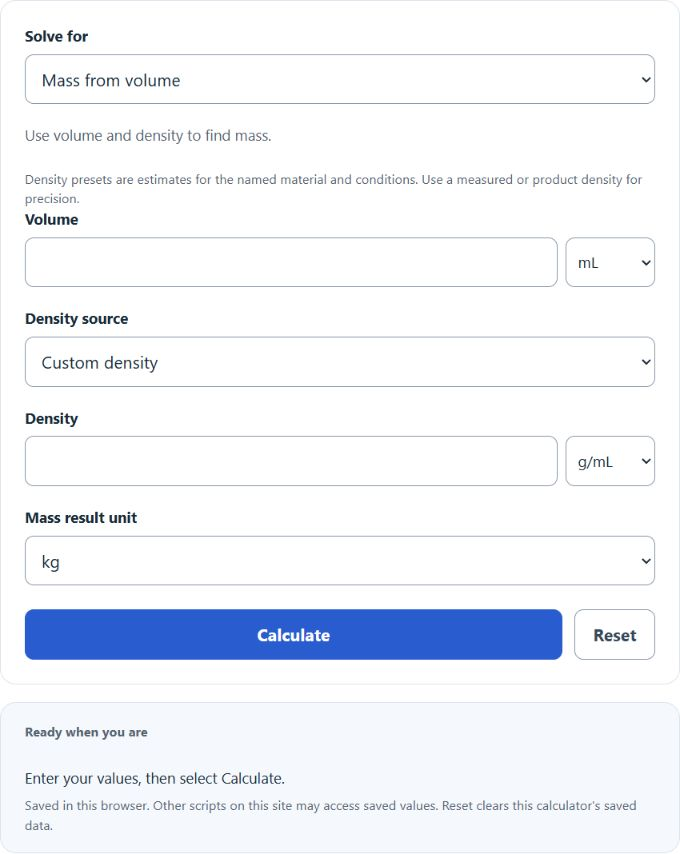
ml to kg Converter using substance or custom density, with reverse kg-to-volume math, metric and US units, and density recovery from measurements.
Quick reference: common mL to kg conversions
The table below shows approximate kilogram values for common volumes of water (density ≈ 1.00 g/mL). For other liquids, multiply by their specific density.
| Volume (mL) | Mass (kg) — Water |
|---|---|
| 50 mL | 0.05 kg |
| 100 mL | 0.10 kg |
| 250 mL | 0.25 kg |
| 500 mL | 0.50 kg |
| 750 mL | 0.75 kg |
| 1,000 mL (1 L) | 1.00 kg |
| 1,500 mL | 1.50 kg |
| 2,000 mL (2 L) | 2.00 kg |
| 5,000 mL (5 L) | 5.00 kg |
Density comparison by liquid
| Liquid | Density (g/mL) | 1000 mL = |
|---|---|---|
| Gasoline | 0.75 | 0.75 kg |
| Ethanol | 0.789 | 0.79 kg |
| Rubbing alcohol | Formulation-dependent | Use product density |
| Coconut oil | 0.924 | 0.924 kg |
| Olive oil | 0.91 | 0.91 kg |
| Vegetable oil | 0.92 | 0.92 kg |
| Water | 1.00 | 1.00 kg |
| Seawater | 1.025 | 1.03 kg |
| Whole milk | 1.03 | 1.03 kg |
| Glycerin | 1.26 | 1.26 kg |
| Maple syrup | 1.33 | 1.33 kg |
| Honey | 1.42 | 1.42 kg |
Reference food densities are approximate and depend on composition and temperature. Water near 20°C uses 0.9982 g/mL in the calculator; the simple water table rounds this to 1.00. Honey varies with moisture content. Coconut oil uses the FAO food-density estimate 0.924 g/mL. Rubbing-alcohol density requires the product concentration and temperature. US cup means the customary cup (236.5882365 mL), not a 240 mL nutrition-label cup. Sources: FAO/INFOODS Density Database, FAO honey properties, and NIST water-density procedure.
mL to kg Formula
The following formulas are used to convert between milliliters and kilograms using density.
Variables:
- kg is the mass in kilograms
- mL is the volume in milliliters
- D is the density of the liquid in grams per milliliter (g/mL)
To convert mL to kg, multiply the volume by the liquid’s density and divide by 1000. To convert kg to mL, multiply the mass by 1000 and divide by the density.
What is mL to kg Conversion?
Milliliters measure volume, while kilograms measure mass. Because different liquids have different densities, there is no single direct conversion from mL to kg that works for every substance. For example, 1000 mL of water has a mass of about 1 kg, but 1000 mL of honey has a much greater mass, and 1000 mL of gasoline has a lower mass. That is why density must be known before converting between these two units.
How to Calculate mL to kg?
The following steps outline how to convert between milliliters and kilograms.
- First, determine the volume in milliliters or the mass in kilograms.
- Next, find the density of the liquid in grams per milliliter (g/mL).
- If converting mL to kg, use the formula kg = (mL × D) / 1000.
- If converting kg to mL, use the formula mL = (kg × 1000) / D.
- After calculating the result, check your answer with the calculator above.
Example Problem:
Use the following values as an example problem to test your knowledge.
Volume = 1000 mL
Density of water = 1.00 g/mL
kg = (1000 × 1.00) / 1000 = 1.00 kg