Calculate mean length of utterance in morphemes and words from a pasted transcript or from morpheme and utterance counts, plus Brown’s stage and age norms.
- All Statistics Calculators
- Syllables Per Second Calculator
- Speech Rate Calculator
- Reading Accuracy Rate Calculator
Calculator Functions
| Function | What it does | What it requires |
|---|---|---|
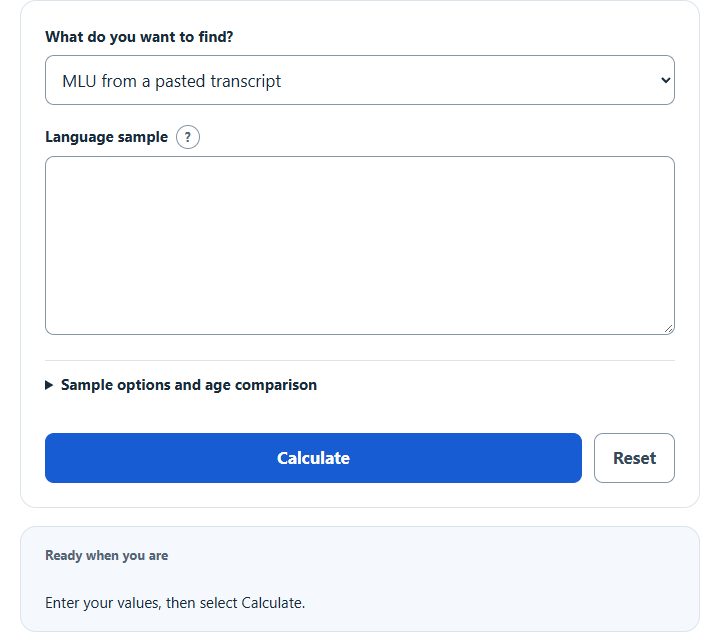
| MLU from a pasted transcript | Counts the morphemes and words in each utterance of a language sample and finds the mean length of utterance | Requires the language sample as text, with one utterance per line |
| MLU from morpheme and utterance counts | Finds the mean length of utterance from totals that were counted by hand | Requires the total morphemes and the total utterances |
| Morphemes needed to reach a target MLU | Finds how many morphemes a sample must contain for its MLU to reach a target | Requires the current MLU and the target MLU |
The first two functions also report Brown’s stage and an age equivalent, and an optional age in years and months adds a comparison with the expected MLU for that age. The transcript function can split utterances at sentence punctuation as well as line breaks, and can score only the lines that carry one speaker label, such as Child or CHI. The counts function gives MLU in words when a total word count is entered. The target function assumes a 50-utterance sample unless another size is entered.
MLU Formulas
| MLU | Mean length of utterance (morphemes per utterance) |
| M | Total morphemes in the sample |
| U | Total utterances in the sample |
MLU in morphemes has been a standard benchmark of early language level since Roger Brown’s transcription and morpheme analysis methods of 1973 [1]. MLU in words uses the same division with the word total in place of M.
How to calculate MLU
Record a sample of the child’s spontaneous speech and write out each utterance. Count the morphemes in every utterance, add them up, and divide by the number of utterances. A sample of 50 utterances with 150 morphemes has an MLU of 150 ÷ 50 = 3.00. Longer samples are steadier: reported test-retest reliability is about .61 to .82 for 50 to 100 utterances and passes .90 only at 175 utterances or more [1].
MLU from a pasted transcript
Each line is one utterance. A speaker label at the start of a line is removed, and every remaining word is scored by these rules:
| Word type | Morphemes | Examples |
|---|---|---|
| Plain word | 1 | want, cookie, home |
| Contraction or possessive with an apostrophe | 2 | he’s, don’t, mommy’s |
| Regular -ing, -ed, plural -s or third-person -s ending | 2 | running, jumped, dogs, eats |
| Irregular past tense or irregular plural | 1 | went, ate, feet, children |
| Diminutive, compound word, hyphenated word or catenative | 1 | doggie, birthday, night-night, gonna |
| Filler or unintelligible mark | 0 | um, uh, xxx |
The sample “I want cookie”, “doggie running”, “he’s eating” and “um mommy went home” scores 3, 3, 4 and 3 morphemes. That is 13 morphemes in 4 utterances, an MLU of 3.25, and 10 words, an MLU in words of 2.50. The endings are found by spelling, with built-in lists of exceptions such as thing, need and bus, so a word outside those lists can be miscounted. The per-utterance breakdown in the result shows each count for checking by hand.
MLU from morpheme and utterance counts
The main formula applies directly: 150 morphemes in 50 utterances is 3.00 morphemes per utterance. With 120 words entered as well, MLU in words is 120 ÷ 50 = 2.40.
Brown’s stages and the age comparison
| Brown’s stage | MLU in morphemes |
|---|---|
| Stage I, early | 1.0 to 1.49 |
| Stage I, late | 1.5 to 1.99 |
| Stage II | 2.0 to 2.49 |
| Stage III | 2.5 to 2.99 |
| Stage IV | 3.0 to 3.74 |
| Stage V | 3.75 to 4.49 |
| Post-Stage V | 4.5 and above |
The stage ranges follow the usual reading of Brown’s five stages [3][4]. When an age is entered, the expected MLU and its spread come from two straight lines:
0.1029 × age − 0.541
Age is in months, and the SD is never taken below 0.2. These lines reproduce the published expected values for ages 18 to 60 months, such as 2.85 (SD 0.633) at 33 months, 4.40 (SD 0.94) at 48 months and 5.02 (SD 1.064) at 54 months [2]. The z-score is (MLU − expected MLU) ÷ SD, and the age equivalent is (MLU + 0.541) ÷ 0.1029 months. For a child aged 3 years 0 months with an MLU of 3.00, the expected MLU is 3.16, the one-SD range is 2.47 to 3.86, the z-score is −0.24 and the age equivalent is 34 months.
Morphemes needed to reach a target MLU
The answer is rounded up to a whole morpheme. Moving from an MLU of 2.0 to 3.0 over a 50-utterance sample takes 3.0 × 50 = 150 morphemes, 50 more than the 100 in the current sample. The result also shows the months that gain would take at the slope of the age line, 1.0 ÷ 0.1029 = 9.7 months, which is a planning figure and not a prediction for any one child.
Limits of This Estimate
- MLU is a screening measure and not a diagnosis. It says nothing about vocabulary, grammatical accuracy or how a child uses language in conversation.
- The transcript count applies spelling rules for English. It cannot tell a plural from a word that simply ends in s unless the word is in its exception lists, so contested words need a hand check before the figure is used clinically or in research. These estimates are based on the best available data and estimations.
- The age comparison rests on norms for children aged 18 to 60 months [2]. Outside that range the calculator still shows a comparison and marks it as indicative only.
- A short sample gives an unsteady MLU [1]. The result notes when a sample has fewer than 50 utterances.
Sources
- Rice et al. (2010), Mean Length of Utterance Levels in 6-month Intervals for Children 3 to 9 Years with and without Language Impairments, Journal of Speech, Language, and Hearing Research: MLU as a benchmark since Brown (1973), and reliability by sample size
- Sawyer, Chon and Ambrose (2008), Influences of Rate, Length, and Complexity on Speech Disfluency in a Single Speech Sample in Preschool Children Who Stutter, Journal of Fluency Disorders, Table 1: expected MLU and standard deviation by age, from Miller (1981)
- Taelman, Durieux and Gillis, Notes on Ingram’s whole-word measures for phonological development, University of Antwerp: Brown’s early Stage I, late Stage I and Stage II ranges
- California State University, Northridge, course notes on Roger Brown’s five stages of language development: MLU ranges for Stages I to V. It does not give the word-by-word counting rules