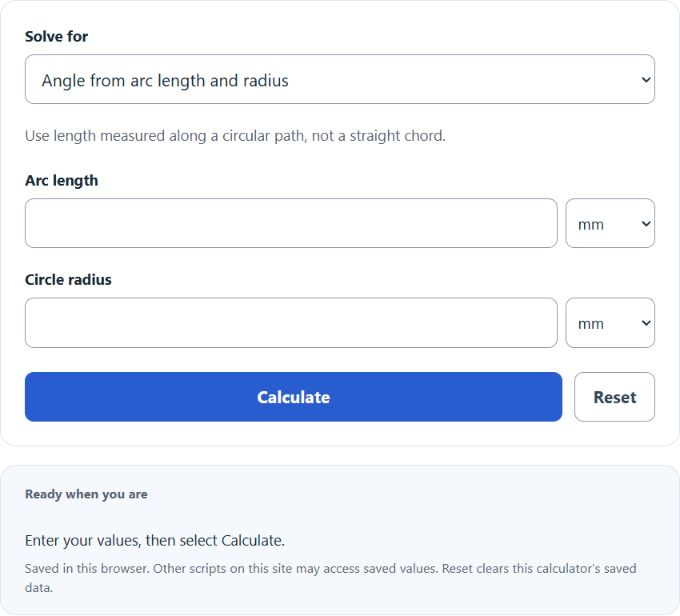
Calculate angle from arc length and radius, or solve for arc length or radius, using millimeters, centimeters, meters, inches, feet, degrees, and radians.
mm To Angle Formula
The following formula is used to calculate the central angle from an arc length (linear displacement along a circle) measured in millimeters.
Variables:
- θ is the angle (degrees)
- L is the arc length (linear displacement along the circumference) (mm)
- r is the radius of the circle (mm)
- π is a mathematical constant whose approximate value is 3.14159
To calculate the angle, divide the arc length by the radius of the circle to get the angle in radians. Multiply the result by the ratio of 180 to π to convert the angle from radians to degrees.
| Arc Length L (mm) | Angle θ (°) |
|---|---|
| 5.0 | 28.6 |
| 10.0 | 57.3 |
| 15.0 | 85.9 |
| 20.0 | 114.6 |
| 25.0 | 143.2 |
| 31.4 | 179.9 |
| 40.0 | 229.2 |
| 50.0 | 286.5 |
| 60.0 | 343.8 |
| 62.8 | 359.8 |
| * Rounded to 1 decimal. Angle in degrees: θ = (L ÷ r) · (180/π). L is arc length along the circumference. For r = 10 mm, one full revolution occurs at L = 2πr ≈ 62.8 mm. | |
What Does “mm to Angle” Mean?
mm to Angle is a conversion process used to convert an arc length (a distance measured along a circular path, often given in millimeters) into an angular measurement (degrees, radians, etc.). This is used when the rotation (central angle) needs to be determined based on how far a point has moved along the circumference of a circle. The conversion requires knowledge of the circle’s radius (if you are given the diameter, use r = d/2).
How to Calculate mm To Angle?
The following steps outline how to calculate the mm To Angle using the formula: θ = (L / r) * (180 / π).
- First, determine the linear displacement (L) in millimeters (mm) measured along the circular path (arc length).
- Next, determine the radius of the circle (r) in millimeters (mm).
- Next, gather the formula from above: θ = (L / r) * (180 / π).
- Finally, calculate the angle (θ) in degrees.
- After inserting the values of L, r, and π into the formula, calculate the result.
Example Problem:
Use the following variables as an example problem to test your knowledge.
Linear displacement (L) = 50 mm
Radius of the circle (r) = 10 mm
π (mathematical constant) = 3.14159