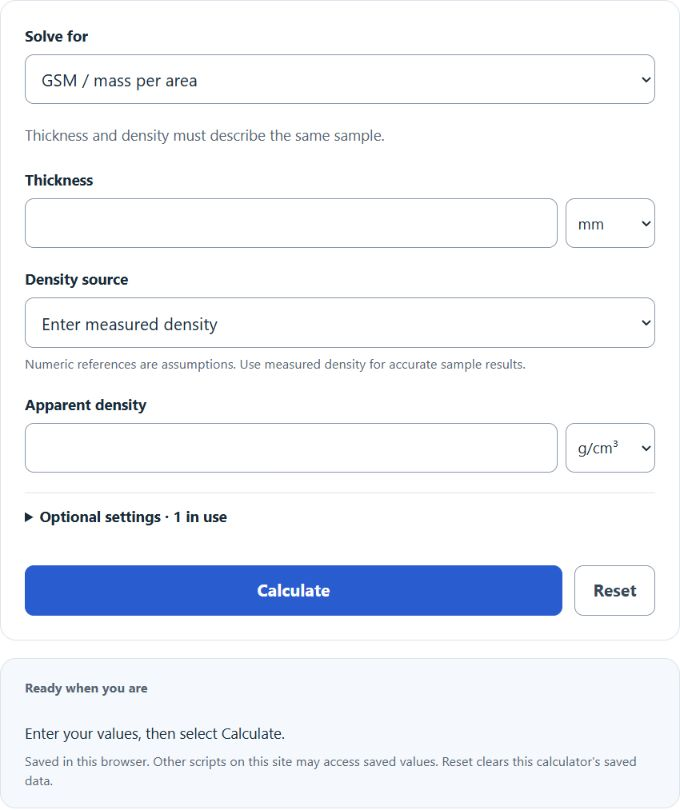
Calculate thickness, density, or GSM from any two values with unit conversions for mm, cm, m, in, ft, g/cm³, kg/m³, lb/ft³, and g/m².
| Thickness to GSM | GSM to Thickness |
|---|---|
| 0.05 mm = 50 g/m² | 60 g/m² = 0.0600 mm |
| 0.08 mm = 80 g/m² | 70 g/m² = 0.0700 mm |
| 0.10 mm = 100 g/m² | 75 g/m² = 0.0750 mm |
| 0.12 mm = 120 g/m² | 90 g/m² = 0.0900 mm |
| 0.15 mm = 150 g/m² | 110 g/m² = 0.1100 mm |
| 0.20 mm = 200 g/m² | 130 g/m² = 0.1300 mm |
| 0.25 mm = 250 g/m² | 160 g/m² = 0.1600 mm |
| 0.30 mm = 300 g/m² | 180 g/m² = 0.1800 mm |
| 0.40 mm = 400 g/m² | 220 g/m² = 0.2200 mm |
| 0.50 mm = 500 g/m² | 250 g/m² = 0.2500 mm |
| 0.75 mm = 750 g/m² | 350 g/m² = 0.3500 mm |
| 1.00 mm = 1000 g/m² | 600 g/m² = 0.6000 mm |
| Formulas (brief): GSM = t × ρ × 1000, and t = GSM ÷ (ρ × 1000). Table assumes ρ = 1.0 g/cm³. | |
| Thickness to GSM | GSM to Thickness |
|---|---|
| 0.05 mm = 45 g/m² | 40 g/m² = 0.0444 mm |
| 0.08 mm = 72 g/m² | 60 g/m² = 0.0667 mm |
| 0.10 mm = 90 g/m² | 80 g/m² = 0.0889 mm |
| 0.12 mm = 108 g/m² | 100 g/m² = 0.1111 mm |
| 0.15 mm = 135 g/m² | 120 g/m² = 0.1333 mm |
| 0.20 mm = 180 g/m² | 150 g/m² = 0.1667 mm |
| 0.25 mm = 225 g/m² | 200 g/m² = 0.2222 mm |
| 0.30 mm = 270 g/m² | 250 g/m² = 0.2778 mm |
| 0.40 mm = 360 g/m² | 300 g/m² = 0.3333 mm |
| 0.50 mm = 450 g/m² | 400 g/m² = 0.4444 mm |
| 0.75 mm = 675 g/m² | 500 g/m² = 0.5556 mm |
| 1.00 mm = 900 g/m² | 800 g/m² = 0.8889 mm |
| Formulas (brief): GSM = t × ρ × 1000, and t = GSM ÷ (ρ × 1000). Table assumes ρ = 0.9 g/cm³. | |
mm to GSM Formula
Thickness in millimeters and GSM are linked by the density of the material. To find GSM from a thickness, multiply the thickness in millimeters by the density in grams per cubic centimeter, then by 1000:
GSM = T * D * 1000
To go the other way and find thickness from a known GSM, divide instead:
T = GSM / (D * 1000)
To find the density that a GSM and thickness imply, rearrange again:
D = GSM / (T * 1000)
Variables:
- GSM is the area weight in grams per square meter (g/m²)
- T is the thickness in millimeters (mm)
- D is the density in grams per cubic centimeter (g/cm³)
- 1000 is the factor that converts the product into grams per square meter
Pick what you want to solve for at the top of the calculator. In the default mode you enter a thickness and a density and the tool returns the GSM. Switch the selector to solve for thickness when you know the GSM and density, or to solve for density when you know both the GSM and the thickness.
Thickness alone cannot give you GSM, because two sheets of the same thickness weigh different amounts if one is packed more densely than the other. That is why the density input is required. Use a measured apparent density for the same sample and thickness method. The numeric density references in the calculator are assumptions for comparison. The thickness, GSM, and density inputs each accept more than one unit, and every result also lists the common equivalent units so you can read the answer in whatever measure you need.
Example Density Assumptions and Thickness to GSM Values
The density you enter drives the conversion. The first table contains illustrative density assumptions, not certified values for paper grades. The second table shows how thickness turns into GSM at two assumed densities.
| Assumption | Example density (g/cm³) |
|---|---|
| Reference range A | 0.55 to 0.60 |
| Reference range B | 0.75 to 0.80 |
| Reference range C | 0.80 to 0.85 |
| Reference range D | 0.80 to 0.90 |
| Reference range E | 1.00 to 1.20 |
| Numeric reference | 1.00 |
These are illustrative numeric assumptions. For paper, use apparent density that includes its structure and porosity, with thickness measured on the same basis. The table below applies the stated density uniformly.
| Thickness (mm) | GSM at 0.80 g/cm³ | GSM at 1.00 g/cm³ |
|---|---|---|
| 0.05 | 40 | 50 |
| 0.08 | 64 | 80 |
| 0.10 | 80 | 100 |
| 0.15 | 120 | 150 |
| 0.20 | 160 | 200 |
| 0.25 | 200 | 250 |
| 0.30 | 240 | 300 |
| 0.40 | 320 | 400 |
| 0.50 | 400 | 500 |
Example Problems
Example 1: Find GSM from thickness and density.
A sheet is 0.2 mm thick with a density of 0.80 g/cm³. Multiply the three terms:
GSM = 0.2 * 0.80 * 1000 = 160 g/m².
Example 2: Find thickness from GSM and density.
A card is rated at 300 g/m² and its stock has a density of 0.85 g/cm³. Divide to get the thickness:
T = 300 / (0.85 * 1000) = 0.353 mm.
Frequently Asked Questions
Can you convert mm to GSM without knowing the density?
No. GSM measures weight per square meter, and thickness measures height, so you need the density to connect the two. Two sheets can have the same thickness but different GSM if one material is packed more tightly. If you do not have a measured apparent density, a selected numeric reference produces only an assumption-based estimate.
What density should you use for paper?
Use the apparent density of the actual paper stock, measured consistently with its thickness. Single-sheet and bulking thickness methods can give different apparent densities. A paper-type label alone does not establish a reliable density.
Is GSM the same as thickness?
No. GSM is the weight of a one-square-meter sheet, while thickness is how tall the sheet stands, usually reported in millimeters or microns. They rise together for a single material, but you cannot swap one for the other across materials without the density. A thin, dense sheet and a thick, airy sheet can share the same GSM.