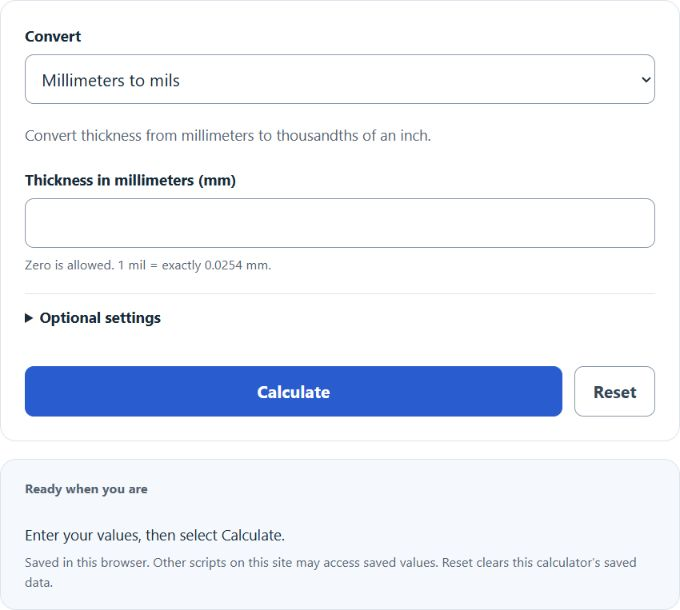
Convert millimeters to mils or mils to millimeters for coating, film, PCB, and manufacturing thickness measurements, with inch and micrometer equivalents.
- All Unit Converters
- Circular Mils Calculator
- mm to Thousandths Calculator
- mm to Fraction Calculator
- Gauge to mm Calculator
- Gauge to Mil Converter
- Fraction to mm Calculator
mm to mils Formula
- mm = thickness in millimeters
- mils = thickness in thousandths of an inch (1 mil = 0.001 in)
One mil equals 0.0254 mm exactly, since 1 inch is defined as 25.4 mm. A mil is not a millimeter and not a micron. Do not confuse them.
Reference Tables
Common conversions for quick lookup:
| mm | mils | inches |
|---|---|---|
| 0.025 | 0.984 | 0.000984 |
| 0.05 | 1.969 | 0.00197 |
| 0.1 | 3.937 | 0.00394 |
| 0.25 | 9.843 | 0.00984 |
| 0.5 | 19.685 | 0.0197 |
| 0.76 | 29.921 | 0.0299 |
| 1.0 | 39.370 | 0.0394 |
| 1.5 | 59.055 | 0.0591 |
| 3.0 | 118.110 | 0.118 |
Illustrative thickness ranges for common materials; products vary. Verify the applicable manufacturer or project specification:
| Material | mils | mm |
|---|---|---|
| Plastic grocery bag | 0.5 – 0.7 | 0.013 – 0.018 |
| Aluminum foil (household) | 0.6 – 0.9 | 0.015 – 0.023 |
| Standard printer paper | 3.5 – 4 | 0.09 – 0.10 |
| Trash bag (heavy duty) | 2 – 3 | 0.05 – 0.08 |
| Vinyl flooring wear layer | 6 – 30 | 0.15 – 0.76 |
| Credit card | ~30 | 0.76 |
| Pond liner (EPDM) | 45 – 60 | 1.14 – 1.52 |
Example and FAQ
Example: A coating spec calls for 0.15 mm dry film thickness. Use the exact conversion: 0.15 / 0.0254 = 5.905511811… mils, or 5.91 mils rounded to two decimal places.
Is a mil the same as a millimeter? No. A mil is 0.001 inch (0.0254 mm). A millimeter is roughly 39.4 times larger than a mil.
Is a mil the same as a micron? No. 1 mil = 25.4 microns (µm). They differ by a factor of about 25.
How do I convert mils to mm in my head? Divide mils by about 40. For a closer estimate, multiply by 0.025.
Why do coating and film specs use mils? Mils give whole-number values for thicknesses that would be small decimals in inches, which makes specs easier to read and compare.