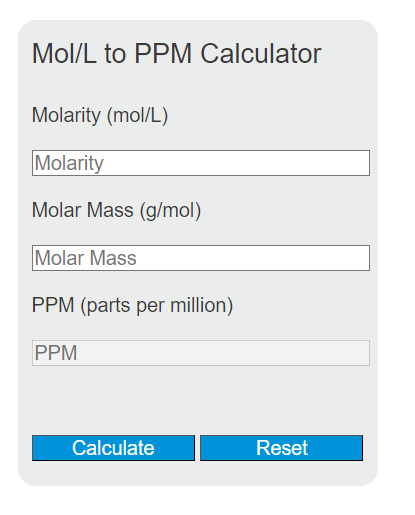
Convert mol/L, mmol/L, or µmol/L to ppm, mg/L, or µg/L using molecular weight, or solve for concentration or molecular weight from any two values.
| Mol/L to ppm | ppm to Mol/L |
|---|---|
| 0.000001 mol/L = 0.05844 ppm | 1 ppm = 0.00001711 mol/L |
| 0.00001 mol/L = 0.5844 ppm | 5 ppm = 0.00008557 mol/L |
| 0.0001 mol/L = 5.844 ppm | 10 ppm = 0.0001711 mol/L |
| 0.00025 mol/L = 14.61 ppm | 25 ppm = 0.0004278 mol/L |
| 0.0005 mol/L = 29.22 ppm | 50 ppm = 0.0008557 mol/L |
| 0.001 mol/L = 58.44 ppm | 100 ppm = 0.001711 mol/L |
| 0.002 mol/L = 116.88 ppm | 250 ppm = 0.004278 mol/L |
| 0.005 mol/L = 292.2 ppm | 500 ppm = 0.008557 mol/L |
| 0.01 mol/L = 584.4 ppm | 750 ppm = 0.01284 mol/L |
| 0.1 mol/L = 5,844 ppm | 1,000 ppm = 0.01711 mol/L |
| Formulas: ppm (mg/L) = (mol/L) × MW × 1000; mol/L = ppm ÷ (MW × 1000). Assumes MW = 58.44 g/mol. | |
| Mol/L to ppm | ppm to Mol/L |
|---|---|
| 0.000001 mol/L = 0.18016 ppm | 1 ppm = 0.000005551 mol/L |
| 0.00001 mol/L = 1.8016 ppm | 5 ppm = 0.00002776 mol/L |
| 0.0001 mol/L = 18.016 ppm | 10 ppm = 0.00005551 mol/L |
| 0.00025 mol/L = 45.04 ppm | 25 ppm = 0.0001388 mol/L |
| 0.0005 mol/L = 90.08 ppm | 50 ppm = 0.0002776 mol/L |
| 0.001 mol/L = 180.16 ppm | 100 ppm = 0.0005551 mol/L |
| 0.002 mol/L = 360.32 ppm | 250 ppm = 0.001388 mol/L |
| 0.005 mol/L = 900.8 ppm | 500 ppm = 0.002776 mol/L |
| 0.01 mol/L = 1,801.6 ppm | 750 ppm = 0.004163 mol/L |
| 0.1 mol/L = 18,016 ppm | 1,000 ppm = 0.005551 mol/L |
| Formulas: ppm (mg/L) = (mol/L) × MW × 1000; mol/L = ppm ÷ (MW × 1000). Assumes MW = 180.16 g/mol. | |
Mol/L to PPM Formula
This yields ppm in mg/L, which is numerically equal to parts per million for dilute aqueous solutions (density close to 1 g/mL). For non-aqueous solvents or concentrated solutions, divide the result by solution density (g/mL) to get true mass-based ppm. Seawater at 1.025 g/mL introduces a 2.5% deviation; blood plasma at 1.025 to 1.030 g/mL requires the same correction.
Molar Mass of Common Substances
Molar mass is the only substance-specific input required for this conversion. Values for frequently converted compounds:
| Substance | Formula | Molar Mass (g/mol) | Common Use Context |
|---|---|---|---|
| Water | H₂O | 18.015 | Solvent baseline |
| Sodium chloride | NaCl | 58.44 | Salinity, saline solutions |
| Glucose | C₆H₁₂O₆ | 180.16 | Blood glucose, cell culture media |
| Ethanol | C₂H₅OH | 46.07 | Solvents, fermentation monitoring |
| Calcium carbonate | CaCO₃ | 100.09 | Water hardness (as CaCO₃) |
| Nitrate ion | NO₃⁻ | 62.00 | Fertilizer runoff, drinking water |
| Nitrite ion | NO₂⁻ | 46.01 | Cured meats, wastewater |
| Phosphate ion | PO₄³⁻ | 94.97 | Eutrophication, wastewater treatment |
| Copper(II) sulfate | CuSO₄ | 159.61 | Algicide, micronutrient dosing |
| Sodium bicarbonate | NaHCO₃ | 84.01 | pH buffering |
| Potassium permanganate | KMnO₄ | 158.03 | Water treatment oxidant |
| Arsenic | As | 74.92 | Groundwater contamination |
| Lead | Pb | 207.2 | Pipe corrosion, legacy contamination |
| Fluoride ion | F⁻ | 19.00 | Drinking water fluoridation |
| Mercury | Hg | 200.59 | Industrial effluent monitoring |
EPA Drinking Water Limits: ppm and Molar Equivalents
EPA Maximum Contaminant Levels (MCLs) are set in mg/L, which equals ppm for dilute water. Labs preparing calibration standards or compliance solutions need the molar equivalent to weigh out the correct amount of reagent. The table below provides both units for primary drinking water contaminants:
| Contaminant | MCL (mg/L = ppm) | Molar Mass (g/mol) | MCL (mol/L) |
|---|---|---|---|
| Nitrate (NO₃⁻) | 10 | 62.00 | 1.61 × 10⁻⁴ |
| Fluoride (F⁻) | 4.0 | 19.00 | 2.11 × 10⁻⁴ |
| Copper (Cu) | 1.3 * | 63.55 | 2.05 × 10⁻⁵ |
| Nitrite (NO₂⁻) | 1.0 | 46.01 | 2.17 × 10⁻⁵ |
| Selenium (Se) | 0.05 | 78.96 | 6.33 × 10⁻⁷ |
| Arsenic (As) | 0.010 | 74.92 | 1.34 × 10⁻⁷ |
| Lead (Pb) | 0.015 * | 207.2 | 7.24 × 10⁻⁸ |
| Mercury (Hg) | 0.002 | 200.59 | 9.97 × 10⁻¹⁰ |
| Source: EPA National Primary Drinking Water Regulations. * Denotes action level, not MCL. Formula: mol/L = ppm ÷ (MW × 1000). | |||